
What we’re really losing when Skate Naked closes
Mandy Shunnarah, the Columbus poet and author of ‘Midwest Shreds,’ on the looming closure of the beloved indoor skatepark.
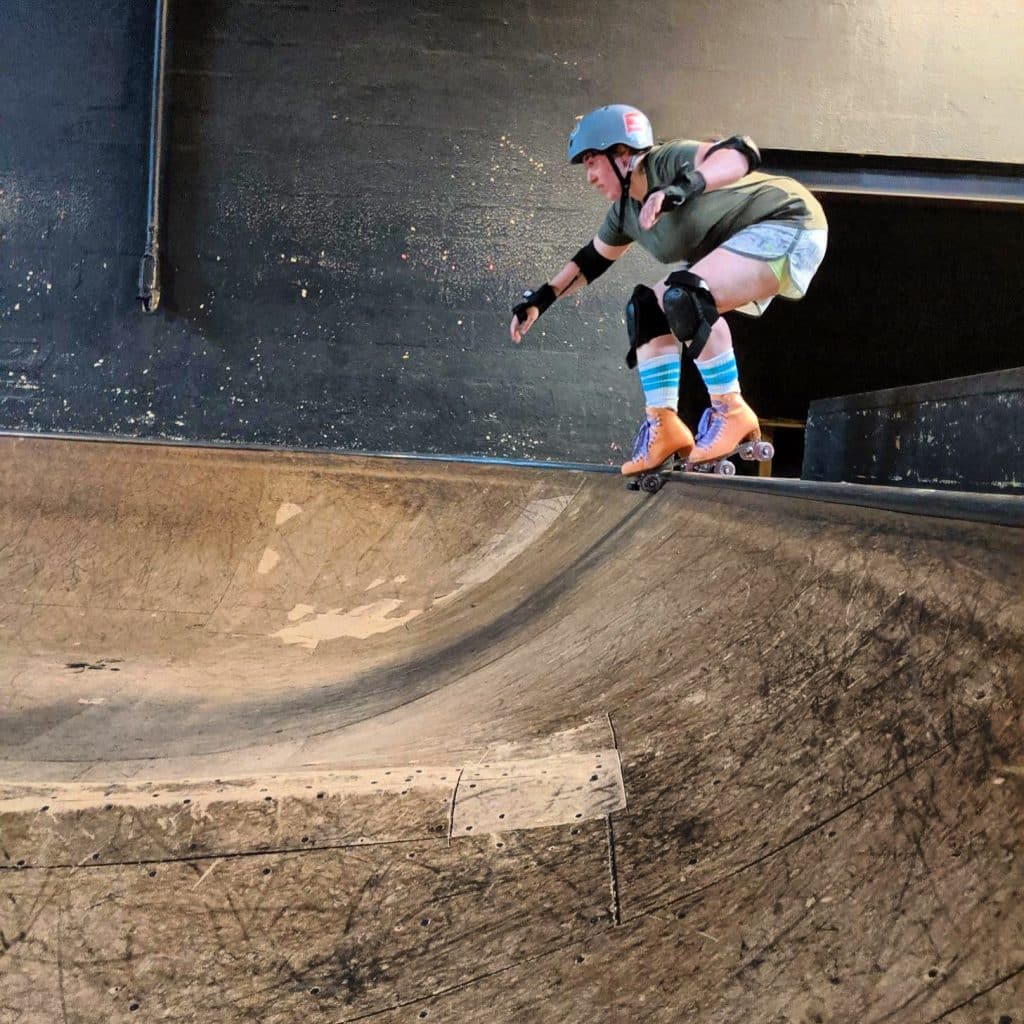
Skaters are the toughest people I know – falling and getting bruises deep enough to qualify as hematomas, slicing skin open to make blood donations to the ramp gods, and breaking bones without shedding a tear. But as the news broke that Skate Naked, Columbus’ only indoor skatepark, will close at the end of August, I know I wasn’t the only skater in the city crying.
I also know my sadness isn’t what Jeff Trasin, Jon Hammond, and the others who have kept Skate Naked’s doors open for the past 14 years want. In their goodbye post on Instagram, they specifically asked skaters to share a favorite memory or funny story. And the community came through, sharing tales of dropping in on a ramp for the first time, nailing white whale tricks, recalling the many birthday cakes consumed on the premises, and the countless friendships forged on wheels. One person, Kate Davis, who patiently taught me how to drop in and do all the basics back when I first started taking my roller skates to skateparks, told of how she fell and split her shorts on the ramp. She spent the rest of her skate session wearing some random shorts from the lost and found because she wasn’t ready to go home yet.
I’m not ready to go home yet, either. As much as I want to respect the owners’ wishes for only happy memories and funny stories, the end of the Skate Naked era is a sad occasion for Columbus skaters. As much as I want to send my happy place off with a smile, I yearn for a place to process my grief among the collective sadness of the city’s skaters.
A donation powers the future of local, independent news in Columbus.
Support Matter News
I moved to Columbus in 2015, and out of all the places in the city, Skate Naked has had an outsized effect on me. I grew up in a small town in Alabama that had no skateparks. Even Birmingham, a city of nearly 200,000, didn’t have a decent skatepark at the time I moved to Columbus from there. So, even though I’d dreamed of rolling at the skatepark since I was a kid, it was inaccessible to me until I landed here.
I started going to the skatepark in April of 2019. Owing to those famed April showers, I began going to Skate Naked early in my aggressive roller skate journey. I quickly made friends who were generous with their time, giving of their knowledge, and enthusiastic with their whoops and claps – even when I wasn’t doing anything objectively impressive. Though I felt intimidated walking in the door, I learned that the best skaters are the most supportive. Even as the summer came and more skaters shifted from Skate Naked to outdoor parks, I stayed. I got attached. Skate Naked was where I felt most at home on my wheels.
Just as I longed to go to skateparks growing up, I also dreamed of writing a book. And I couldn’t have known that wouldn’t have been possible without Skate Naked either. If I hadn’t fallen in love with Skate Naked, I wouldn’t have written my first book, Midwest Shreds: Skating Through America’s Heartland. The fact that Skate Naked will be closing only about a month after my book was published makes me all the more glad I wrote it. Skate culture in the Midwest deserves to be championed. And for Columbus, Skate Naked is the pinnacle.
Writing Midwest Shreds took me on the road around the region for five weeks of interviews with skaters, skate shop owners, skate manufacturers, and indoor skatepark owners. And nearly everyone I talked to had a story about a beloved skatepark that was no longer around. These losses could be attributed to landlords, pandemic woes, bad business partners, lack of profit, disaster (such as the fire that claimed Sk8 Liborius in St. Louis), and other misfortunes. More generally, I learned that keeping an indoor skatepark open, especially during summer when the weather is nice, is extremely challenging. Indoor skatepark ownership is not for the faint of heart. Sadly, indoor skatepark closures are so common that I nearly added a chapter to Midwest Shreds titled “Nothing Rolled Can Stay” as a means to memorialize the places we’ve lost. I ended up leaving that chapter out because it didn’t fit cleanly with the rest of the book. Now, I wish I hadn’t.
The folks at Skate Naked didn’t go into many details about the closure, stating simply, “We are losing the building… just know it’s out of our control.” That could mean any number of things, but ultimately the reason for the closure is less important than the fact that when Skate Naked closes its doors at the end of the month, the many skaters of Columbus will be without an indoor park.
This is not to say that there won’t be places to skate in Columbus. The city finished pouring the concrete at Tuttle not so long ago. Dodge just got an epic makeover. Fairwood lives on. And it seems like every suburb is following in the footsteps of Dublin, Pickerington, and Worthington by getting their own skateparks, with Bexley and Gahanna being the most recent additions. And, of course, there are always the streets.
People who don’t skate might wonder, “Isn’t this enough?” But if you’re a skater, you know how it feels to be itching to practice and find out it’s going to storm that afternoon, or it’s so blazing hot you can’t function, or snow and ice coat the bowls. Outdoor skateparks – as wonderful and important as they are in their own right – are only as functional as the weather allows them to be. Outdoor skateparks might be sufficient in places where it doesn’t snow and only rains a handful of days per year, but not here.
Additionally, not every outdoor skatepark is as welcoming as it might seem. One suburban skatepark was built adjacent to a police station, menacing skaters – a group of people who are already maligned and stereotyped as delinquents. This can make that skatepark unfriendly to people of color and others. Another suburban skatepark is almost entirely made of metal ramps, which can practically melt your skin if you fall on a hot day. Another wasn’t poured with the smoothest of concrete, so the texture is more like that of an old, somewhat gravelly sidewalk, which sits ready to rip your clothes and skin wide open should you fall. Still another suburb built a smooth-as-butter ramp only to put up a sign next to it that says what wheels are and are not welcome. Some of these skateparks don’t have outdoor lights, so they close at dark, which is particularly disheartening as the days grow shorter.
Skate Naked is singular in its welcoming attitude toward all people and all wheels, its defiance of troublesome weather, its late-night opening, and its location away from the eyes of trigger-happy cops. It’s off the beaten path – as anyone who’s tried to use GPS to get there for the first time would know – so you know that no one ended up there by accident. Anyone who arrives at the door likely drove past at least one outdoor skatepark on their way there and still chose Skate Naked. Not because it was the easiest, cheapest, or most convenient, but because it felt like home. And home is worth investing in.
If there’s one thing I know about skaters, it’s that we’re born of resilience. It takes a certain kind of person to perform physical feats that are inherently dangerous, and to keep getting back up after countless falls and their accompanying scrapes, bruises, and broken bones. We cry today as we mourn Skate Naked. But we’ll get back up. We’ll make do with what we have. We’ll find other parks or street spots while we hold out hope that someone else will take up the mantle and open another indoor skatepark in the city.
After all, we’re not ready to go home yet. We just wish we didn’t have to find another home.
Related Articles

If you start from a place of love, you can’t go wrong
A vigil for an unhoused community member who recently died in Newark served as a call to not look away.
On Development: Rapid-transit is moving slowly. Maybe we need a new model
Our policies suggest a willingness to spend any amount to add lanes and bigger (towering!) interchanges for major highways, while transit spending is too often regarded as frivolous.
Local Politics: Drain the swampy Municipal Courthouse
Columbus wants to renovate the Franklin County Municipal Courthouse instead of replacing it. The people who work there say this very wet “derelict” building is beyond repair.