
David Butler wants you to sit with the discomfort
A new weeklong exhibition opening at 700 Bryden on Saturday, Sept. 7, builds on the ideas the Columbus artist first explored in earlier exhibits ‘Snowflake for President’ and ‘Whiteland.’
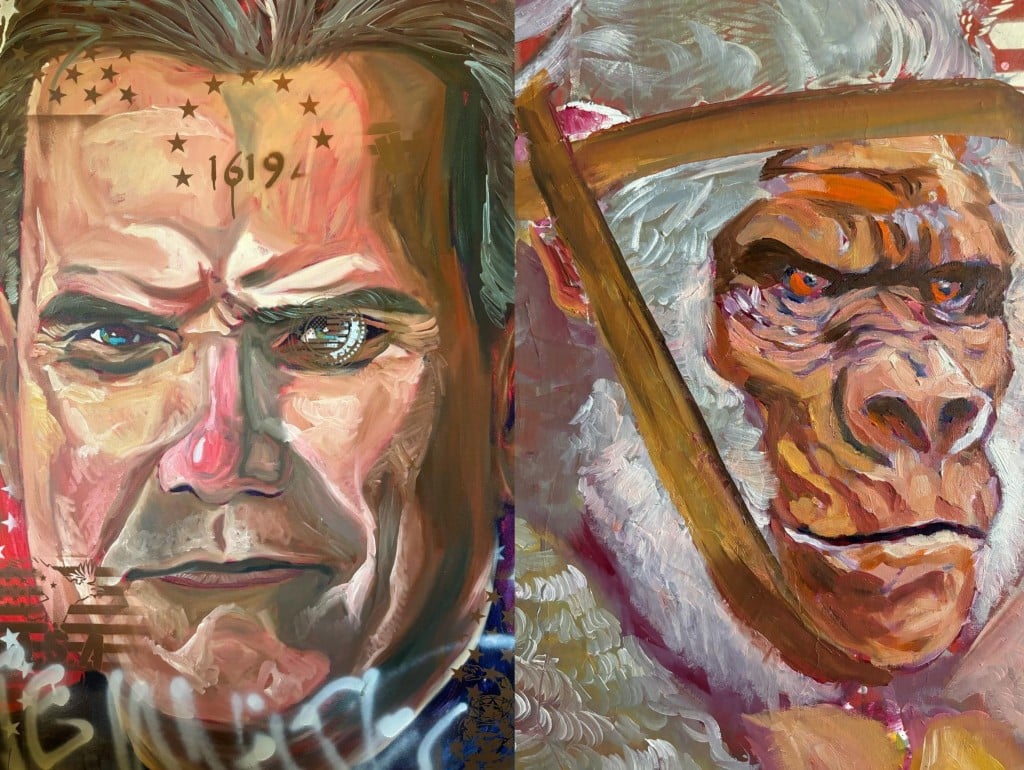
Amid the exhausting will he or won’t he media conversations that took place in the weeks before President Joe Biden officially withdrew as the Democratic nominee, Columbus artist David Butler began to revisit the paintings that he created for a couple of earlier exhibitions – “Snowflake for President” and “Whiteland” – both of which explored the intersections of white supremacy and power.
“It was during that whole debacle where people were like, ‘If Biden’s not the choice, what’s going to happen?’ And there was this confusion over whether it would be this person or that person,” Butler said in late August from his home on the far East Side. “And I was like, ‘All this shit is such privileged talk.’ For people who have always been oppressed by whiteness, it’s all the same cogs. You’re just putting different widgets in the machine as it’s continuing to spin.”
As these ideas circulated, Butler first returned to “Snowflake,” which he exhibited at the Vanderelli Room in 2018 at a point in time when he was still wrangling with the presidency of Donald Trump, as well as the 2016 death of Harambe, a lowland gorilla who was shot and killed by a worker at the Cincinnati Zoo after a 3-year-old child fell into the ape’s enclosure. In the months after Harambe died, Butler said he became curious if there had ever been a white primate that had been alternately revered, which led him to the discovery of Snowflake, the world’s only known albino gorilla, who attained celebrity status in his years at the Barcelona Zoo, where he lived until his 2003 death of natural causes approaching the age of 40.
A donation powers the future of local, independent news in Columbus.
Support Matter News
“With Harambe, you’d see people wearing these T-shirts saying, ‘Harambe was right,’ or these other funny memes. But to me, it was almost an allegory of how people see Blackness, where it’s commodified or twisted to be a joke, a punchline,” said Butler, who discovered an ideal metaphorical foil in the revered (and much paler) Snowflake. “He lived this long, happy life with the status of privilege. And there are all these happy photos of him, and an animated movie. And he almost reminded me of Trump, in a way. And so, I started to explore what would happen if [Snowflake] ran for president.”
Recently, Butler created a new series of works building on this concept, including a portrait of Snowflake in a suit with a bloodied and bandaged ear – a nod to the July assassination attempt against Trump. (The title of the painting: “Harambe Tried to Kill Me.”)
At the same time as these ideas were recirculating, Butler also revisited his exhibit “Whiteland,” held at the Vanderelli Room in 2021 and centered on similar themes. The centerpiece of that show consisted of a trio of portraits of white faces, each created with the aid of what was then rudimentary A.I. technology.
For one image, Butler imported the photographs of eight to 10 white police officers who had killed Black citizens (Derek Chauvin, Jason Meade, Darren Wilson). For another, he uploaded male politicians who regularly advanced white supremacist policies (Donald Trump, Matt Gaetz, Jim Jordan). And for the third, he drew upon the female equivalents who populated the worlds of politics and media (Tomi Lahren, Ann Coulter, Marjorie Taylor Green). He then completed a large-scale portrait of each composite, the effect of which left him somewhat horrified. “It was freaky, because it felt like you knew the people,” Butler said at the time. “These are all people I could walk by in the Short North today, and that’s creepy.”
Revisiting the concept, Butler created a companion trio of smaller portraits, this time utilizing photos of Black men and women who uplifted and advanced white supremacy. There’s one image created using Trump-supporting Black women (Amber Rose, Candace Owens, podcasters Diamond and Silk). Another incorporates Black male Republicans (Ben Carson, Tim Scott, Allen West). And a third centers Black male podcasters/influencers such as the rapper Joe Budden, whom Butler respects as an artist but who too often “says some pretty idiotic shit just to get clicks.”
In creating these new pieces, Butler said he couldn’t give himself over in quite the same way he did in painting the original white faces, and as a result the Black composites don’t have the same disquieting effect on him. “It’s almost like I want you to know the Black people aren’t real,” he said. “I couldn’t bring myself to be as freely passionate about painting Black people into it, but I knew that conversation had to be added.”
Butler will exhibit these newly created paintings alongside the works he first displayed in “Snowflake” and “Whiteland” during a weeklong pop-up set to open at 700 Bryden at 6 p.m. on Saturday, Sept. 7. Dubbed “Snowflake for President, Whiteland, USA,” the collection serves as the latest iteration of the various big ideas to which Butler has repeatedly and fearlessly returned throughout his artistic career.
“I think right now, this all lives as one big piece in my head,” Butler said. “I see it as one room of eyes awaiting your words, awaiting your actions. … Having all of these set up in a way where they’re almost staring at you, I want it to feel uncomfortable. Because that’s what we have to go through as a country, as a people, if we want to figure out how to get by all of these discomforting things that we just keep pushing off.”
Author
Related Articles
‘Pulp Stiction’ joins the resistance
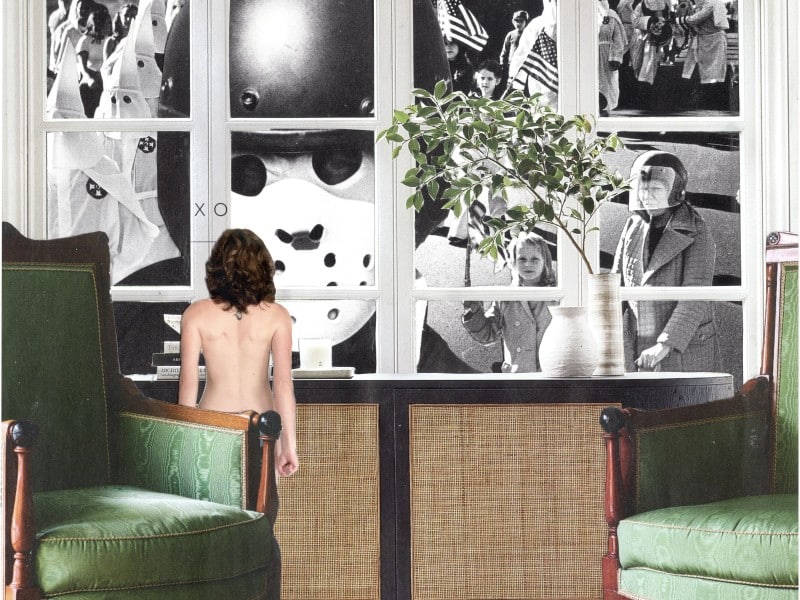
A deeply compelling new collage exhibition brainstormed and curated by Emily Morgan opens at Hopkins Hall Gallery on Monday, Oct. 26.
Andrea Myers comes full-circle with progressive mural at the Line
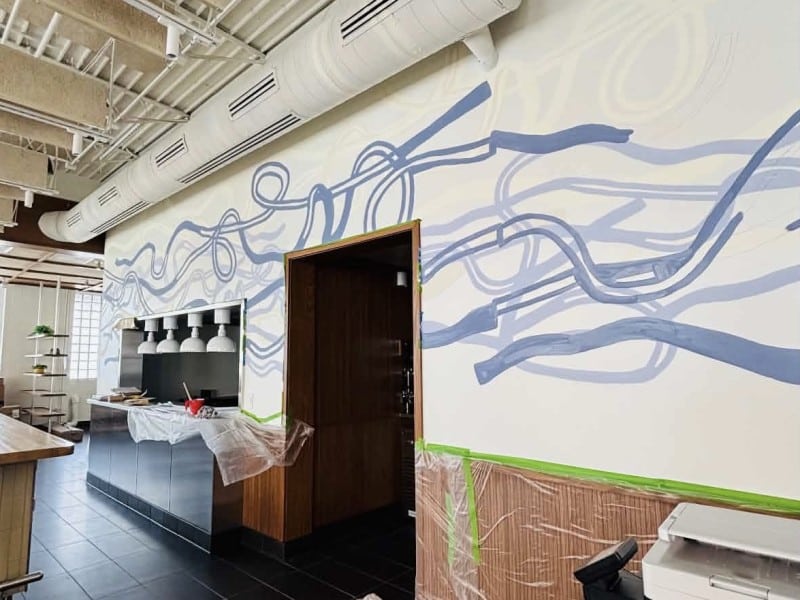
The Columbus artist once took drawing classes in the building that now houses the new restaurant and hospitality training center founded by Service!
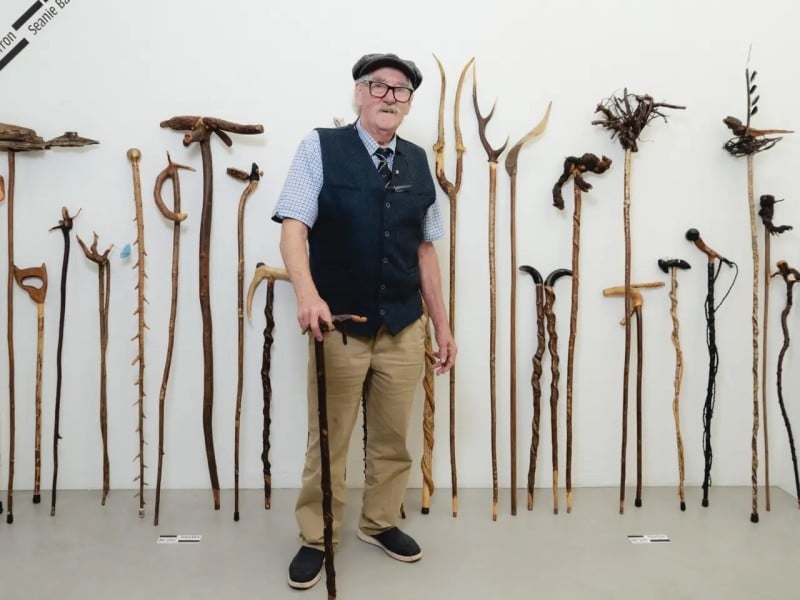
Take a leisurely stroll through the woods with Seanie Barron
The Irish artist’s new exhibition of hand-carved walking sticks kicks off at No Place Gallery with an opening reception today (Friday, Oct. 16).