
The joy and resilience of artist Stephanie Rond
The Columbus native shakes off stagnation and rediscovers joy in the wondrous ‘Spacewalkers,’ which kicks off with an opening reception at the McConnell Arts Center on Thursday, Sept. 19.

Stephanie Rond said that a few years back she started to get bored with her work. At the time, Rond was nearly a decade into creating paintings centered on her “ghost girl,” and she was beginning to feel stagnant, with everything from her color palette to her approach to composition adhering to familiar patterns.
“I felt like I wasn’t pushing myself,” Rond said in mid-September at the McConnell Arts Center, where her new exhibit, “Spacewalkers,” kicks off with an opening reception on Thursday, Sept. 19. “As an artist, we’re all great problem solvers. But I wasn’t creating enough problems for myself in my own work. I wasn’t challenging myself.”
In treading the same artistic ground, Rond also said her work had neglected to explore more monumental life events, including the passing of both of her parents. And as she started to seek new ways forward, the imprint of these deaths began to find new life on the canvas, her dad’s presence felt in the galactic swirls that started to surface in her work and her mom in graceful swarms of butterflies.
A donation powers the future of local, independent news in Columbus.
Support Matter News
“I just lost my mom a year ago in September, and the butterflies are coming from this idea of change and new life,” said Rond, who then traced the emergence of the winged creatures to an earlier childhood memory. “I was a very, very sensitive child. … And I found out butterflies only lived for two weeks, and I was heartbroken for weeks. I was just like, ‘What’s a world without butterflies?’”
In creating the pieces on display in “Spacewalkers,” a term Rond gleaned to after hearing it used by NASA astronaut Kathryn Sullivan, the artist would generally start by “wrecking” her canvases, tagging them with handwritten graffiti and other sorts of creative hurdles that forced her to adopt new workarounds. “I basically wanted to mess up the work and then figure out how to make it look right,” she said.
At times, these missteps were wholly incidental, including one piece that now features a faint tire tread imprinted on it – a result of the artist accidentally rolling over the painting when, unbeknownst to her, she dropped it in the garage while loading her car.
Embracing these purposefully haphazard methods, Rond gradually emerged with pieces that often reflect the chaos of recent years, directing my attention to one oversized canvas jammed with female figures, graffiti-like text and segments of chain-link fence, among myriad other elements.
“Especially with a piece this large, if you’re up close, you’re going to see parts of it but you’re not going to see the whole,” she said. “And I feel like that’s where we’ve been the last three years. Everything’s been compartmentalized, where we have to deal with this, and then we have to deal with this. But we have to deal with all of it. And maybe when we step back a little further, we can see a little easier how all of the pieces work together.”
That Rond would turn to creating in the midst of multiple global crises shouldn’t surprise, with the artist relaying how she first turned to drawing as a means of self-preservation, picking up crayons and coloring pictures to deal with a traumatic childhood experience. “When I was little, very bad things were happening to me, and there weren’t any adults at the time who understood what was going on,” she said. “And so, I was drawing. And I was creating an archive of myself to prove I existed. … And I think that’s maybe why my work leans toward social and political justice, because it was my survival. And I feel like that’s what I can bring to the world.”
Beyond process, Rond’s current work has shifted in other, more subtle ways. While she’s still having many of the same conversations in the art – her paintings take aim at everything from the patriarchy to racism and white supremacy – the tone has softened somewhat, with the artist expressing a desire to better engage with viewers.
“If you’re making people uncomfortable right out of the gate, you’re not going to change many minds. It’s more important to have the conversation,” said Rond, who traced her earlier, more confrontational approach to both her upbringing (“We’re Irish Catholic, so yeah, we’re scrappy”) and her experiences coming up in the Columbus punk music scene playing in the band subDevil. “I know if you came at me aggressively, I’m going to hunker down in what I believe. So, I think talking about beauty and joy and love helps with all of those harder conversations we need to have.”
Earlier in her career, Rond balanced this more aggressive messaging with an almost childlike sense of wonder, recalling how her then 4-year-old niece served as the model for ghost girl, and how her presence in the work allowed the artist to tap into the sense of discovery and exploration the youngster harnessed. As the artist’s tone has softened, her work has taken on the weight of mortality – evidenced by the galaxies and butterflies representative of her late parents – keeping it in a state of equilibrium and reflecting the reality that life is forever a jumble of ups and downs.
Along with this, Rond also expressed an increased comfort in centering voices and perspectives that are not her own, best evidenced in a series of portraits lining both sides of the hallway outside of the McConnell’s main exhibition space. Here, Rond pays tribute to the many women in her life, creating celebratory paintings of busts meant to both honor those depicted and to upend the status quo.
“I’ve been to so many museums, and I’ve walked through and seen so many busts of men,” said Rond, whose portraits include that of Ghana-born Columbus poet Cynthia Amoah, who will host an evening of poetry in the exhibit space on Thursday, Nov. 14. “I wanted female identifying people to come through this hallway and feel completely seen.”
These ideas echo throughout the gallery space, particularly in the larger pieces painted on wheat paste paper and meant to be mounted on outdoor walls – a continuation of the artist’s long-held explorations with street art and making her presence felt in spaces not typically open to women. When Rond started creating street art more than 15 years ago, she said female artists generally weren’t represented, and she shouldered her way into the scene in part “to see what this boy’s club was all about.”
“To be honest, women feel unsafe in a lot of spaces,” Rond said. “And that’s why these are all monuments. For me, it’s all about [asking] where do you feel safe? Where do you feel represented? Where do you feel most powerful?”
Author

Related Articles
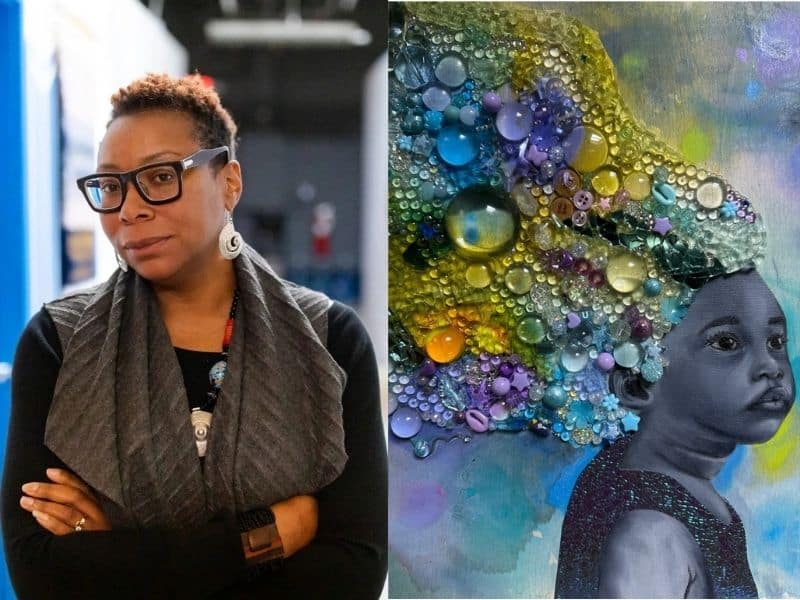
April Sunami finds a sacred space
The Columbus artist and recipient of the 2026 Aminah Robinson Fellowship plans to embrace the residency as an opportunity to take her work in bold new directions.
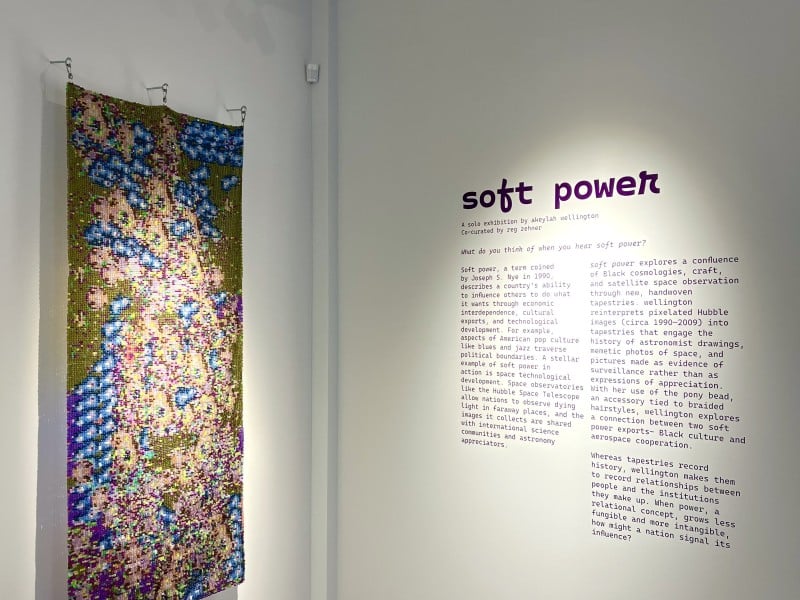
Akeylah Wellington explores ‘soft power’ in a world grown hard
The Columbus artist’s new exhibition, co-curated by Reg Zehner, kicks off with an opening reception at Pecha Projects today (Friday, Jan. 16).

Kadir Nelson still driven by a love for the game
Following the release of ‘Basket Ball: The Story of the All-American Game,’ the celebrated artist and picture book author will appear in conversation with fellow roundball aficionado Hanif Abdurraqib at King Arts Complex on Wednesday, Jan. 14.