
Jacob Mason-Macklin comes back home again with ‘Wheatland’
The Columbus expat’s new art exhibit kicks off at No Place Gallery with an opening reception on Thursday, Dec. 12.
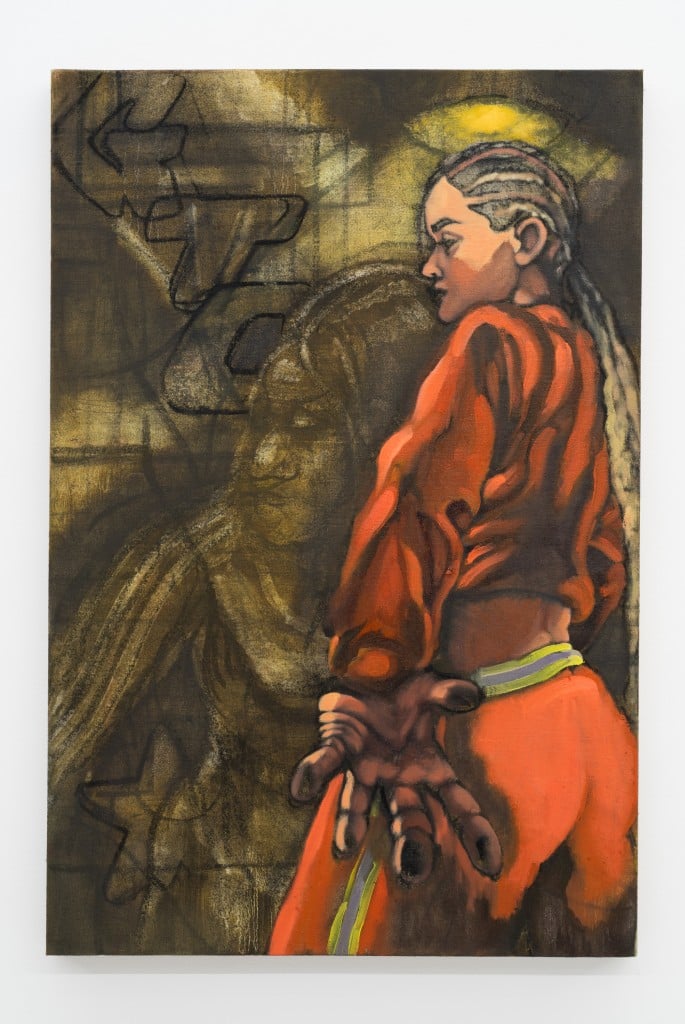
The last couple of years have been a time of experimentation for Columbus-born artist Jacob Mason-Macklin, who took part in a couple of residencies – one in London, England, and another at the Studio Museum in Harlem, New York – during which he pressed his craft, and himself, to a breaking point.
“And I’m both frustrated and excited, and I’m in the woodshed, where I don’t know exactly what I want the works to be. And I’m throwing things in the fold, in the fray, and things aren’t landing,” Mason-Macklin said in early December from his home in Queens, New York. “There was all of this failure, and I was reaching this impasse where experimentation time was over, and it was time for production to begin.”
As a means of overcoming these hurdles, the artist ensconced himself in his studio and stapled all of the paintings he had produced over the last five or six years to the walls. He then took out a journal and began writing, documenting what he liked and didn’t like about each piece, gradually winnowing the collection down from more than 40 pieces to the 13 or so he viewed as the best representations of the work he had created in that time.
A donation powers the future of local, independent news in Columbus.
Support Matter News
“And the works [I homed in on] showed the adjustments in thinking, or the adjustments in material, and they allowed the mistakes to be present,” said Mason-Macklin, whose new exhibit, “Wheatland,” kicks off at No Place Gallery with an opening reception at 6 p.m. on Thursday, Dec. 12. (“Wheatland” will be held in Gallery A, while “Afterimage,” from the artist Catalina Ouyang, will feature in Gallery B.) “There is this tracking of thought and traces of the hand throughout the completed image that felt really communicative of a psychological state. … And the works seem to have this nice melody of failure and virtuosity.”
Mason-Macklin described the emergent exhibition as “a meditation on seeking … or the more pursuant aspects of looking,” and the bulk of the images contained within are centered on his observations of a narrow strip of the East Side that stretches from the artist’s childhood home to Wheatland Foods, a skeletal carryout near the intersection of Mount Vernon Avenue and Graham Street.
Of course, it’s been more than a decade since the artist last walked the streets in this neighborhood. And while he leaned on available technology in creating the paintings – in particular those images of the East Side available on Google Earth – he also accepted the reality that a degree of memory slippage, of decay, could also be present in the work. “It’s not a clean retracing of the experience,” he said, an acknowledgment that falls in line with the way the artist embraced moments of imperfection in the crafting process. “There are those sorts of unresolved portions, or failures, or misdirections. … The paint, when it jars and when it breaks, or when it slips and pushes and pulls, it feels like the articulation of a conflict. And that’s kind of what’s going through my head when I’m painting.”
Generally, Mason-Macklin said, he approaches the act of painting as a series of compositional riddles to be solved, focusing his attention on things such as line, color, shape and composition. It’s not until long after an image has started to take form that he even begins to untangle the larger conceptual ideas embedded in the canvas.
“Something happens where you see the painting through and then it stops becoming paint,” he said. “And then once you step away, these worldly communications start to be imbued within the material, and you start to understand the geopolitical or psychoanalytical implications of your work. … So, in short, I’m in the dark 99 percent of the way. There is no stewardship until I get fortunate enough to be able to see what it is I was going for.”
When he stepped back from the paintings on display in “Wheatland,” Mason-Macklin was struck with the realization that the place in which he was raised had not fully released its grip, and even a decade removed from living in Columbus he was still unpacking the various ways the area had shaped him. The artist said he was no stranger to these concepts, having previously explored them while attending school at CCAD, but he allowed that time distance had afforded him the means “to be a little more observational … while understanding the emotional and psychological weight the area still carries.”
There’s also a natural angst, or tension, in Mason-Macklin’s work that the artist attributed in part to the observational aspect of his paintings, a number of which contained people obscured by shadows or rendered featureless by distance. For the exhibition he created in residency at the Studio Museum in Harlem, for instance, Mason-Macklin centered his work on state surveillance, compelled by the prevalence of NYPD cameras and floodlights in the neighborhood, while simultaneously grappling with his own outsider presence.
“I’m not from Harlem, and I’m in this residency, so I’m a transplant, right?” the artist said. “And so, my own surveying of the culture and the atmosphere in Harlem was uneasy. I felt a confliction.”
Similarly unsettled vibes ripple throughout “Wheatland,” which the artist attributed to a general angst present within our world at this moment, the tensions brought about by creating a show to be staged a five-minute drive from a neighborhood for which he still holds unresolved feelings, and his complete inability to avert his gaze from all of the above.
“I’m coming back as a visitor but even being in that space [No Place Gallery], which in itself is proximate to where I grew up,” Mason-Macklin said, and briefly trailed off. “I don’t know. It just feels like it allows for this deeper articulation for me of looking as a painter, but also as someone who can’t help but look.”
Author

Related Articles
Matt Yoho finds his way back with ‘Alright So Far’
The Columbus artist’s new solo exhibition – his first in nearly 15 years – kicks off with an opening reception at Awesome Gallery from 1-3 p.m. on Saturday, April 11.
Columbus artist Colleen Scott learns how to love herself again
‘Redirected Pathways,’ which kicks off with an opening reception at the Franklin County Coroner’s Office on Thursday, April 2, centers on work created both pre- and post-sobriety, capturing a personal evolution that speaks to a range of universal concepts.
Emily Morgan and Hannah Maltry rely on instinct for ‘We Did It Wrong’
The two artists will host an opening reception for their exhibition at High Road Gallery & Studios from 6-8 p.m. on Saturday, March 28.