
‘Superspreader’ continues to mutate
Steyven Curry and Co. will celebrate the third edition of the ever-evolving DIY publication with a release party at Two Dollar Radio Headquarters on Saturday, Sept. 27.
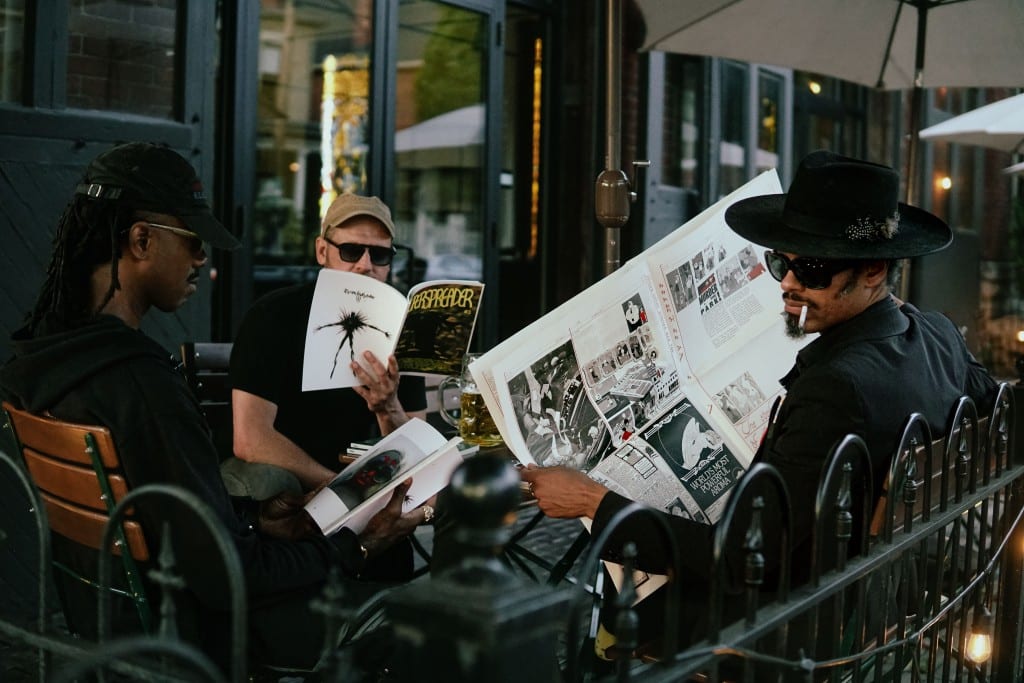
The first edition of Superspreader emerged out of the first year of Covid, with artist Steyven Curry roping in a handful of friends and fellow creators to produce a full-color print magazine centered on comics art and poetry.
Adopting its name both from the pandemic and philosophical concepts advanced by the late writer William S. Burroughs, who once expressed that “language is literally a virus,” the magazine’s roster of contributors has continued to multiply like the infected in a zombie film, moving from Curry’s inner circle to friends of friends and even people he has never met.
“It’s nice to have those revolving doors, too, because each producer is not only putting up their own funds, but they’re appointing artists based on their own networks,” said Curry, who joined poets Mike Wright and Larry Robertson for an early September interview at Upper Cup on Parsons Avenue. “And that gives us a nice little balance, and more diversity as you’re flipping through.”
A donation powers the future of local, independent news in Columbus.
Support Matter News
The catalyst for Superspreader #3, Curry said, was the participation of writer and editor Dr. Rachel Moss, who interviewed the creators during a panel around the release of the first issue and came on board as a producer for the latest edition, which will be the focus of a release party at Two Dollar Radio Headquarters on Saturday, Sept. 27. Coming into the project, Curry was particularly inspired by the vibe of Moss’ “Internet Bedroom” newsletter, which he said ripples with a spirit similar to Superspreader.
“I love the ’60s, the Risograph revolution, where you could just make this DIY thing and put it the fuck out,” said Curry, who pointed to the reality that many artists are creatively hemmed in, to at least some degree, limited to work that generally falls within a particular spectrum that the public already associates with them. “With this project, I always tell everyone, be selfish. Make work that’s just for yourself.”
Robertson took this advice to heart, choosing to submit images from a massive series of photographs he amassed largely in secret over nearly a decade rather than the poetry for which he has best become known.
“There are these controlled environments, and to get support, or to position myself in this space where I can get resources, you have to say, ‘I’m a poet, I’m a poet, I’m a poet,’” said Robertson, who also founded the Poetry Festival, which returns for its second go-round this weekend. “With [Superspreader], it’s the wild, wild west. It was like, ‘Hey, we respect you as an artist and we’d love you to share something.’ And I know the first thought might have been poetry, but … I’ve been working on this photo project for eight years and have hundreds of images that I haven’t shared. … It’s something I’m passionate about, and something that I’ve given as much if not more time to than my poetry.”
Robertson’s photographs, taken at Art Basel Miami and featuring the performance artist Crackhead Barney, fall on a pair of pages between the short story “TV in a Dark Room,” by Zoey Miller, and a seismograph activity page by Cecil Engelhardt. There are also illustrations by Curry (who creates under the name Nevyets), a trio of new poems from John M. Bennett, and an original 12-page comic by celebrated artist Ronald Wimberly, whose own print publication, LAAB Magazine, treads similarly sprawling ground.
“I think that’s part of what makes the magazine work,” Wright said. “Steyven and I have both talked about this idea that artists, just as a necessity of focusing on discipline, can become siloed. … And what this does is sort of expose you to a different kinetic energy.”
Flipping through the pages of the latest issue, this energy practically radiates, a diversity of ideas ping-ponging off of one another and occasionally drawing out unanticipated dimensions in the submissions. Falling immediately after a trippy, chain restaurant-themed drawing by artist Victor Cayro, Nathan Moore’s poem “For External Use Only,” for one, begins to read even more explicitly as a condemnation of consumerism. Pulling further back, the amassed materials begin to read as a reflection of the chaotic modern times from which this new collection emerged.
“This is like my ghost-busting machine. You’re just capturing things, making the record,” Curry said. “It’s what we do as human beings: We tell stories, and we record. … And it should inspire. That push and pull is good tension, like sibling tension, or a group like Wu-Tang. You want to be good at what you do, and if you phone it in, Wimberly is gonna hit you with a 12-page mini-comic. And maybe that can make you feel some type of way. But to me, that’s good. It’s like, damn, I need to step up now.”
Author

Related Articles

Kadir Nelson still driven by a love for the game
Following the release of ‘Basket Ball: The Story of the All-American Game,’ the celebrated artist and picture book author will appear in conversation with fellow roundball aficionado Hanif Abdurraqib at King Arts Complex on Wednesday, Jan. 14.
Leslie Battle seeks, finds connection in ‘From Spark to Fire’
The Columbus poet will read from her forthcoming collection at Streetlight Guild on Sunday, Dec. 7, joining the likes of Karen Scott, Marquita Byars, Schyler Butler, Rachael Scott, and Miccau McClelland.
Brent Warren puts Columbus on the map
The longtime local reporter will celebrate the release of ‘Columbus in 50 Maps’ at Prologue Bookshop tonight (Tuesday, Dec. 2).