Artists explore ruin, reconstruction in ‘Converge’
Alissa Ohashi and Janelle Bonfour-Mikes will utilize simple tools to explore a range of complex ideas in creating a performance installation at ROY G BIV Gallery on Tuesday, Nov. 11.
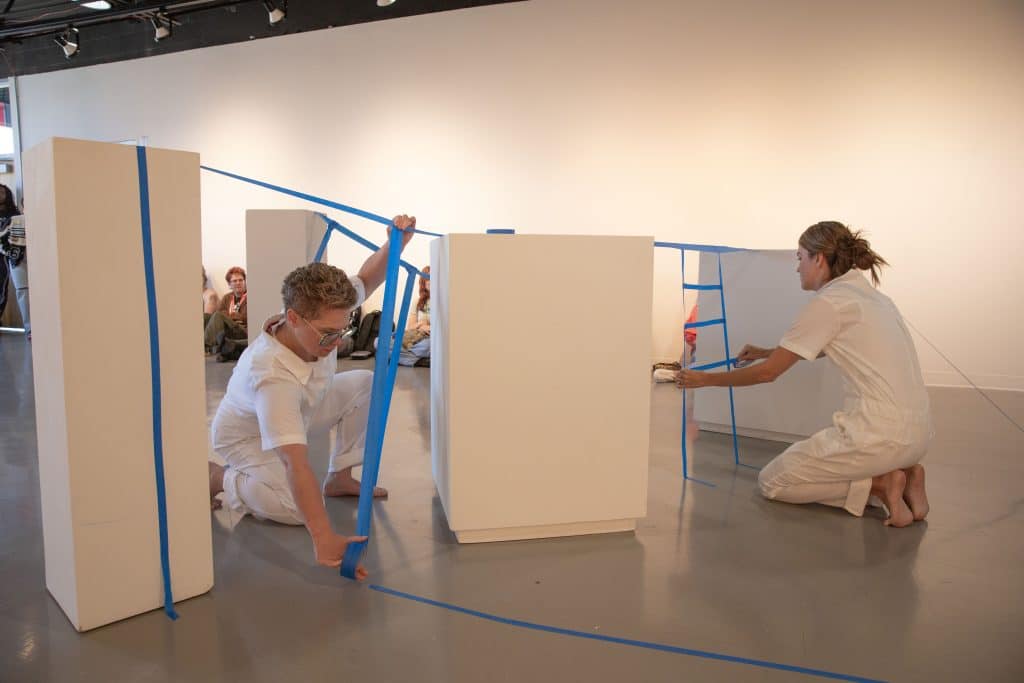
When Alissa Ohashi and Janelle Bonfour-Mikes collaborated on “Conduit” in 2023, the performance had a more inward focus, with the two artists stretching blue painter’s tape along a floor and wall at Urban Arts Space as a means of exploring the places in which their divergent spiritual and philosophical perspectives converged and overlapped.
For the pair’s new collaboration, dubbed “Conduit” and taking place at ROY G BIV Gallery at 7 p.m. on Tuesday, Nov. 11, that focus has turned outward – a shift in perspective the two traced to the various damaging actions undertaken this year by the Trump administration.
“We were really dialing things in when DOGE was happening in January,” Bonfour-Mikes said in reference to the Elon Musk-led Department of Government Efficiency, which earlier this year began making sweeping cuts absent oversight to myriad federal departments, causing untold collateral damage. “And in that, we began thinking of all of these structures and how everything was collapsing. But then also asking how we could move on from that and create lasting change. How do we take something that is a mess, and that maybe wasn’t perfect before, and turn it into something new?”
A donation powers the future of local, independent news in Columbus.
Support Matter News
“It seemed like everything was collapsing and changing at once,” said Ohashi, who called attention to everything from the stream of executive orders issued by President Donald Trump to the increasingly hostile actions of ICE agents. “My family was in the Japanese internment camps during World War II … and I was thinking not about how history repeats but how it rhymes. And we could be talking about anything, but I’m speaking about ICE and the detention camps. … So, there were tons of these thoughts floating around, and then we were trying to think about how we could contribute.”
Befitting this more expansive perspective, the two artists have adopted a three-dimensional approach with “Conduit,” utilizing podiums, the floor, and moveable walls to create a twisting, temporary structure as attendees look on. Working with these simple materials, the two are able to expound on a range of complex ideas, delving into the destructive urges of this political moment and pondering what kind of societal rebuild might be possible. Even the choice of material teases out added depth in the concept, with the blue painter’s tape meant to reflect “the temporality of things,” Ohashi said.
Since the artists create the installation intuitively on site, they can’t predict final shape the form will take. Prior to doors opening, however, the two plan to begin with a half-hour conversation centered on world events, allowing them to enter into the creative process with similar ideas in mind. From there, intuition takes over, the artists weaving in and around each other and the gallery space to create temporal structures that can be altered, torn, evolved and rebuilt.
“My initial background is in improvisational modern dance, and in that you’re thinking thematically about what you want the piece to be about but also reacting to what the other person is doing,” said Bonfour-Mikes, who tends to favor straight lines in working with the tape – an approach that runs counter to the more organic, free-flowing forms preferred by Ohashi. “So, I might start out with this idea, but then realize Alyssa is in the pathway I wanted, or she’s doing something much more interesting, so I need to switch and support her rather than fighting against it. And it’s allowing that change to happen and giving that attention to something other than myself and my own ideas.”
Bonfour-Mikes and Ohashi first met as graduate students at CCAD in 2017, hatching initial plans to collaborate five years later. At the time, both happened to be centering the color blue in their respective solo work – Bonfour-Mikes in cyanotype printing and Ohashi in a series of amorphous sculptures – which led them to choose blue painter’s tape as their medium for “Conduit.” Both that initial show and the upcoming performance of “Converge” were shaped in part by the limitations of the material, which Bonfour-Mikes said has an unpredictable tackiness (“It’s almost like the stickiness changes”) and a thickness that can make it difficult to gauge precisely how much tape is left on a roll. “I’ll have this idea to do something, and all of a sudden I don’t have the three feet I needed,” Bonfour-Mikes said. “So, you have to be quick in the moment with problem solving, where you can pivot and figure out where to go next.”
This, at its core, is the concept the two are working to unpack within “Converge,” which has emerged as another means of locating stable ground from which the two can better assess what comes next.
“Grounding is a great word, because this gave me a partner, a creative partner to have discussions with, where even when it felt like everything was out of our control we could still work toward hope,” Ohashi said. “And sometimes it wasn’t even working toward hope. Sometimes we were like, can we actually do anything? Is there any change we can make? But what happened was that even in that questioning, I became more grounded, where I wasn’t just flailing about alone with my thoughts.”
“There were times it would be like, can we talk about that?” Bonfour-Mikes said. “And then you allow your ideas to change or become more formed. But it’s having that trust to say whatever and still understand we’re working toward the same thing.”
Author
Related Articles
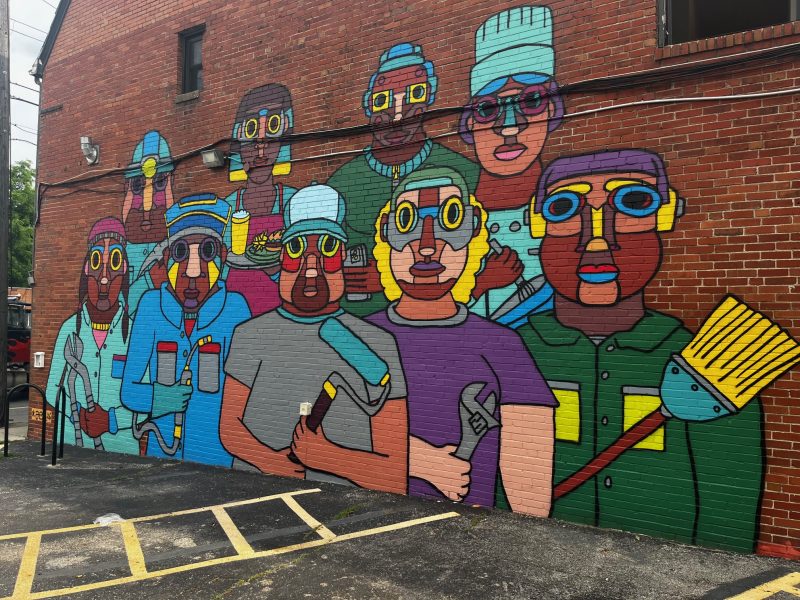
Adam Hernandez aims to uplift immigrant workers with his latest mural
The Columbus artist will be on site at 1014 Parsons Ave. for the public unveiling of ‘We the People/Nosotros la Gente” on Thursday, June 11.
Johnny Williamson finds himself on the other side of ‘Nightmares’
In the midst of rebuilding his life for the second time, the Columbus artist and musician will host a dual album listening party and exhibition at Rehab Tavern in Franklinton on Friday, June 5.
Mark and Anne Spurgeon embrace their familial bond with ‘Blood Harmonies’
The new exhibition from the Spurgeon siblings kicks off at the downtown gallery Blockfort with an opening reception on Friday, June 5.