
The Returning Artists Guild continues ‘Imagining Abolition’
The collective will commemorate a sprawling group exhibition now on display at the Columbus Metropolitan Library with an opening reception on Saturday, Dec. 6.
When Joy first began to craft in prison, her work typically took on more functional form, centered on objects such as quilts and stuffed animals. In the years since, however, Returning Artists Guild cofounder Aimee Wissman said Joy’s work has grown “both more and less chaotic,” stretching from cloth bears stitched out of discarded prison garb to elaborate, mobile-like structures like the one currently on display in RAG’s new exhibition, “Imagining Abolition: Blood, Sweat, and Tears,” on view at the Columbus Metropolitan Library through Jan. 30.
“As time has gone on, I’ve shown her more pictures from museums and been like, ‘Why don’t you try this?’ And something in her brain clicked and she has just taken off,” said Wissman, who will join fellow RAG cofounder Kamisha Thomas at the downtown library for an opening reception from 2-4 p.m. on Saturday, Dec. 6. “We want them to understand the idea that what they have to say is super important, and actually what you have to say on this topic is the most important. And it’s been fun to watch people shift from, ‘Well, I draw butterflies because that’s what I know how to draw,’ and into, ‘Well, I drew butterflies trying to escape this bottle because they’re trapped.’ … The reason we keep using the prompt ‘Imagining Abolition’ is because we’re trying to solidify in everyone’s minds that we can imagine a different future, a free future.”
Oftentimes, people and organizations that work with the incarcerated will frame their mission around a belief that they’re speaking up for people who can’t speak for themselves. “And that’s very untrue. Incarcerated people can fucking speak for themselves,” said Wissman, an accomplished artist who within RAG has also branched out into areas such as podcasting while continuing to advocate for currently incarcerated artists as well as those adjusting to life outside of prison. “We just need to find ways to get their messages out. And art, writing, whatever the creative practice is, it’s one of the places you can really express yourself. And even if you’re hiding your message within visual innuendo, you can still get it out and into the world. And for some of the artists we work with, it’s changing the way they do their time and how they think about it.”
A donation powers the future of local, independent news in Columbus.
Support Matter News
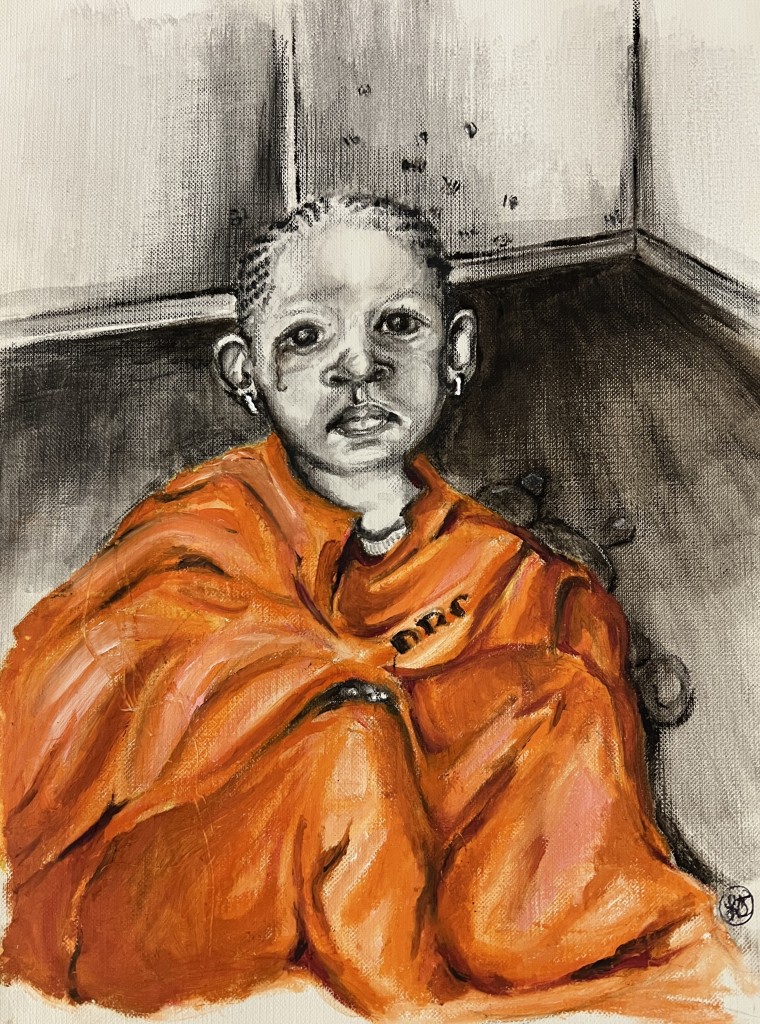
These messages are currently reverberating in the work displayed throughout the Losinski Gallery, located on the second floor of the Columbus Metropolitan Library, some of which speaks explicitly to abolition and the harms of the prison industrial complex. Witness a portrait of a young Black child in an oversized orange prison jumpsuit titled “Don’t Worry, You’ll Grow into It.” Then there are other pieces whose messages are more deeply encoded but still every bit as resonant, including Joy’s twisting, entangled mobile, which offers a sort of visual language for incarceration, right down to the way its complex inner workings hang within a confined space.
The shift from making pretty drawings to creating something more deeply layered with meaning is one that requires a degree of vulnerability, which Wissman acknowledged can be a challenge for currently incarcerated artists whose environment can require them to remain hardened on a day-to-day basis. “And also, so much of prison is cut off … from the visual language of the world,” Wissman said. “Everything in there is the same. It’s all gray and stark and unappealing. And when you’re in that space, to push your brain to imagine other things can be really hard.”
These gradual artistic evolutions exist throughout the exhibition, including a painting by one artist that introduces previously unexplored textural elements such as glitter and melted wax, and a collage by another artist who has traditionally submitted more stripped-down black and white drawings. “And I was excited to see that, because you’re adding in additional material, and it’s not as flat,” Wissman said. “It’s softly trying to encourage them to think beyond what they’re thinking of now, right? Because for me, it’s more about their creative practice and their mental health than it is about the outcome of an exhibition.”
For Wissman, pursuing abolitionist work in this specific political and cultural moment can be a mixed bag. On one hand, violently ramped up immigration enforcement and the passage of laws criminalizing homelessness have continued to funnel unchecked funds into an already outsized prison industrial complex. “Unfortunately, some people are worth more in a cage,” she said. “And there doesn’t seem to be an interest in solving things on the front end or thinking about social problems as things we should all be invested in changing. … And as they take away more resources and programs and defund things, the only place for the overflow is always going to be the carceral system.”
At the same time, these developments are steadily opening more eyes to the nature of policing and the types of people who have a tendency to gravitate toward a career in it – particularly within the routinely unchecked ranks of ICE – in a way that could begin in time to shift the conversation.
“Most people learn through pain,” Wissman said. “I’m that person, and there are a lot of things I’ve had to learn the hard way, obviously. … But I do think more people are starting to take a peek behind the curtain because so many of our systems aren’t working the way they’re supposed to. Or maybe it’s that they’re working exactly how they’re supposed to. And I think that helps the conversation around prisons, and it makes it easier for folks to understand that these places are a lot more nefarious than we were led to believe. They’re not colleges or hospitals or rehab centers. They’re prisons.”
Author

Related Articles
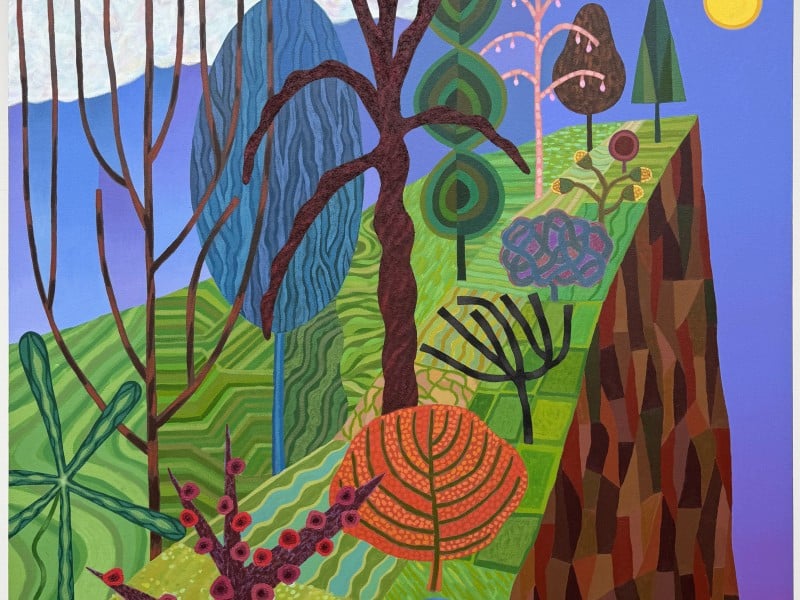
Aaron Troyer brings a colorful cast of characters to life in ‘False Meridian’
The artist’s new duo exhibition with Jolene Powell kicks off with an opening reception at Brandt Gallery tonight (Friday, Feb. 6).
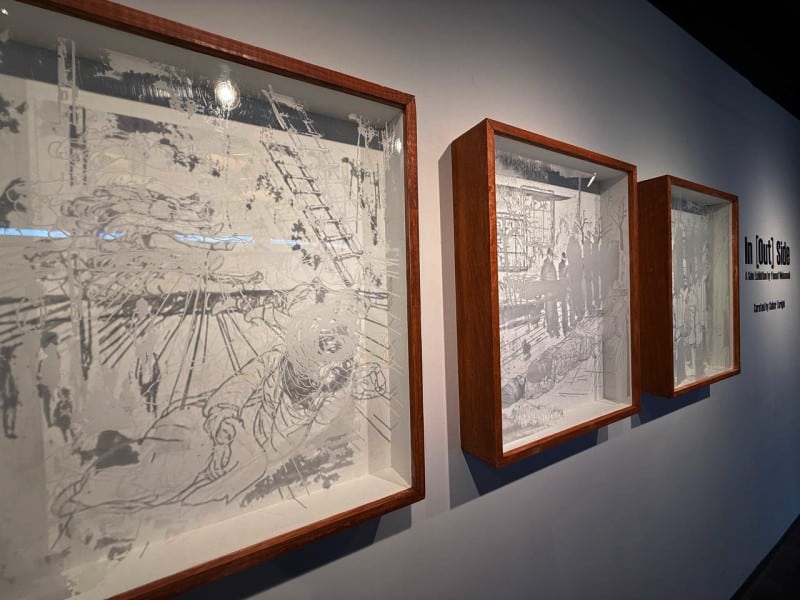
Yoosef Mohamadi preserves a collective memory at Blockfort Gallery
The Kurdish artist’s staggering new exhibition, ‘In(Out)Side,’ will remain on display at the downtown gallery through Feb. 21.
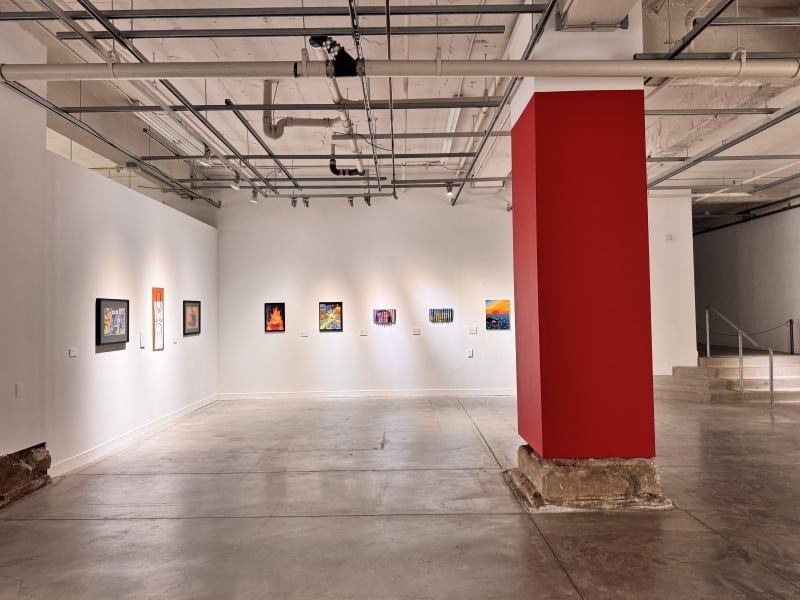
‘I wanted the kids to … understand this could be a possibility for their future’
In curating the ‘Young Artists of Columbus’ exhibition now on display at Urban Arts Space, Imara January wanted to open the eyes of young creators to the potential of life in the arts.