
Kirsta Niemie Benedetti wants you to know you’re worth it
The Columbus artist’s new exhibition, which kicks off at 934 Gallery with an opening reception on Friday, Dec. 19, empowers incarcerated women to take a different view of themselves.
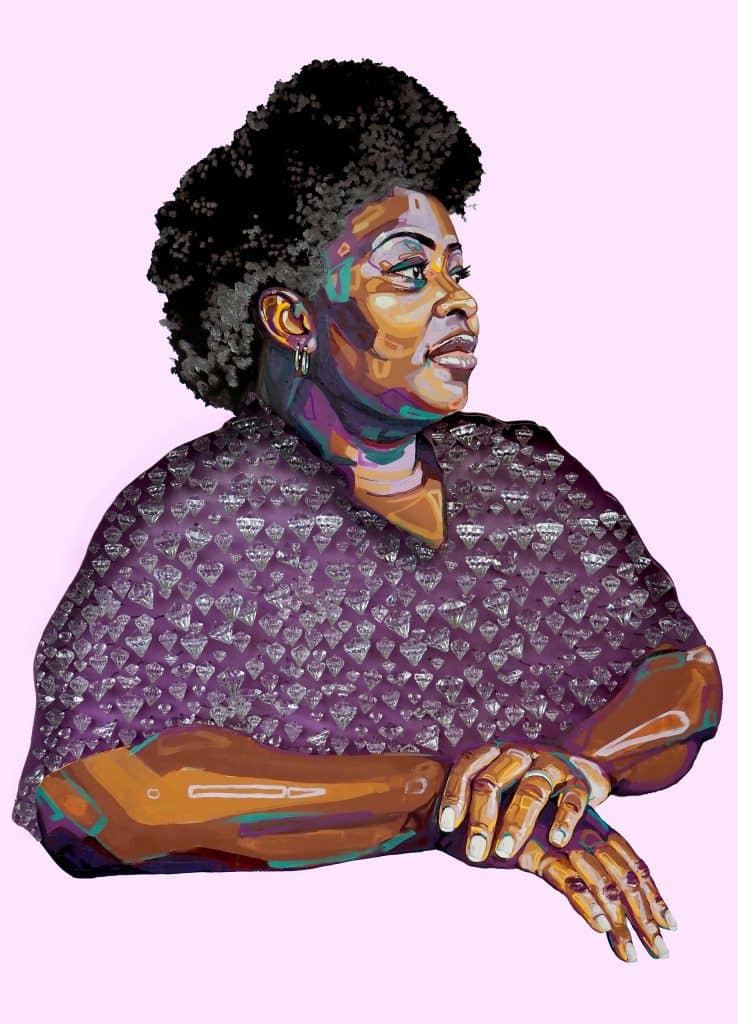
In the course of creating portraits for 15 incarcerated women, artist Kirsta Niemie Benedetti asked each of them how they would want to be seen and remembered by others.
The responses helped to shape what became the body of each painting, with Benedetti taking source photographs and then excising the prison-issued clothing from the image because “the only way you can tell you’re looking at a picture of a person who is incarcerated is by their prison uniform,” the artist explained.
Benedetti then filled this hollowed-out core with sculptural elements inspired by the answers given by each woman, utilizing stacked limbs collected on walks through the woods for Melanie, who spoke about her deep connection to nature, and cherry blossoms in various states of bloom for Erica, who described how she had finally come into her own in the time she had been incarcerated.
A donation powers the future of local, independent news in Columbus.
Support Matter News
For some of the women, this question proved challenging, leading to running dialogues with Benedetti that could have doubled as therapy sessions. And then other times the women provided the artist with the challenge. Mindy, for one, wanted to be seen for the freedom she had gained from addiction in prison, a concept Benedetti initially struggled with finding a way to represent visually.
“At first, I was like, that’s a really ethereal and complicated concept. How can we visualize that?” Benedetti said in mid-December from 934 Gallery, where the Columbus artist’s solo exhibition will kick off with an opening reception from 6-9 p.m. on Friday, Dec. 19. “And so, I would keep asking questions, and she would think about it and come back.”
In the course of this ongoing dialogue, Mindy eventually shared with Benedetti a story about an experience she had after serving years in jail while awaiting sentencing – a stretch of time in which she wasn’t granted access to the outdoors. “And so, she didn’t see the night sky for years. And when she was finally processed to be taken to prison, it was in the middle of the night,” the artist said. “And when she stepped off the transport, she saw the night sky and realized, oh, I can see beauty now that I’m not addicted.”
Owing to this revelation, the body of Mindy’s portrait is taken up by a wide expanse of nighttime sky filled with celestial swirls of twinkling stars.
This process was aided by the fact that the women Benedetti began meeting with in weekly groups three years ago had previously been part of an oral history project within the prison – an undertaking that required them to interview one another about their accrued traumas, retracing the sometimes-knotty paths that led each to incarceration. The trust built in those conversations carried over into the meetings with Benedetti, who challenged the women to begin to see themselves not through the veil of past actions but in a gentler, more humane light. “And I started with questions I thought were softballs, like, when have you felt most beautiful? How would you describe yourself and how would others describe you?” said Benedetti, a social impact artist who has previously created portraits depicting new Americans and victims of human trafficking. “And they were like, ‘Whoa, you’re throwing us in the deep end right away,’ which wasn’t my intention. … But a few women led with vulnerability, and that set the tone at the beginning. It was like, okay, we’re going to trust each other. We’re going to do this. And it’s going to be worth it.”
Throughout, Benedetti focused on letting each woman maintain control over the process, empowering them in every aspect of the journey from selecting the source photograph from which the portrait would be created to deciding what objects would fill the hollowed-out core of the three-dimensional wooden box on which their likeness rested. At times, this meant going against her artistic training, particularly when the women opted for photographs in which they were posed in a manner that didn’t present as strong compositionally.
Over time, however, this collaboration proved transformative for both the women and the artist, with Benedetti allowing that the undertaking eventually blurred the lines in terms how she viewed people who are incarcerated, as well as introducing the idea that had circumstances been different in her own life, she could have ended up alongside these women.
“I think at the baseline I’ve always seen myself as a good person, and what I realized is that being a good person doesn’t mean that I shouldn’t be in prison or that I couldn’t be in prison,” she said. “In hearing their stories and putting myself in their shoes, there have been a few times where I’ve been like, yeah, that could have been me if I was in a different situation at 17. Sure, I could have made that choice. I think anytime you develop dimensionality of a people group, you are changed. … Going to prison and spending time with these women is one of my favorite things. It fills me. It makes me feel grounded. And I feel reminded of what is really valuable as a human.”
Benedetti has expanded on this idea in continuing to evolve the exhibition, which she first presented inside the prison in 2024. One section within 934 Gallery, for instance, focuses not on images but on words, with Benedetti asking the women about the everyday things they missed being in prison and then punching those responses out on a series of placards. (“I miss being able to grieve loss and death,” one reads. “In prison it’s impossible to grieve.”)
“Since it’s a piece about absence and what you miss, I wanted people to read the negative space,” said Benedetti, who recently received permission to make the prison art program permanent, with a new group of women set to take part in a new session beginning in March.
More recently, the artist developed an interactive element to go along with this installation, printing a small stack of cards, each imprinted with the name of one of the women and a task meant to draw the viewer closer to them. On one card, for example, Adriana invites the participant to go “into your room by yourself, snuggling with your pillows, and think about how amazing it is to have the room all to yourself.” On the back of each card is a QR code linked to a Google document where the person can share what they experienced in performing the action, which Benedetti then relays to the women.
“And it creates this connection loop where it’s like, you’re not invisible, you’re not forgotten,” said Benedetti, who recalled how one documentary filmmaker responded to Melanie’s challenge to take a walk in the forest by creating a short film that enabled viewers to travel alongside him as he hiked. “And she was like, ‘This is for me? He made this for me?’ … I’ve studied a lot of social psychology and the psychology of change, and one of the best, most effective ways to change somebody is to have that one-on-one connection with a person, not a concept.”
In engaging this process over the last three years, Benedetti said she has seen these changes firsthand. But while the artist has an awareness of the power portraiture can have – “There’s still this framework and assumption that being painted means you are wealthy or famous or worthy,” she said – she’s still been caught off-guard by just how strongly these realities have manifested.
“I had each woman write a letter to their portrait when they were done, and those were so revealing and powerful, where they were sharing things like, ‘I never knew I could be proud of myself until I saw this portrait,’” said Benedetti, who equated the impact to a study she came across by a researcher in the United Kingdom that painted portraits of the terminally ill with their guidance – a process that enabled them to “see themselves outside of their illness.” “So, it’s fascinating, and I hope to keep pushing that and learning more as I go. … And then the honor and dignity of being painted can also, I think, speak to a different part of your brain that might have told you that you’re not worth it. And what this says is you are.”
Author
Related Articles
‘Immigration: A Journey of Belonging’ seeks deeper understanding
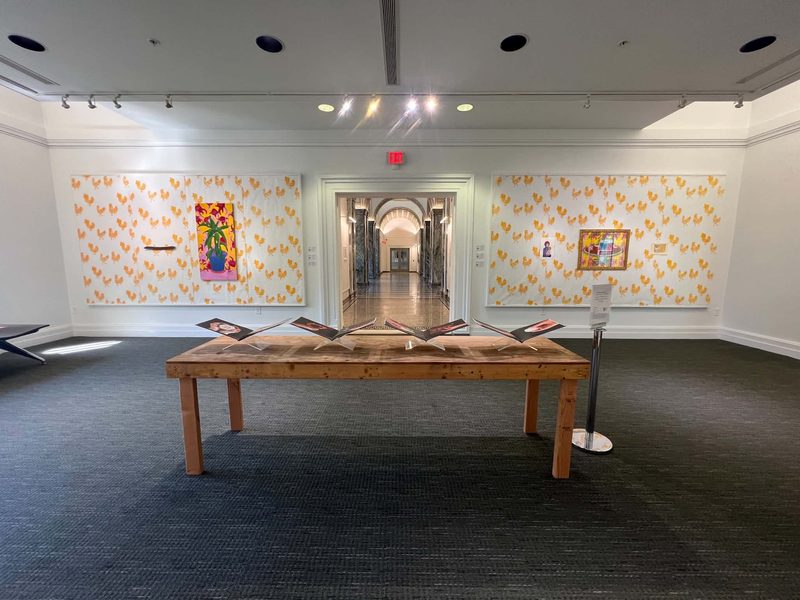
The new group exhibition, open now at the Losinski Gallery at the Main Library, will host a reception from 2-4 p.m. on Saturday, Oct. 3.
Deep conversations pave the way to ‘Chasing the Light’
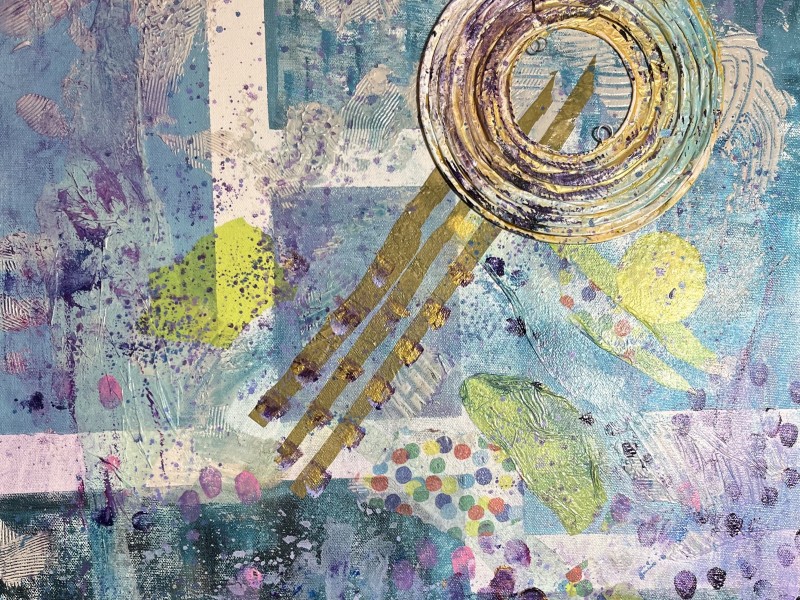
A couple of years ago, Loren Bucek invited a group of artist friends to her Clintonville home. The gathering soon evolved into regular meetups that shaped the creation of a new exhibition opening this week at McConnell Arts Center.
Henry Hess says goodbye to his longtime Chromedge studio
Faced with a rent increase of more than 30 percent, the Hess family opted to move on from the artist’s creative home of the last eight years. And while the next steps remain uncertain, they stressed that Henry would maintain a presence in Franklinton. ‘We’re not going anywhere,’ Sophia Hess said.