
Inside the diverse coalition united against Anduril
Made up of environmentalists, anti-war activists, pro-Palestine organizers, privacy advocates, Indigenous scholars, and impacted residents, among others, the group’s diversity is reflective of the massive scale on which Anduril already operates within the defense contractor industry.
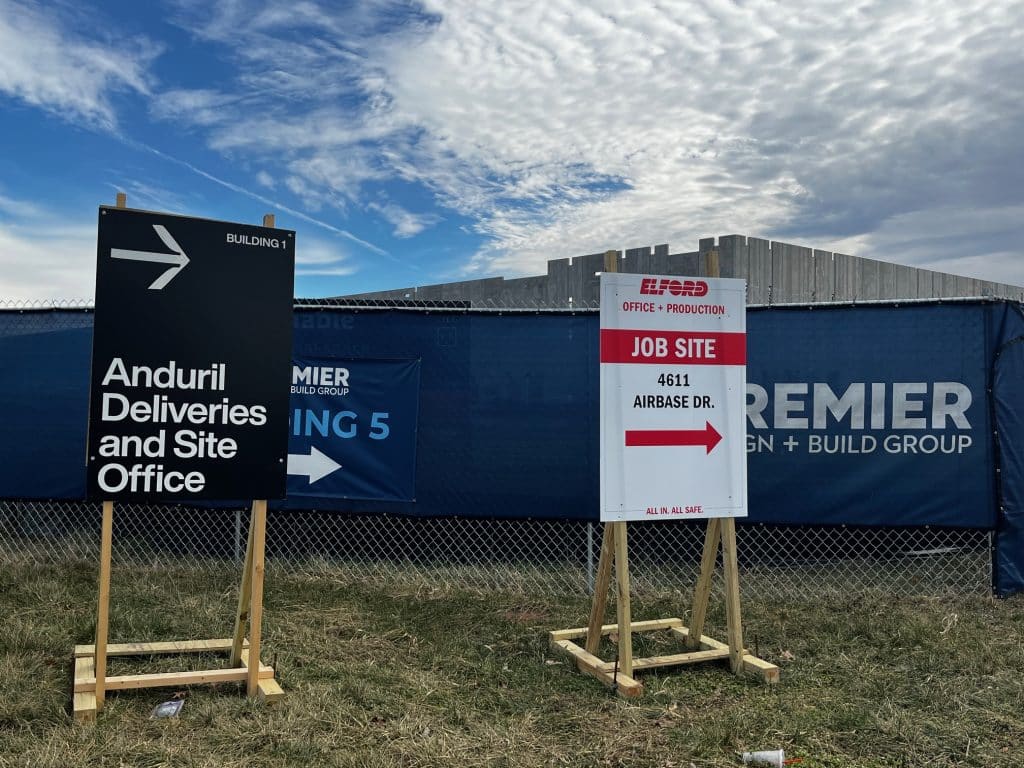
Ross Larue grew up in Pickaway County in a home still owned and lived in by his parents that rests less than a quarter mile from where Anduril Industries is currently building its $900 million Arsenal-1 hyperscale manufacturing facility. But Larue’s family roots in the region run even deeper; he now lives roughly a mile and a half from the site in a house formerly owned by his grandparents.
“So, we’ve obviously been in the area a long time,” said Larue, who began to track the development of the Arsenal-1 plot long before the Anduril name was even attached. “CT Realty, the [developer] who owns the actual property, they originally bought it to build warehousing. And it was going to be five, six, seven warehouse-type buildings extending to the west of the property. And then, all of a sudden, there was this talk going around about something called Project Thor.”
The codename was chosen by Pickaway County officials to keep details of the Anduril project hidden – a layer of secrecy that Larue said has accompanied the facility at each stage, compelling him to push for more public transparency around not just Arsenal-1 but developments of all kinds within Madison Township. “And that’s really been our fight all along, trying … to make it where citizens know what’s going in before the zoning takes place,” said Larue, a medical researcher and assistant professor at Ohio State University. “The way it works now, we’re kind of putting the cart before the horse, where the zoning is granted and then they come back, like, ‘Oh, by the way.’ … I’ve said all along, my fight isn’t with Anduril or any of the other companies. My fight has always been to make the process transparent, to make it more fair, so that citizens can know, okay, this will be the impact. Because once you build it, it’s done, and there’s no way to go back.”
A donation powers the future of local, independent news in Columbus.
Support Matter News
Larue is one in an expansive collective that has formed in opposition to the Anduril development. Made up of environmentalists, anti-war activists, pro-Palestine organizers, privacy advocates, Indigenous scholars, and impacted residents, among others, the coalition’s diversity reflects the massive scale on which Anduril already operates within the defense contractor industry. (Founded in 2017 by Palmer Luckey, the defense-tech startup has already secured billions of dollars in Department of Defense contracts in spite of drone-testing failures recently reported by Reuters that run counter to Anduril’s claims of battlefield readiness.)
Kat Finneran, board co-chair for the Buckeye Environmental Network and one of the founders of No Ohio Anduril Plant (NOAP), recalled one early Anduril teach-in she led last year during a statewide conference at First Unitarian Universalist Church aimed at getting local governments to divest from Israel. “And it’s really that conference where NOAP was born,” Finneran said. “We had a packed room where all the seats were filled, and there were rows of people seated on the floor, like at a child’s daycare. … And the conversation just got so big, and it was pro-Palestinians listening to anti-nuclear and anti-war fighters. … And there was such massive buy-in from everyone involved. And from there it was like, how can we start organizing?”
From the onset, the coalition operated on multiple fronts, focused on everything from site permitting, particularly as it related to plots that needed to be rezoned from rural residential to business development in order for construction to move forward, to the environmental impact of Arsenal-1, the initial plans for which required 76 acres of trees to be cleared and effected 5.6 acres of wetlands.
“I’ve torn through the wetlands permits, and they don’t have any sort of clarification on what they are going to be doing at the plant or what the manufacturing process will be. Will they be molding plastics or carbon fiber, where there might be more of an air pollution issue? I don’t know. And we don’t know what on-site battery compilation might look like, and if it means we’re potentially looking at more toxic metals in the water,” Finneran said. “And that makes it hard to know how to inform the community that lives around the facility.”
Adding to the challenge, the construction of Arsenal-1 has received no pushback from the Ohio EPA, which Finneran said declined to hold any public meetings related to the environmental impacts of construction “for reasons they could not disclose.” The decision echoes a larger shift that has taken place under Trump within the national EPA, which earlier this month announced it would calculate only the cost to industry when setting pollution limits, and not the monetary value of saving human lives. (The Ohio EPA did not immediately respond to a request for comment.)
Then there are the potential issues related to the Indigenous people who first inhabited the land and whose presence lingers in the burial mounds, earthworks, and artifacts that exist stretched across the region, particularly along the terrace of adjacent Big Walnut Creek. In December, Al Tonetti, a trustee and government affairs chairman of the Ohio Archaeological Council, told The Columbus Dispatch that a Native American mound was recorded on the 300-acre Anduril site in a 1914 state map. Tonetti also described a June archeological survey completed by a contractor for CT Realty as cursory and insufficient. (In response, James Watson, a partner with CT Realty, sent an email to The Dispatch in which he said the firm had conducted a thorough search of the property in accordance with state law, attributing any concerns to an organized group of dissenters that “simply wants to interrupt the progress of Arsenal-1 without regard for the truth.”)
Dr. Paul Edward Montgomery Ramirez, a public archeologist, decolonial heritage specialist, and adjunct professor at Cleveland State University who reviewed the cultural land survey at the invitation of NOAP, said that the laws on the books to safeguard Indigenous relics in Ohio are almost nonexistent compared with those states that are home to federally recognized Native nations who can then “push back on the archeological processes.”
“There are a lot of good CRM (cultural resource management) firms out there, don’t get me wrong. But there are a lot of firms where they are there to do a job, and do it quick, where it’s basically the first step in construction” said Ramirez, who recalled a different archeological survey done years earlier in advance of a hydrofracking facility being built in southeastern Ohio. “And they did the phase one survey in two days. And I know for a fact they found cultural material, because I was in the pits finding it, and the project still went forward anyhow. So, even if you find cultural remains, there can still be enough pressure from companies to say, ‘Well, no, these things aren’t important,’ or they could argue that the site is not a spectacular example, a historic example. … There are layered arguments that can always be made to make sure a development goes through.”
Part of this, Ramirez continued, could be attributed to a deeply seated colonial mindset that has long framed Indigenous people as little more than an impediment to development. “And our pushback, for a lot of people, is considered a stance against human progress, which is the very idea that brought genocide to us. We were standing in the way of the good progress of the West, and we needed to get out of the way or get run over.”
For those pushing for increased transparency in the process, such as Larue, and others advocating for the total halt of Arsenal-1 construction, a similar reality has taken hold in recent weeks, with granted rezoning approvals and the brushing aside of environmental impact studies adding further momentum to a project that by the scale of investment alone already served as a near-insurmountable opponent. In making the official announcement of the project last January, Gov. Mike DeWine pledged state financial support of more than $800 million, including state tax credits and money for a taxiway at nearby Rickenbacker International Airport. At the time, DeWine also announced a JobsOhio grant of $310 million over 10 years for the facility, which Anduril expects to create more than 4,000 jobs by 2035.
But at what cost? Writer and activist Prince Shakur said he has more recently started to grapple with the attempts companies such as Anduril have made to profit from war while framing their businesses as apolitical. “No matter how much profit is happening as a result of human misery, these institutions are going to do their damnedest to paint any kind of dissent as nonsensical. And they’re going to frame their development as this logical progression of where Ohio should be going, when in actuality it is a moral choice,” said Shakur, who traced his involvement in NOAP to the work he did last year in support of the Boeing Five – a group of protesters arrested for staging a direct action against the Boeing plant in Heath, Ohio, and aimed at raising awareness of the role the United States and its weapons manufacturers, including Boeing, have played in helping Israel advance a genocide against Palestine. “Do we want these weapons and tech companies here? Or do we want a city and state that is willing to stand up against federal intervention and the increased presence of ICE?”
Yezen Abusharkh of Baladna: Palestine Society of Columbus, expressed similar notions while also addressing how proponents of the facility have been quick to dismiss any of the big picture, long term questions raised in relation to the site, framing the argument purely in terms of the potential immediate economic gains.
“I worry that in cases like these that sort of opposition gets thrown out the window because you’re talking about long term versus short term, and people tend to think short term, and people tend to think, ‘Okay, how do we revitalize this area with jobs? With opportunity?’” said Abusharkh, who also called attention to the likelihood that any manufacturing jobs created by Anduril would bear little resemblance to those union-backed positions that helped to grow a robust middle class in post-World War II America. “We’re not necessarily bringing back the collective bargaining power that came with industrialization. We’re just getting the industry as sort of a cold, hollowed out shell of robots and tech overlords.”
Abusharkh also raised issue with the assumption that Arsenal-1 will generate greater wealth for the immediate area, which he said ignores a growing precedence within tech where profits are controlled by an increasingly small number of individuals. Expanding on this idea, Larue noted that many of the developments now existent in the Rickenbacker Business District that will be home to Arsenal-1 haven’t exactly been economic drivers for the region, mainly consisting of warehouses that employ small numbers of entry-level workers.
“The big criticism of warehousing is that they’re typically low paying, part-time jobs,” said Larue, who described the local response to Anduril as a “mixed bag,” split between those who believe the factory could offer locals access to higher paying careers than neighboring warehouses and others wary of a facility about which still so little is known, including the types of jobs and who might eventually be invited to fill them and from where. (This week, Anduril announced the hiring of 50 Arsenal-1 workers who the company said will be tasked with building Fury, an AI-powered, unmanned aircraft.)
Building a campaign against Anduril has proven challenging owing to everything from the scale of the project to the myriad different cultural and political faultlines on which it rests, with Abusharkh rightly noting that the opposition can’t be easily distilled to a tagline. “Theoretically, if we were running on campaign logic, you’d have a struggle finding what our line is. Is it that this is going to hurt the environment? Is it mounds? Is it war? Is it the economy?” said Abusharkh, who also noted the difficulty of organizing in a time when institutions and norms have been eroded to such a point that some see little hope for change. “So, I think with Anduril, it’s something where we’re trying to get the word out to see if there is a base of people who are ready and willing to take on this fight. And then the second question becomes, okay, if there is that base, then how do we direct them?”
Finneran said this question has weighed more heavily on her in recent weeks, with the permitting fight all but exhausted and the construction of Arsenal-1 continuing apace. “Over the years, after getting a taste of a lot of different movement organizing, you begin to realize the core quality of environmental justice work is continuing to fight even though you know you are going to lose,” she said.
And yet, the work continues, with victories often rooted in intangibles and an understanding that any gains might not be realized until the next fight. “It teaches people that anger means something. It teaches people that gathering with other people, turning away from isolation, calling bullshit for what it is – all of those things matter,” said Shakur, who described movements such as the Standing Rock protests as momentum generating even in the losses absorbed. “I think any struggle where people are fighting for a dignified life is always useful, because if it’s not for this, it’s going to be for something else down the line.”
This could certainly prove true of the work that has been undertaken by the members of NOAP over the last year, with Larue speaking to a sense of optimism grown within him that local officials could embrace increased transparency in future rezoning discussions owing to the intense public interest around Arsenal-1. “I used to be on the zoning board in Madison [Township], well before the Anduril thing, and then you might have one or two adjacent landowners attend a meeting,” Larue said. “It was never an event. And hopefully that interest keeps up. Any time the public is more informed, no matter the topic, I think that’s a good thing.”
Finneran, for her part, said she has already seen the skills and lessons absorbed by those engaged with NOAP surfacing on other fronts, including the potential development of a new ICE facility in Columbus – one of 20 cities named by the Trump administration for an expansion of federal law enforcement operations in a report surfaced last fall.
“With Anduril, we were showing people how you can pull up the auditor’s map and go parcel by parcel. And now you get in the [ICE] chat, and suddenly everybody from the Anduril chat is pulling up the auditor’s map and going parcel by parcel again,” said Finneran, who also noted that NOAP’s efforts have created greater site documentation related to everything from the permitting process to environmental and archeological reviews that could prove useful to activists engaged in similar fights years or even decades down the road. “And maybe there won’t be an ICE facility [in Columbus]. Maybe it won’t happen, or maybe it will go elsewhere. But if they do move forward, we already have a huge, organized team prepared to fight it. And what if we fight it and win?”
UPDATE: Following publication, the Ohio EPA replied to the request for comment sent by Matter News, writing, “Because Ohio law does not require public hearings on these particular permits, public interest is a significant factor as we consider hearing requests. During the public comment period on the Arsenal-1 Hyperscale Manufacturing Facility, Ohio EPA received only a small number of requests for a public hearing. Due to the limited public interest in this matter, we did not hold a hearing but considered all public comments and provided a response to each.” Those responses can be viewed by clicking here.)
Author
Related Articles
The rapid origination of Andy’s Law
Tensions between guards and the incarcerated at Ross Correctional Institution went from bad to worse following the 2024 murder of corrections officer Andy Lansing. Now, the prison could serve as a restrictive model of what’s to come under consequential House Bill 338.
The billionaire-backed think tank that wants to change harm reduction and homeless policy
Joe Lonsdale’s Cicero Institute contends that we can arrest our way out of the housing crisis, and that states must enforce laws ‘prohibiting open drug use, urban squatting, camping, and loitering.’
Opinion: You can’t talk about Issues 8 and 9 without race
A problem with the discourse around these issues is that it isn’t being completely honest when it comes to race. Not publicly, anyway.