
Ohio voter purge strikes more than 75 Columbus residents experiencing homelessness
‘They don’t want the unhoused to have the same voice as everybody else. And it works, right? It works for their aims, which are to make it harder for these folks to vote or to have them give up on the idea of voting altogether.’

In early June, Secretary of State Frank LaRose released a list of 158,857 inactive Ohio voters who were at risk of having their voter registration canceled ahead of the upcoming presidential election – a number that accounts for roughly 2 percent of registered voters in the state.
Ohio’s “use it or lose it” voting law allows the state to purge voters from the registration rolls if they fail to return a mailed address confirmation form and then don’t vote for four years (or two federal election cycles). The law, upheld by the U.S. Supreme Court in a 2018 decision, has drawn criticism from both voting rights groups and more recently civil rights organizations, which argued this year’s cancellations disproportionately targeted voters of color. In late July, the Ohio Capital Journal reported that more than half of the voters at risk of having their registration struck were registered in counties where a majority of the population consisted of people of color.
The practice also has a disproportionate impact on the unhoused or the housing insecure, who already face challenges in obtaining and maintaining the documentation needed to register to vote and then cast a ballot. Hundreds of unhoused Ohioans appeared on this year’s list of inactive voters scheduled for cancellation, with nearly 400 registered at a single location: 2100 Lakeside Ave., the site of a Cleveland men’s shelter operated by Lutheran Metropolitan Ministries.
A donation powers the future of local, independent news in Columbus.
Support Matter News
In Columbus, at least 76 unhoused or housing insecure individuals risked removal from the voter rolls. Of those, 31 were registered to vote at the YMCA-operated Van Buren Shelter, 15 at the YWCA Family Center, 10 at the Volunteers of America Housing Services & Veteran Resource Center, nine at the Faith Mission on Eighth Avenue, seven at Star House, three at the YWCA Columbus, and one at the Church for All People. (Responding via email, a spokesperson for the Secretary of State’s office did not address specific questions related to the canceled registrations of those experiencing homelessness, instead providing absent request a list of reasons why a voter might have been removed from the rolls, including a failure to update their registration following a change of address.)
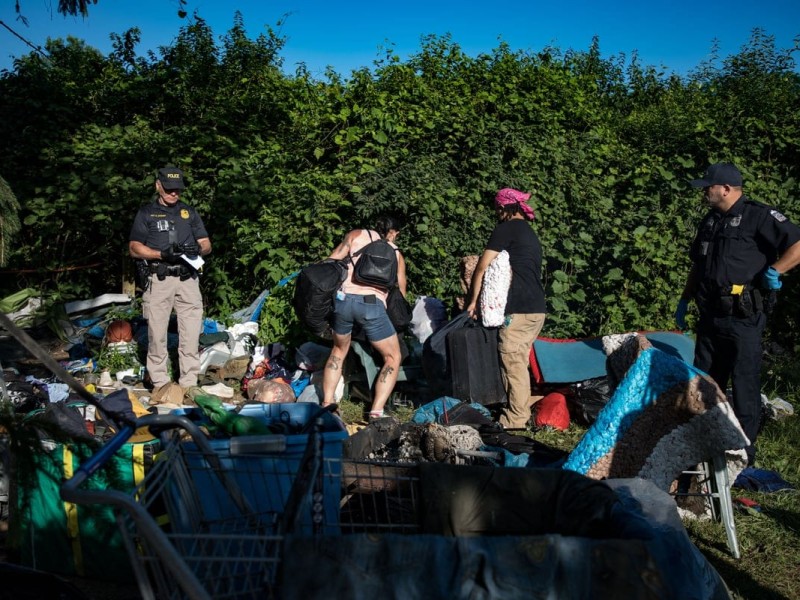
“This population, this group of voters, they have so much already on their plate, from wondering where that next meal is coming from to trying to find employment,” said Collin Marozzi, deputy director of policy for the ACLU of Ohio. “[The voter purge] is not something designed for that population. As a result, they’re often the first ones cut out of the process, and then, troublingly, the last ones brought back in.”
Marozzi allowed that federal law requires the Secretary of State’s office to conduct maintenance on the Ohio’s voter registration list, updating the rolls to remove voters who died or moved away. But he also argued that the current system in Ohio has “serious design flaws,” which, if corrected, could prevent eligible voters from being incorrectly purged.
“We are not taking advantage of opportunities to catch these people before they even go on the inactive list,” Marozzi said. “When people do change residences, it would be very easy for the state to track that through a number of means. For instance, when people go to the BMV and update their license, we could be updating their voter registration forms in real time. Unfortunately, there’s not much appetite in the General Assembly to help voters stay active and stay engaged, which is not surprising to anyone who’s paid attention [to the legislature] over the last few years. Everything dealing with voting coming out of the General Assembly is trying to make it harder, trying to make it illegal. And in the ACLU’s opinion, that’s not what our government should be doing. We should be doing anything and everything to encourage and facilitate participation in our democratic process.”
Limitations on voting in Ohio, including a voter ID law that currently stands as one of the strictest in the nation, have been pushed by Republicans and driven by false claims of widespread voter fraud. In reality, prosecutors have reported just 18 incidents that resulted in voter fraud charges out of more than 14.7 million ballots cast since LaRose took office, according to Ohio Capital Journal reporting. “I really think we started a whole new chapter of this post-2020, when former President Donald Trump was making very serious false accusations about the accuracy of that election,” Marozzi said. “And that rhetoric is still being used. And it makes people think our elections are not safe and they’re not secure and they’re not accurate. When we know for a fact that they are.”
To register to vote in Ohio, residents currently must provide valid photo identification, be it a driver’s license, a State of Ohio ID card, a passport, or a U.S. military ID. But for a person experiencing homelessness, even obtaining photo identification can be a fraught process, requiring an individual to access birth certificates and social security cards that might not exist at arm’s length and can take months to obtain.
In a series of late May interviews, unhoused individuals participating in a pilot program run by Community Shelter Board described the challenges involved in obtaining photo identification. One person described months-long delays in accessing a copy of an out-of-state birth certificate, while another shared how they had recently visited the Ohio BMV with two pieces of mail and a social security card in hand, only to be denied a copy of their photo ID when they learned they had a warrant block stemming from an unpaid $137 parking ticket.
Even those who had successfully obtained identification expressed concern about what might happen if their ID was lost or stolen. “Once that ID is gone, you’re fighting tooth and nail to get it back,” one resident said. “And then it’s over. And you can’t get a job, and you can’t get this, or you can’t do that. And that scares me to no end.”
A number of local shelters provide resources to help those experiencing homelessness register to vote. Representatives for the Faith Mission on Eighth Avenue and the YMCA-operated shelter on Van Buren both said the ACLU would be conducting on-site informational sessions in the coming months designed to register unhoused voters (the deadline to register for the 2024 election is Oct. 7). And Mike Premo, executive director of Community Development for All People, said voter registration and education remain key ongoing planks in the South Side nonprofit’s platform.
“We do voter registration year round, and when someone comes through our ID program to get their birth certificates or ID cards, we offer them an opportunity to register to vote,” Premo said. “Voting is the one time when everybody, whether you’re the President of the United States or you slept on the street last night, has an equal amount of power. We each get one vote. … And any time you pass laws that make it harder for people to do anything, those laws disproportionately impact people who are struggling with homelessness or poverty. So, when they pass laws making it harder for people to vote, they’re saying, ‘This is a group of people we don’t want to be able to participate in the franchise.’ They don’t want the unhoused to have the same voice as everybody else. And it works, right? It works for their aims, which are to make it harder for these folks to vote or to have them give up on the idea of voting altogether.”
Even when an unhoused person has a stable address where they can receive email, Premo said, it’s still not a certainty that they will be in a position to access it in a timely manner. As a result, some people experiencing homelessness might never receive mailings meant to inform them that their voter registration is in danger of lapsing. Additionally, a majority of those who register to vote via mailing addresses at local shelters are unlikely to remain at the facilities long-term, and they’ve often moved on by the time any notices are sent. Yolanda Jackson, director of supportive services at Faith Mission, said the “sweet spot’ in which a resident remains at the shelter on Eighth Avenue generally falls somewhere in the range of 75 to 85 days.
“When you’re living on the land, you have bigger priorities than figuring out how to register to vote, figuring out where your polling place is, figuring out who the candidates are,” Premo said. “So, if you were on the rolls, and you woke up and said, ‘You know what? I should vote.’ And then you show up and learn you can’t, and that you’ve been purged, well, that’s just another hit that folks experiencing poverty and homelessness take from a system that keeps hitting them.”
But Premo and Jackson both expressed similar views that voting, as a practice, can have an impact on the unhoused that surpasses any legislation or candidate for whom the individual might cast a ballot.
“It’s always affirming and empowering for them to hear, yes, you have a voice, and we see you as a citizen and as someone who might be going through a hard time but that is going to get back on their feet,” Jackson said. “A lot of these individuals have been so beaten down and told so many bad things about themselves. If we can empower them to vote and to make their voice heard, maybe there’s a layer of trauma they can peel off to say, ‘I did this.’”
Author

Related Articles

Columbus refugee detained by ICE in April faces imminent deportation
Days before Mohan Karki was set to appear in federal court, his attorneys learned that U.S. authorities plan to deport the Ohio resident to Bhutan on Tuesday, Dec. 2. Emergency appeals have since been filed, while attorneys and advocates work to see if Karki will be able to meet with his wife and his 5-month-old daughter, whom he has yet to hold.
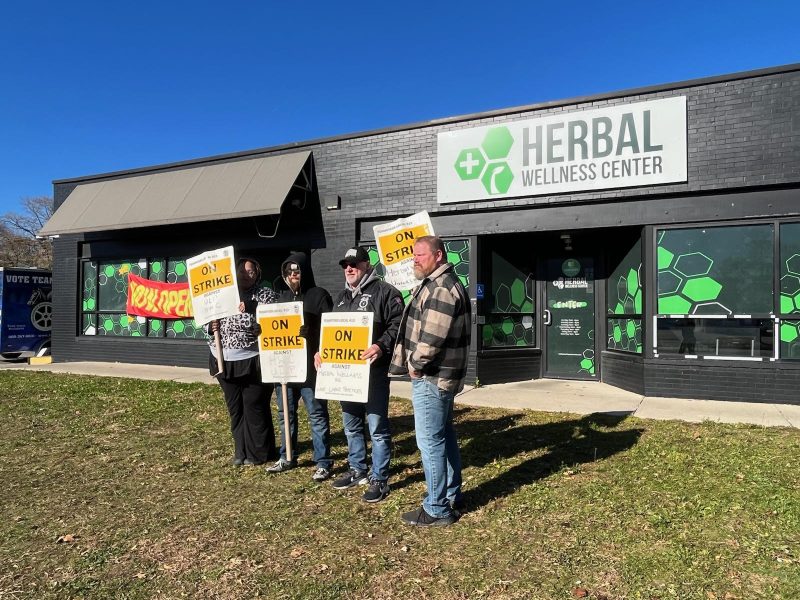
The Worker’s View: Herbal Wellness Center employees strike for change
Staffers at the East Main Street shop are currently engaged in the longest cannabis worker strike in U.S. history.

Local Politics: Accountability can’t exist without transparency
Columbus City Council’s failure to discuss the allegations against Emmanuel Remy until after November’s election reads as a deliberate decision to protect those in power while keeping residents in the dark.