
The right-wing campaign targeting Somali daycares isn’t really about fraud
‘It’s a very coordinated propaganda campaign to demonize and dehumanize really small groups and to justify violence.’
In late December, right wing streamer Nick Shirley posted a video online claiming widespread financial fraud by Somali-operated childcare centers in Minnesota. The claims, refuted by state officials, immediately drew attention and support from a wide swath of right-wing media outlets, as well as Republican politicians including Vice President JD Vance, who wrote on X that Shirley had “done far more useful journalism than any of the winners of the 2024 [Pulitzer Prize].”
A week after the video surfaced, the Star Tribune visited the daycares that appeared in the clip, four of which allowed access to their facilities where reporters witnessed children in attendance, contrary to Shirley’s claims that the buildings were empty. “I don’t like the idea of people coming from out of town, coming into our neighborhood and making assumptions without talking to people and getting the facts,” Kevin Brown, who owns a business next door to one of the targeted Minnesota daycares, told the newspaper. “That’s the definition of fake news.”
And yet, the viral nature of the video has since spawned a series of copycats, including in Columbus, which is home to an estimated 60,000 Somali American residents – the second largest Somali population in the United States behind Minnesota.
A donation powers the future of local, independent news in Columbus.
Support Matter News
Extremism expert Kate Ross compared the current daycare fraud outrage with previous right-wing campaigns targeting trans people and Haitian immigrants in nearby Springfield, Ohio, who were accused of eating pets in a smear so pervasive that President Donald Trump repeated the false claims during a presidential debate in September 2024.
“I think of it much like the trans panic, where they’re picking on a very small group,” said Ross, who noted there are only about 280,000 people of Somali descent living in the United States, the majority of whom are citizens. “And then they create this digital lynch mob, where they’re sending in these provocateurs and infiltrators and agitators. … It’s a very coordinated propaganda campaign to demonize and dehumanize really small groups and to justify violence. And then if you question the narrative, they’re like, ‘What, you don’t care about fraud?’”
Ross noted that the campaign has roots in how Somalis have frequently been portrayed by the media, which has focused on instances of piracy while downplaying the domestic and international factors that have at times driven the practice, fueling a false narrative that criminal elements somehow dominate the country. “We always take people from Somalia, places that are a disaster, right? Filthy, dirty, disgusting, ridden with crime,” Trump said last month as he addressed supporters in Pennsylvania. “The only thing they’re good at is going after ships.”
“It’s old, gutter racism,” Ross said. “And they’re using it to carry out ethnic cleansing.”
On Jan. 13 – the day after Ross spoke with Matter News – Trump revoked temporary protected status for Somalis living in the United States, issuing a March 17 deadline for the roughly 1,100 impacted immigrants to leave the country. (In sharing the news on X, the Department of Homeland Security captioned a photo of Trump with the phrase “I am the captain now” – a frequently memed line spoken by a Somali pirate in the 2013 film “Captain Phillips.”)
Gov. DeWine, for his part, has repeatedly defended the systems already in place within the state to deter financial fraud, while also debunking claims spread online that a Somali-run nonprofit had registered 40 daycare providers on the same day, as reported by the Columbus Dispatch. “There has been some connection I’ve seen on social media from people who say, ‘Well, there’s a lot of [Somalis] in Ohio, too. There are [Somalis] in Minnesota. Therefore, Ohio probably has a huge problem,'” DeWine said in an early January press conference. “I don’t think that’s fair.”
DeWine’s stance hasn’t deterred would-be influencers from trying to capitalize on the issue within the state. In late December, one user on X created a since-deleted thread, screen shots of which were preserved by Matter News, in which they accused a number of Columbus-area daycare centers of perpetrating fraud, including 161 Child Care, the site of which they said was actually a vape shop, citing as evidence an outdated Google Maps photograph. In a subsequent post, DeWine wrote that the building hadn’t operated as a smoke shop since 2022, and that 161 Child Care, which opened earlier last year, had not yet received any public money.
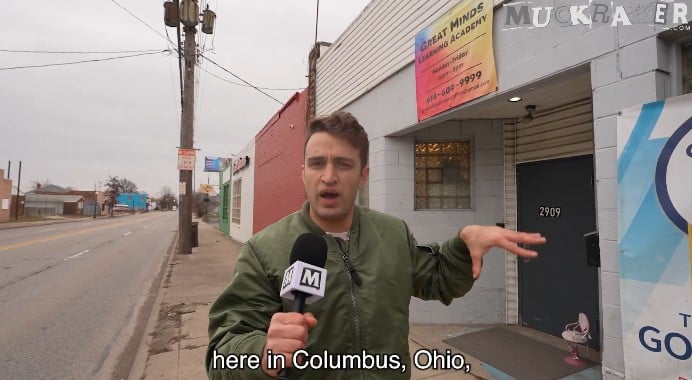
The same week, Anthony Rubin, founder of the Florida-based website Muckraker.com, posted a video filmed in front of Great Minds Learning Academy in which he attempted to access the facility to speak with the operators and verify the presence of children. “We’re not sure what the hell is going on here,” he says standing in front of a locked door. (“I want to make it clear right off the bat … I’m alleging no fraud,” Rubin said in an interview with WOSU that took place less than a week after he posted his video to X under the bolded header “FIRST SIGNS OF MASSIVE POTENTIAL SOMALI FRAUD IN COLUMBUS, OHIO.”)
Then in early January, the former professional baseball player John Rocker, accompanied by Jack Windsor of the Ohio Press Network, spent a day filming his interactions outside of a number of Somali-run childcare centers, later claiming on X that “THERE ARE NO FUCKING KIDS AT THE DAYCARES” when operators at the facilities either ignored their presence or refused to grant entry. (Windsor did not respond to an email sent via the public address posted on the Ohio Press Network website.)
Jason Russell, a former police officer and Secret Service agent who 13 years ago founded Secure Environment Consultants, which partners with childcare centers and schools nationwide to provide security needs assessments, described the idea that daycares would grant outsiders access to the children as “ridiculous.”
“With our centers, we always recommend that you don’t allow drop-in tours, where someone just walks in off the street,” he said. “So, I think the idea that these people would show up, knock on the door, and expect to be let in is pretty ridiculous, and, quite frankly, causes a significant security concern for the childcares. Every childcare we work with – and we work with thousands of them – we always stress that they need to have a solid visitor management policy … so they can control who gets in and to make sure they know who’s actually in their facilities.”
Russell also deflected concerns expressed by those video creators who suggested daycare facilities that blocked out their street-level windows were somehow engaged in a form of coverup. “You don’t want your kids in a fishbowl when they’re in a childcare, for a variety of reasons. There are kids in diapers and changing tables and restrooms where the caregivers have to have a line of sight,” he said. “With our clients, we would expect that they would restrict, or make attempts to restrict, vision from the outside.
Dr. Frank Sheboy, a former educator and superintendent who now advises with the School Liability Expert Group, said that it would be “negligent” for any daycare to allow access to outside visitors, particularly in this day and age. “The verification of individuals entering your facility is a very serious matter,” said Sheboy, who advised that any concerns related to financial fraud at childcare facilities instead be referred to the proper authorities. “In my experience, it has been better to allow the individuals who are trained in doing investigations to do those investigations rather than someone who is untrained.”
Case in point: In a video clip posted last week to the Columbus Reddit, Jack Windsor can be seen ringing the bell outside of a local daycare and then retreating to the background as former MLB reliever John Rocker steps to the door to audition bits from the Chris Farley film “Tommy Boy” (“Hello? Housekeeping.”) and crack racist jokes (“They can’t chuck a spear through this thing, can they?” he muses while pointing at the entrance, and then adds, “I shouldn’t have said that.”) – comments that play as cringe-worthy attempts to create a viral moment and undercut the seriousness with which the two claimed to have undertaken the venture.
“I think [social media] platforms are to blame, in large part, because they monetize clicks, they monetize outrage,” said Kurt Gray, a psychology professor at Ohio State University who studies morality in politics. “So, you can build this entire life, save for your 401k, by generating this content and getting people outraged, even if it’s at the expense of immigrants trying to do their best in life and in Columbus.”
Kate Ross said one effective way to combat the presence of these influencers is for the targeted parties to simply not engage with them, denying the viral moments that can drive traffic and increase monetization opportunities. Ross also recommended that the impacted childcare centers play Disney music over loudspeakers when approached by camera-toting outsiders, noting the speed with which Disney attorneys typically issue copyright take-down notices.
More difficult is the Sisyphaen task of shifting the narrative that has started to solidify around Somali immigrants over the last few weeks, particularly within the right-wing sphere, which is already populated by millions of people who in the face of overwhelming evidence continue to believe falsehoods about elections and vaccines.
“It’s really a thorny problem,” Gray said. “And I think it’s widespread because of these platforms, and because society creates space for these … folks who are doing it for clicks and money, and who don’t care about the damage they’re doing.”
Author

Related Articles

Meet the Columbus Black-Owned Bookstore Collective
Tracy Ramey of Tastes & Tomes will join fellow collective members Barbara Bailey (Eqstesi by B.E.E.) and Megan Turner (Rooted Books) in a panel discussion at Zora’s House from 6-8 p.m. on Tuesday, April 7, as part of the inaugural National Black Bookstore Day.
On Development: Developing better health care and hospitals
Despite the hospital construction projects all over the state, residents across most of Ohio are no closer to health care – and many are even further removed from hospitals.

Local Politics: Proposed trade partnership with Israel draws criticism
A bill to create an Ohio-Israel trade partnership is under review in the State Senate. Reactions in the city have been mixed at best.