
Ajanaé Dawkins addresses heavy questions in ‘No One Teaches Us How to Be Daughters’
The artist and poet, whose new exhibit is currently on view at Urban Arts Space, will also host a poetry workshop at the downtown gallery on Friday, July 26.

Around 2016, Ajanaé Dawkins sat down and recorded an interview with her great grandmother as the elder neared the end of her life.
“I knew she was dying. She had lung cancer and another form of cancer, so her time was limited,” Dawkins said in late July at Urban Arts Space, where her debut exhibition, “No One Teaches Us How to Be Daughters,” will remain on view through August 3. “So, I sat with her … in the rehabilitation center and asked her a lot of questions.”
The conversation, during which Dawkins’ great grandmother reflected on her early life and dished out nursing home gossip, sparked what has evolved into an ongoing project for Dawkins, in which she continues to document and interrogate her family history as one means of working toward a better understanding of herself.
A donation powers the future of local, independent news in Columbus.
Support Matter News
Four years ago, as part of this process, Dawkins brainstormed a series of questions that she wished she could ask all of the women in her family, dead or alive, including: What is your legacy? What is your testimony? Where do Black girls go when they go missing? And tell me about the first time you fell in love.
In a sense, “No One Teaches Us” reflects Dawkins’ attempts to answer these questions for herself, combining poetry, photography, collage, archival footage, legal documents, interactive displays, short film, spoken word and more – all of which have deep personal ties to the artist. One collage, for example, superimposes photographs of Dawkins and a trio of female relatives, including her Aunt Ruth, her grandmother and her mother, atop the oldest legal document she could locate related to her family – a will drafted in 1898.
In exploring the idea of lineage and what traits get passed down from one generation to the next, Dawkins said she was struck by the similarities that emerged. “I found out at one point that one of my great grandmothers wrote poetry and it was like, ‘Nobody was going to tell me that?’” said Dawkins, a poet by trade who traced her early love of language through her bloodlines (her father, for one, was a poet, a hip-hop artist and a pastor). “And I’m my grandmother’s twin. … She’s ambitious. She’s outgoing. She’s very worrisome, a little neurotic. And she loves to be surrounded by other people, and in particular Black women. She’s pretty much built a life where in almost every part of her existence she’s surrounded by or integrated with Black women.”
This idea of sisterhood resonates in another of Dawkins’ installations, which includes photos of Black women dangling from the ceiling like mobiles and two large-scale prints of the artist with one of her best friends, the artist and poet Brittany Rogers. Adding to the resonance, visitors can listen to an audio interview with a woman who survived an encounter with a serial killer. “And she’s talking about all of the women who died. And in all of the newspapers where the women were discussed, they were being referred to as crack addicts and prostitutes and maybe sometimes the more politically correct term sex workers,” Dawkins said. “But when they asked [this survivor] about her testimony, she said. ‘Oh, I’m here for my sisters.’ And it was the only point where somebody who wasn’t a family member … spoke about the women with any kind of tenderness. And the audio is a small reflection on that, and after she says it, it just repeats over and over: ‘My sisters, my sisters, my sisters…’”
Another emotionally heavy display featured in the exhibit emerged from Dawkins revisiting the question about where Black girls go when they go missing, which has its roots in real-life experiences (Dawkins has a family member who vanished) but also touches on the more metaphysical ways someone can lose themselves, whether a person’s sense of self is subsumed by marriage and/or parenthood, or obscured amid the throes of depression and self-doubt.
In exploring this idea, Dawkins created a series of “missing” posters featuring photographs of the artist taken at different points in her life. Each flier is also printed with a poem in which Dawkins wrangles with the concept of self and includes phone number tabs that direct callers to another recorded poem written at a point in time when Dawkins felt as though she had lost her sense of identity.
“So, in some ways, this wall almost feels like a place of grieving for me, because the poem that the phone number leads to is not where I’m at now,” said Dawkins, who will lead a documentary poetry workshop at Urban Arts on Friday, July 26. “And I grieve for that version of myself. … But I also feel like, without having been in that place, I don’t get to the place I am now, where I feel like I know myself more intimately. … I think there’s a way I’ve settled into myself as I’ve gotten older. I’m more fearless. And I feel I have the capacity to dream bigger.”
Other installations explore Dawkins’ deep, evolving connection with religion (she grew up in Pentecostal church and later attended seminary), as well as her love for Alice Walker’s The Color Purple, which she described as a foundational text in her faith journey. “So much of The Color Purple, for me, is about the main character, Celie, not knowing herself and not having a good idea of who she is or who she could be, owing to her circumstances,” Dawkins said. “And then she regains autonomy and relearns who she is. … And as she’s trying to figure these things out about herself, she moves from writing to God to her sister to the universe, and it just shakes me.”
Though the revelations have been different, Dawkins said she’s had similar breakthroughs in pulling together the various tendrils that make up “No One Teaches Us How to Be Daughters,” the components of which originated individually but take on more deeply layered meaning when placed adjacent to one another within the gallery space.
“I’ve been writing about these things for a long time,” Dawkins said. “And I think it used to be, ‘I’m writing about all the things in the world.’ Now it’s like, dang, that whole time I was just talking about me. … But the more I explore [these ideas], the more centered I feel.”
Author

Related Articles
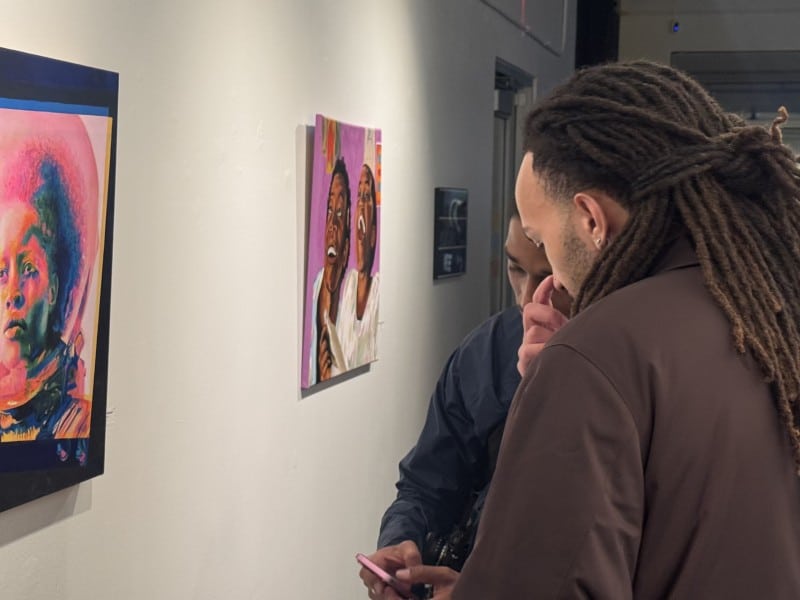
David Butler finds big screen escape in ‘F’Reel’
The Columbus artist curated the new group exhibition, on display at All People Arts through April, in part to create a place of joy and healing coming out of an emotionally heavy time.
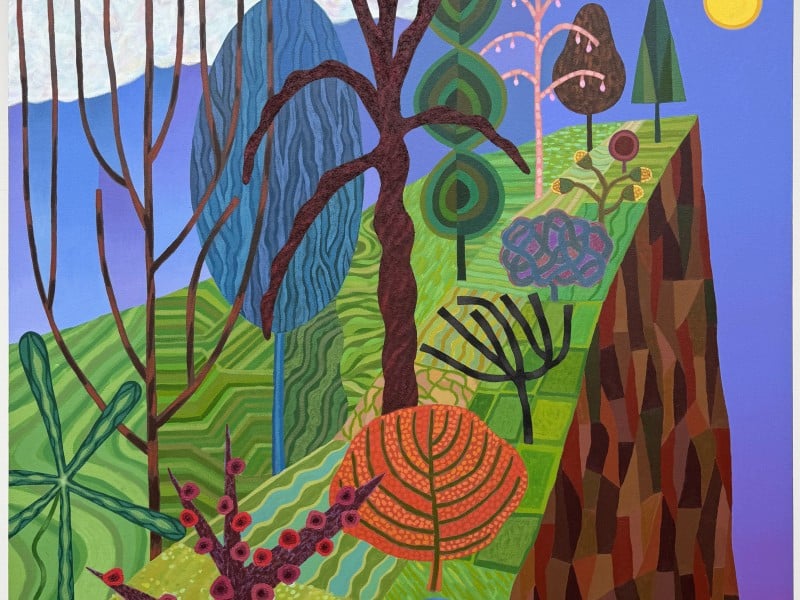
Aaron Troyer brings a colorful cast of characters to life in ‘False Meridian’
The artist’s new duo exhibition with Jolene Powell kicks off with an opening reception at Brandt Gallery tonight (Friday, Feb. 6).
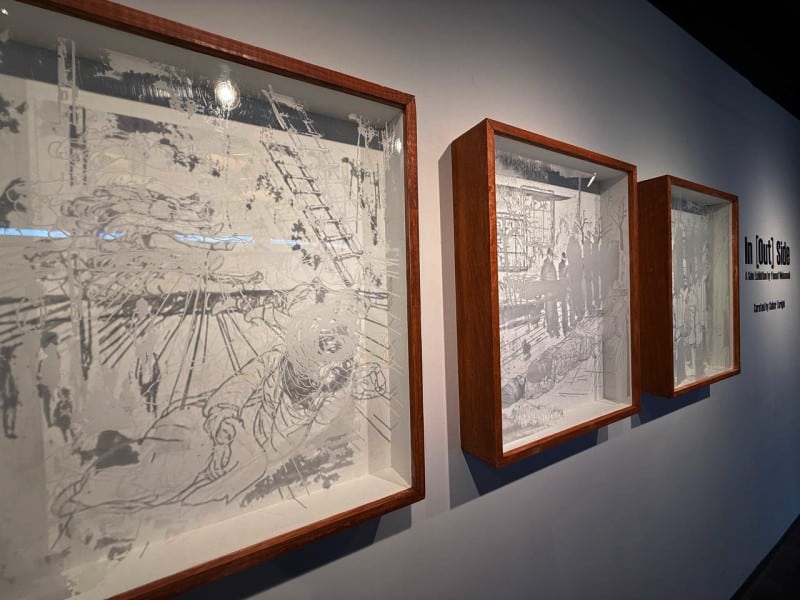
Yoosef Mohamadi preserves a collective memory at Blockfort Gallery
The Kurdish artist’s staggering new exhibition, ‘In(Out)Side,’ will remain on display at the downtown gallery through Feb. 21.