
David Butler finds big screen escape in ‘F’Reel’
The Columbus artist curated the new group exhibition, on display at All People Arts through April, in part to create a place of joy and healing coming out of an emotionally heavy time.
As a child growing up in St. Louis, David Butler would often visit his uncle’s commercial electrician shop, a multipurpose storefront that also housed a space to repair box speakers, a window where people could order ice cream and heat-and-eat foods, and a wall of VHS tapes available for rental.
“In St. Louis, there was a time there where everything was something else. You’d go to a barbershop, and it would also be a car wash and a barbecue spot,” Butler said. “So, my uncle, he had his own type of space. … And as part of it, he had sort of a hood Blockbuster, where you could point at the [movie] you want … and he would rent it out for a few bucks.”
It was in this shop that Butler was first introduced to the 1985 film “The Last Dragon,” which follows the exploits of the martial arts-obsessed Leroy Green, aka Bruce Leeroy. The artist said he has now viewed the movie more than 100 times throughout the years, describing it as a work that has the power to whisk him back to age 6, evaporating any present-day worries.
A donation powers the future of local, independent news in Columbus.
Support Matter News
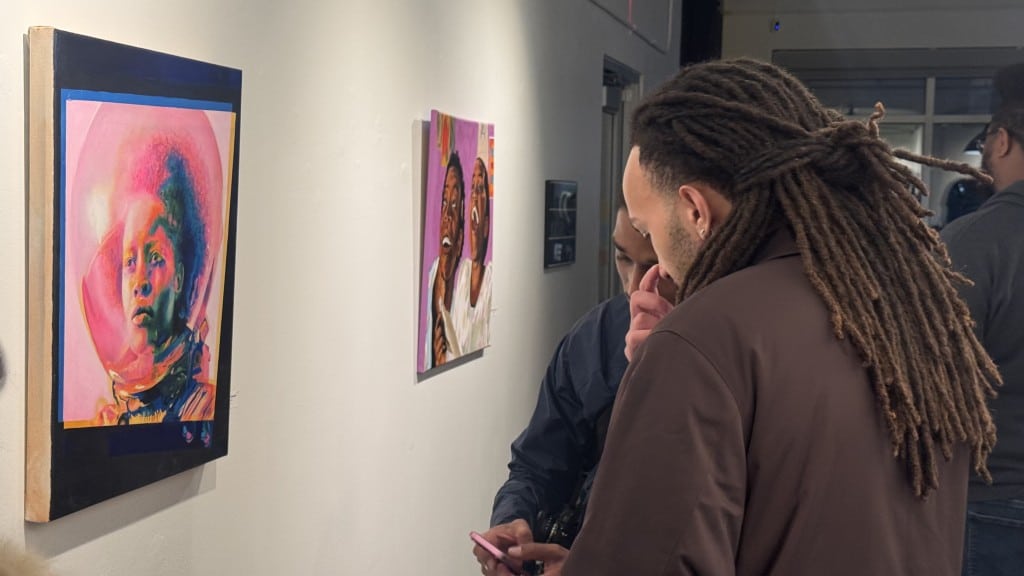
“The soundtrack, as ridiculous as it is, with Leroy doing his form in the opening number, it still makes me happy, and it’s instantaneous even if I’m in the deepest of sadness,” said Butler, who focused on “The Last Dragon” for his contribution to “F’Reel: Reflections of Nostalgia in Black Films,” a group exhibition he curated for All People Arts, and which will remain on display through a closing reception on Friday, April 24. “You feel that nostalgia come through your body, and there’s a healing that happens. And I think that idea is reflected in a lot of the works that are in this show.”
Butler brainstormed the exhibition as a way to give artists the means to approach nostalgia in a more celebratory way, noting that when Black creators are typically asked to look back, these reflections can be tarnished by all manners of trauma. “It’s been proven over and over again that our history is not filled with a lot of joyous things that have happened to us on American soil,” said Butler, who solicited contributions from nearly a dozen artists for the exhibition, including Sidney Renee-Crews, Marshall Shorts, Raeghan Buchanan, and Jasmine Wooten.
Within the space, there are reflective works rooted in “The Color Purple,” a parade of dancing flappers born in part of the time-hopping music scene in “Sinners,” and a trio of paintings inspired by the films of director Robert Townsend, whose movies Butler described as “for us and our family’s experiences.”
“During that time, [Black movies] had to be extremely serious and traumatic or almost minstrelsy-funny, where it was Blackness putting on for whiteness,” the artist continued. “But there’s a more universal language he’s speaking with in a lot of his work.”
The escapism that went hand-in-hand with “F’Reel” arrived at an ideal time for Butler, who navigated a series of losses toward the end of 2025, including the death of his father, whose passing he only recently found the time to begin to mourn. “I needed something to get the endorphins up,” said the artist, who will host a screening of “The Last Dragon” at All People Arts on Wednesday, Feb. 18, in addition to organizing a “Love Jones” poetry night for April 15.
In the weeks before his father’s death, Butler would visit the elder and talk to him, even when he grew so ill that he could no longer respond. He would talk to him about his grandchildren, his plans for the “F’Reel” exhibition, and about his late 2025 trip to Selma, Alabama, where he painted murals alongside students in a city that was central to the Civil Rights movement and has since been all but left behind. “There are historical buildings where you can go on tours, and it’ll be like, ‘This is the church where Martin Luther King said such and such,’ and every building they point to has boarded up windows,” Butler said.
These conversations served for Butler as a reminder that, while he and his father might have differed in their approaches, both moved with a similar destination in mind.
“A lot of what I’m doing in response to grief comes from understanding this is what he would want for me and my family, and he would want to know I’m still engaging with the community in the way that I do,” said Butler, who also has a handful of more explicitly political paintings addressing the scourge of white supremacy on display in the group exhibition “Speaking Our Truths,” which runs through the end of February at Hammond Harkins Gallery. “I know I have a responsibility to continue that kind of work. … But at the same time, I intentionally have to tap into community spaces where I can speak to my people directly and say, ‘Look, I know this is going on over there, but I have a space for joy for us over here.’”
Author

Related Articles
New report recommends cutting GCAC funding to increase the Experience Columbus marketing budget
Under the current model, GCAC receives 29 percent of the funds generated by the hotel/motel tax, which a FRAC report calls for reducing to 0 percent. In return, the share allocated to Experience Columbus would rise from 43 percent to 72 percent.
Shiva Addanki and Nikholis Planck continue the conversation in ‘American Inquisition’
The duo’s exhibition, now on view at No Place Gallery, looks both backward and forward, seeing echoes of this social and political moment in ‘the ruins of history.’
Kasmira Snyder reclaims the night in ‘Untethered’
The new exhibition from the Columbus artist kicks off with an opening reception at Wild Goose tonight (Friday, March 13).