
Emily Morgan and Hannah Maltry rely on instinct for ‘We Did It Wrong’
The two artists will host an opening reception for their exhibition at High Road Gallery & Studios from 6-8 p.m. on Saturday, March 28.
Growing up in Asheville, North Carolina, Hannah Maltry would often find herself swarmed by her two younger sisters and a trio of much younger cousins. And so, as a means of escape, the artist developed the habit of climbing up into the higher branches of trees where she could sit in relative solitude.
“And I would sit in the trees, and they would leave me alone, and I would sit so still and so quiet, trying to be Zen for a moment,” Maltry said. “And I would be up there so still that the birds would come very close, and I always associated them with a happy vibe, which turned into a complete compulsive obsession.”
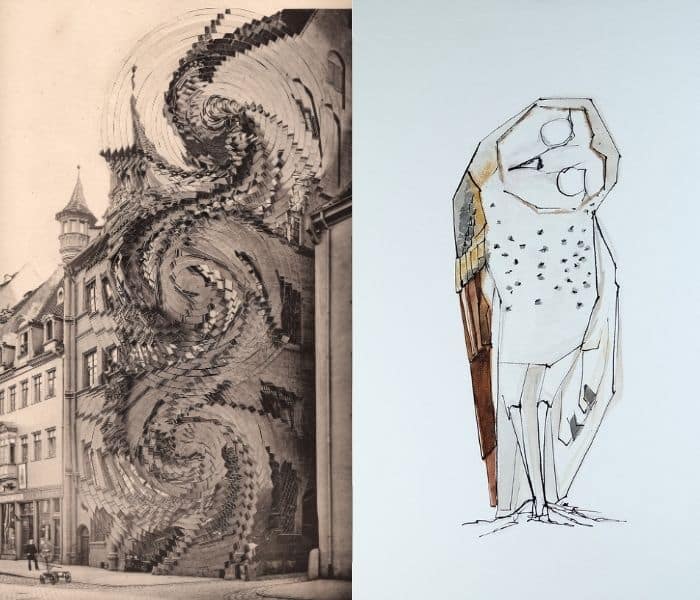
This obsession spills over into “We Did It Wrong,” a duo exhibition with collage artist Emily Morgan now on view at High Road Gallery & Studios, which features dozens of Maltry’s colorful watercolors of birds, stretched from a massive bald eagle to a red-headed woodpecker as delicate and weightless as the paints with which it was brought to life.
A donation powers the future of local, independent news in Columbus.
Support Matter News
In brainstorming the title for the exhibition, Maltry and Morgan met and filled a notebook page with potential ideas that ranged from creepy, more occult-inspired names to comparatively high-minded academic terminology. “It was a complete journey,” Maltry said.
Eventually, though, the two landed on a phrase that each has heard at multiple turns in their respective careers.
“I think we both settled on something we’ve both felt in our own artistic journeys,” said Morgan, who will join Maltry in hosting an opening reception at the Worthington gallery from 6-8 p.m. on Saturday, March 28, “where we have been told that we have done it wrong.”
For Morgan, this applied to both her idiosyncratic early approach to collage making and the more recent pushback she said she received for transforming historical photographs into a series of reality-bending collages. Maltry, in turn, has received criticisms from watercolor purists who have questioned everything from her application of the paints (she avoids the heavy use of blending common to the form) to the surfaces on which she chooses to work. Within the exhibition, for example, Maltry has on display a number of large canvases, the surfaces of which have been treated with a transparent gesso so that the watercolor paints will take.
“And this [bald eagle] was the first one I did like that, and I’m showing him off because I was working on him live at a downtown thing and the president of a local watercolor-based club came over and was asking about it,” said Maltry, whose work also draws influence from the likes of artist Mary Blair as well as the surrealistic, mid-century children’s books she read as a child at her grandmother’s house, including How Fletcher Was Hatched and Miss Information and the Upsy Downsy Circus. “And then he basically told me it didn’t count, because watercolor had to be done on paper. … And that seems really goofy to me.”
Morgan pulls from three different bodies of her work within “We Did It Wrong,” incorporating a handful of her earlier, comparatively traditional collages along with a trio of pieces inspired by M.C. Escher’s “Relativity” that she created blindly by cutting out a series of architectural forms, turning them upside down, and then gluing them into building-like shapes before flipping it over to reveal a finished image. “So, talk about doing it wrong. You’re telling me you’re not even looking at the elements that you’re placing?” Morgan said, and laughed. “How do I want to say this? It’s almost like a psychic practice.”
But the bulk of the collages on display are culled from a series the artist created using vintage photographs cut from the pages of Denkmaler Deutscher Renaissance, a folio of German Renaissance architecture published in 1884 that Morgan found and purchased at the High Street antique store Down Memory Lane. The artist said she approached the first piece in the series as a challenge, hand cutting a series of concentric circles with an X-Acto blade, rotating each ring slightly, and then gluing them back down.
“And it’s really rough, and you can see all the imperfections, and to me, that was almost telling me I had done it wrong,” Morgan said. “But then it sort of became this journey, like, no, I think that’s actually the best part, seeing the imperfections and being able to know a human made it. And that opened the door to this whole conversation about AI, and the perfection of AI, and how there’s this shift in contemporary art that is moving back to wanting to see things that are handmade and wanting to see imperfections and weirdness.”
While the work on display by the respective artists takes radically different forms, at the core there exists a similar drive, with both Morgan and Maltry both embracing their art as a more instinctual practice at odds with the way each tends to move elsewhere in life.
“From the very beginning, [the collages] were always a reaction to my overthinking,” Morgan said. “And that’s something we have in common. I do data analytics in my day job, and I’m overthinking shit constantly. So, when I come home and work with paper, I just want to rely on instinct. This is a practice in instinct.”
Author

Related Articles
Brian Canini takes stock of 25 years in self-publishing
The Columbus comics artist will unpack lessons learned over the last quarter-century in a weekend talk at SPACE.
New report recommends cutting GCAC funding to increase the Experience Columbus marketing budget
Under the current model, GCAC receives 29 percent of the funds generated by the hotel/motel tax, which a FRAC report calls for reducing to 0 percent. In return, the share allocated to Experience Columbus would rise from 43 percent to 72 percent.
Shiva Addanki and Nikholis Planck continue the conversation in ‘American Inquisition’
The duo’s exhibition, now on view at No Place Gallery, looks both backward and forward, seeing echoes of this social and political moment in ‘the ruins of history.’