Gaye Reissland leaves no doubt about the circumstances shaping her work
The Columbus artist, who will take part in Aminah Day at the King Arts Complex this weekend, has taken to writing on the back of each canvas, explaining in detail the circumstances that gave rise to her paintings.
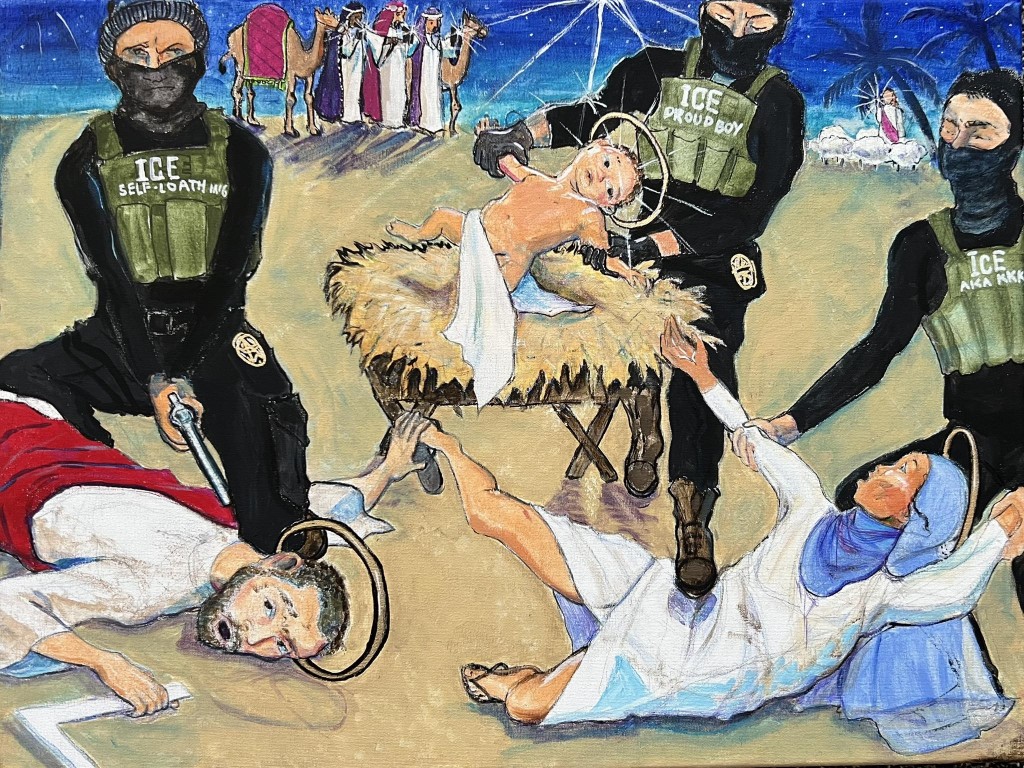
In recent years, artist Gaye Reissland has taken to working on both sides of the canvas, painting vivid scenes frequently rooted in social justice issues on the front, and then reserving space on the back to write about the social and political realities that combined to give shape to the piece.
“I have grandchildren, and I’ve started writing on the backs of my paintings to tell them about what is happening and what spurred me to do the painting, so that they can know the truth from my perspective,” said Reissland, who included one of these messages on the flipside of the recently completed “Unholy Night,” which depicts a trio of U.S. Immigration and Customs Enforcement agents terrorizing the nativity scene, with one pinning Joseph to the ground and holding him at gunpoint while another rips the baby Jesus from the manger. “And what I wrote on the back of that painting has to do with the current administration and the ways they’re treating Black and Brown people in this country, where they’re saying certain humans have rights and others don’t based on how they look or how they sound. … And when someone finds that writing on the back, they’re going to be able to read it and at least know how I was feeling. And that’s what art history does for people. You might know an artist’s name and that it was an oil painting done in 1600-whatever. But did the church commission it? The government? Was there a war going on? What spurred it? And those are the things I want people to understand. And I pray to God that in 25 years people will look at this painting and be like, ‘What even is this? It doesn’t make any sense.’”
“Unholy Night,” which Reissland said is partly inspired by a similar painting from Columbus expat Paul Richmond, began to take shape in December, when her work for a local convent found the artist making Christmas deliveries to immigrant families who were often too afraid to even open the door. “And that’s when it became apparent to me that this is how this administration would have treated Jesus’ family if they were living in the United States today,” said Reissland, a lapsed Catholic who remains disheartened by the way Republican politicians continue to cloak their cruelties in the Bible. “It’s like conservative Christians have never thought about Jesus as an immigrant before, and as a Brown child that lived in Palestine. … Even some of the people I was raised with, I’ve had to block them on Facebook and things. I almost can’t believe we grew up reading the same Bible, taught by the same nuns.”
A donation powers the future of local, independent news in Columbus.
Support Matter News
This steady pull Reissland feels toward social justice was fueled in large part by her early childhood experiences growing up on the South Side and within the since-shuttered Holy Rosary-St. John Church, where she bore witness to the work done by a pair of Dominican Sisters of Peace, who instilled in her the idea that charity should be accompanied by actions that challenge unjust systems. These lessons have frequently been reaffirmed by political realities, with Reissland noting that she was born her parents’ fourth daughter in 1963, not long before the Ku Klux Klan bombed 16th Street Baptist Church in Birmingham, Alabama, killing four young Black girls.
“And I can’t imagine how that impacted my parents; it impacts me now with four granddaughters, you know?” Reissland said. “And when we don’t learn from history, we’re bound to repeat it. And I think that’s what’s happening now.”
Art has always existed as a way for Reissland to process this larger world, and she struggled to recall a time when she didn’t draw or paint, sharing how as a child she used to color on the closet walls in her bedroom where her scribbles would remain safely out of view of her parents. “I wasn’t stupid about it,” she said, and laughed. “But when I’m stressed, when I’m frustrated, art just takes that away.”
Finding a connection within that space proved more challenging, at least early on, with Reissland relaying how she first saw people who resembled her not in museums or art galleries but in photographs of “power to the people” murals adorned with raised Black fists and afroed profiles. In later years, Reissland gravitated toward artists such as Kehinde Wiley, whose paintings pushed back against this erasure, setting Black people within the traditional Old Master settings from which they’d long been denied access.
It didn’t help, of course, that Reissland’s family lived at a remove from the Black art scene that then thrived in the city, their home resting closer to Rickenbacker Air National Guard Base (that artist’s father was in the Air Force) than the Near East Side where the likes of Aminah Robinson, Smoky Brown, and Elijah Pierce lived and worked. “I’m so envious of the people who had relationships with the artists from back then, because they really did have a tendency to take people under their wings,” said Reissland, who is scheduled to take part in Aminah Day, which takes place from 3-6 p.m. at the King Arts Complex on Saturday, Feb. 21.
And yet, Reissland has come to be deeply influenced by these artists, and in particular the late-Robinson whose relentless pull toward creating is one in a number of traits Reissland has come to view as shared by the two. “It almost feels like she could not not do it,” Reissland said. “It was part of her as much as her eyes or her hands or her feet. It was just her. And you feel her still. You feel her spirit.”
Author

Related Articles
Stephanie Rond hopes to kickstart a larger conversation on AI with ‘Pink Waves’
The Columbus artist wants her new exhibition at Chaos Contemporary Craft to be the start of a bigger discussion regarding the divisive technology.
Fifteen years in, Ken Eppstein remains committed to Nix Comics
‘There’s just the improbability of 15 years, and all of the things that have to happen to end up where I am now, doing what I’ve done, and doing what I continue to do.’
No Place Gallery turns 10
‘Between Fields and What Isn’t: A Decade Inside No Place’ will take over a pair of galleries beginning on Thursday, Feb. 12, with an opening reception running from 4-7 p.m. at Beeler Gallery and then continuing at No Place from 7-9 p.m.