
Michelle Herman finds new ways to communicate with ‘If You Say So’
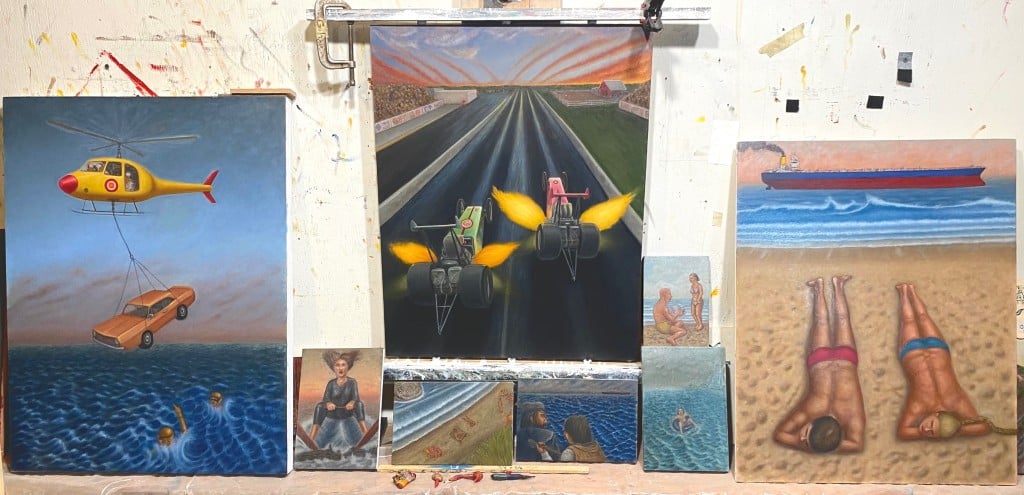
The exhibition, now on display at Urban Arts Space, features paintings by Herman’s husband, Glen Holland, along with a short film and a series of associated events that all extend in some way from the author’s new essay collection, released in March.
Each time Michelle Herman finishes a collection of essays based on her experiences, she believes it to be her last, thinking, she said, “I have nothing more I can possibly say about my life.” She then returns inevitably to fiction writing, which served as her primary outlet in the years after she first picked up a pen at age 7.
Recalling her time teaching creative writing at Ohio State, Herman said she viewed creative nonfiction with a jaundiced eye, questioning students who wrote directly about their experiences rather than adapting these events into potentially grander works of fiction.
“I asked, very genuinely, why they would take that material and waste it on true stories when they could be mining it and rearranging it for fiction,” Herman said in early June at Urban Arts Space, where the multi-arts exhibition “If You Say So,” which also features the work of Herman’s husband, the painter Glen Holland, opened earlier this week. (An opening reception takes place at 6 p.m. on Friday, June 20.) “And I never understood it until I did it myself. And I remember when I wrote my first essay, a poet friend said, ‘It’s amazing it took you this long to find this genre,’ because, by nature, it’s such an expansive and digressive genre, and it’s big enough that it can incorporate so many different kinds of things.”
A donation powers the future of local, independent news in Columbus.
Support Matter News
In some ways, the exhibition serves as a visual representation of the divide that exists between Herman’s fiction work and her collections of nonfiction essays, with the gallery split between oil still lifes that Holland completed earlier in his career and more recent pieces done in egg tempera – a change in medium driven by tremors Holland began to experience in 2009, and which toxicologists eventually traced to years of exposure to the mineral spirits present in oil paints.
This discovery triggered a series of crises for Holland, who stopped painting for a time, returning to it after discovering egg tempera. “And so, he would order pigments from Germany, and then he started each day by cracking an egg,” Herman said. “And for a while after that, he continued making still lifes, but he wasn’t happy, because he couldn’t get those vibrant colors. So, another crisis, and then he began making cartoons, which was something he’d always done for relaxation. … And the first ones he felt good about, those are the ones you see in the first gallery there.”
These paintings are comparatively wild and free, combining comic book panels and still life in a way that’s reflective of Herman’s anything-goes approach to essay writing. Also included in the exhibition and further strengthening this link is a short film capturing a dance performance choreographed by Russell Lepley of Flux Flow in which the participants (including Herman) are armed with spatula swords and hold pots and pans as shields in a scene that the author said could have been lifted from one of Holland’s newer paintings.
And yet, Herman said she didn’t initially see Holland’s recent works inhabiting the same universe as her latest essay collection, If You Say So, released in March and the basis for the gallery show at Urban Arts Space, crediting a conversation with her editor for helping her connect the dots. “And that was the first time I thought, ‘Oh, yeah. These paintings and these essays really speak to each other,’” she said. “And of course they do. Glen and I have been living and working alongside one another since 1992. And when he was still making still lifes, people would comment that they reminded them of my fiction, because there was this painstakingness and a sense of another time. They were both these glowing little objects. And now, we’ve both evolved.”
If You Say So arrived via a confluence of seemingly unrelated events, rooted in a series of essays Herman penned in the wake of her father’s 2014 death and her decision to take up ballet three years later at age 62. This experience led to a January 2020 Slate essay in which Herman unpacked her later-in-life dance pivot, the viral success of which led a colleague to suggest she expand the idea into a book.
“So, I actually worked on a proposal, but quickly realized I didn’t have enough for a book about dance,” said Herman, who experienced one in a series of breakthroughs when the Covid pandemic hit and ushered in a stretch in which we collectively mourned as a society – for the lives lost to the virus, for the human connections severed, for a way of life that in that moment felt as though it were slipping away, perhaps for good. “And I can’t tell you at what point it occurred, but there was a convergence between the essays I had been writing about my father and the dance essays. And I think one of the reasons I was so susceptible to that first ballet class is because I was processing a line of grief.”
These ideas coalesced in an essay that Herman wrote after she believed the book to be done, in which she processed the death of one of her fellow dancers, a person with whom she had lived in community throughout the pandemic, gathering first on Zoom and later for weekly masked and distanced rehearsals outside at Whetstone Park. “And in that, I did the opposite of what one does,” Herman said. “You’re supposed to write an emotion recollected in tranquility. But writing in the midst of her death and the aftermath of her death, I wrote a long essay about her that I didn’t even realize as I was writing it was the end of the book. And I normally don’t write this way, but I wrote in this rush of emotions and sent it to my editor, and he said, ‘Every single thread from the book comes together in this.’ … And I was very much just following my nose, and when I started writing about my friend, I didn’t realize it was going to end up being about my father and her father and my dog and death itself, and that it would eventually come back to the dance studio, because that’s where we met.”
This clash of seemingly unrelated yet entirely connected ideas is reflected in the construction of “If You Say So,” a multi-arts exhibition featuring paintings and a short film, sure, but also dance parties, author panels, beginner ballet classes, book club discussions, and a closing performance from Holland’s band, Bottleflies. (A full schedule of events can be found here.)
In this way, the gallery show has come to reflect the couple’s life, encompassing both joy and grief, but also conveying the essential work of finding new, art-forward ways to share those lessons absorbed along the way. “I’m never thinking about where something is going to end up or the form it might take,” Herman said, “but it’s always about communicating something.”
Author

Related Articles
New report recommends cutting GCAC funding to increase the Experience Columbus marketing budget
Under the current model, GCAC receives 29 percent of the funds generated by the hotel/motel tax, which a FRAC report calls for reducing to 0 percent. In return, the share allocated to Experience Columbus would rise from 43 percent to 72 percent.
Shiva Addanki and Nikholis Planck continue the conversation in ‘American Inquisition’
The duo’s exhibition, now on view at No Place Gallery, looks both backward and forward, seeing echoes of this social and political moment in ‘the ruins of history.’
Kasmira Snyder reclaims the night in ‘Untethered’
The new exhibition from the Columbus artist kicks off with an opening reception at Wild Goose tonight (Friday, March 13).