
Peter Megert’s design work, deep humanity feature in career-spanning new exhibit
The longtime Ohio State design professor, who died in 2022, is the center of a new retrospective at Hopkins Hall Gallery, which also features ceramic pieces crafted by his wife and creative partner, Ursula.
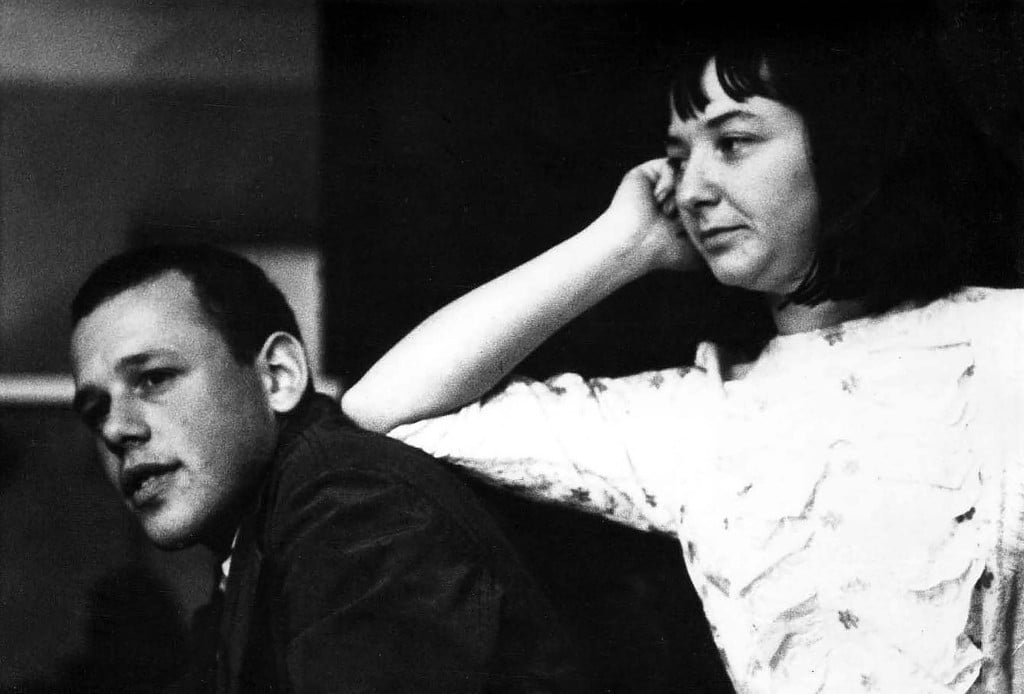
A month after Peter Megert died at age 85 in June 2022, Oscar Fernandez, an associate professor in the School of Design at the University of Cincinnati, scheduled a call with colleagues across the globe, determined to honor Megert’s lifelong work in service to the field of design.
This initial call birthed an informal collective that dubbed itself the Megert Legacy Group, and whose members were granted access to the full archives belonging to the late designer to create a career-spanning memorial exhibit that opened this week at Hopkins Hall Gallery at Ohio State University. (Megert served as a professor in OSU’s Department of Design for 15 years, retiring from the position in 1985.)
Fernandez, joined for a recent interview by Axel Roesler, an adjunct professor in the Department of Human Centered Design & Engineering at the University of Washington, described the process of creating the exhibit as one of continual surprise.
A donation powers the future of local, independent news in Columbus.
Support Matter News
“When we began informally archiving Peter’s work, it was an experience of discovery every day,” Fernandez said. “I mean, I never knew this guy did this and he did that, and I was just blown away. But that’s just who he was. He didn’t promote himself, but he did beautiful work.”
In assembling the exhibition, Fernandez said he allowed the concept to shift and evolve as new discoveries surfaced, with the various turning points in Megert’s career emerging to provide natural chapter breaks, of sorts, that helped to give the display some definition.
Born and raised in Bern, Switzerland, Megert first studied design at the Kunstgewerbeschule, later emigrating to the United States in the late 1960s after confirming he would not be conscripted into the Vietnam War draft upon arrival. Once in the U.S., he moved to Pittsburgh, where he was hand-picked by Paul Rand for a design role at Westinghouse. At Westinghouse, Megert worked alongside industrial designers, graphic designers and engineers, sharpening and honing his already ample skillset. The position also afforded him opportunities to design at scale, Roesler said, with Megert creating the “W” sign that stood in front of Westinghouse tower.
“And when I first heard the story, I thought, ‘Oh, okay, he came to Westinghouse, and he learned so much and developed all of these skills.’ … But on the contrary, Peter was already prepared, and Westinghouse got the benefit of his talent, his knowledge, his experience,” Fernandez said. “But the narrative for this [exhibit] just started coming into focus, and it started to define itself as we went through the artifacts. So, you had the Westinghouse period. And then eventually you had the Ohio State period, where he was teaching. … And then you have the time when he went back to being a private practitioner in his last studio, Visual Syntax.”
Megert’s presence at OSU proved transformational, with Roesler describing the university’s design program as more “craft oriented” prior to his arrival. “Ohio State’s graphic design program, at the time, was a little more traditional, a little bit decorative,” Roesler said. “And Peter comes in and brings this entire European-Swiss graphic approach, further deepened by his experience at Westinghouse, where he had the chance to work with Charles Eames, Louis Kahn and also Paul Rand himself.”
More than any aspect of Megert’s resume, though, the curators were consistently struck by the influence shared between Peter and his longtime wife Ursula, who he met while attending art school in Bern. Roesler, for one, described the two as opposites “who melted together,” with Peter, the more composed city boy, naturally compelled toward Ursula, the more free-spirited country girl. “Ursula is not as structural and systematic and minimal as Peter,” Roesler said. “And I think that was very present in their house, where you’d have … Marcel Breuer chairs next to this George Nelson shelf, very clean. And then her pottery was on the shelf. So, it was this mix of life and design coming together.”
While their artistic practices were often reflective of their individual personalities – the composed lines of Peter’s designs standing in contrast to the hand-molded ceramic works created by Ursula – there was an inevitable bleed that existed between the two that reveals itself throughout the exhibit, which also includes a number of pieces crafted by Ursula. And both Roesler and Fernandez said that Peter’s work often contained a sense of humor and a deep humanity that served to round the corners of his designs, in essence.
This deadpan humor exhibited itself in Megert’s classroom – he could let the air out of a pressure-filled room with a single joke – as well as in his day-to-day life. The first time Roesler went out to dinner with Megert, for instance, he met Peter and Ursula at their house. When it was time to leave, the designer said, “Ursula, are we going to take the Porsche or the jeep?” (The Megerts didn’t own a Porsche.)
“The systematic approach, the minimalism, the modernism, it can turn you into a robot very quickly if you’re not careful. And I think Peter did it as a human being, as a person with a big heart,” Roesler said. “And that was very much Ursula’s spirit. Ursula, she was wise, and she didn’t have a filter and would just say it how it is. … And she was deeply, genuinely invested in people. And she would always help others.”
“He certainly worked in that well-known international style, but Peter’s designs were warmer, and the corners had been rounded off a little bit,” Fernandez said. “Peter never hid his humanity, and you could see it in his work.”
Author

Related Articles
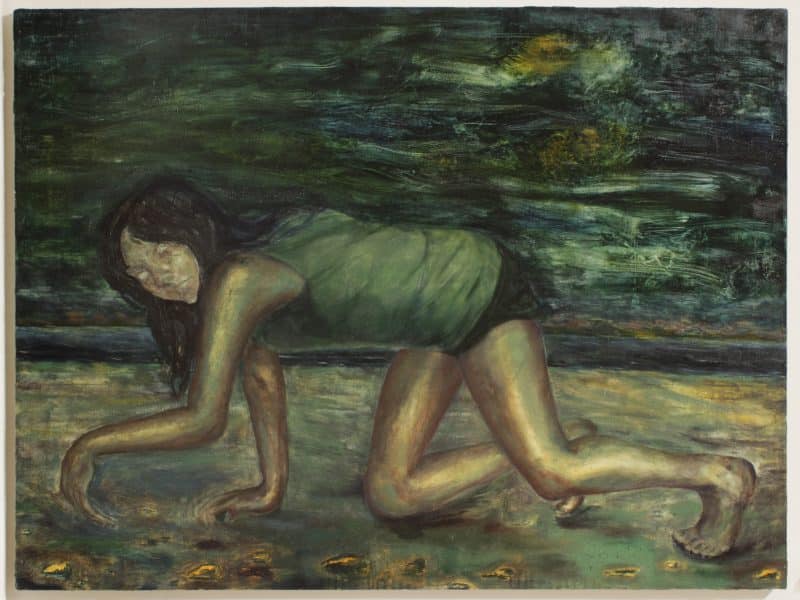
Kasmira Snyder reclaims the night in ‘Untethered’
The new exhibition from the Columbus artist kicks off with an opening reception at Wild Goose tonight (Friday, March 13).
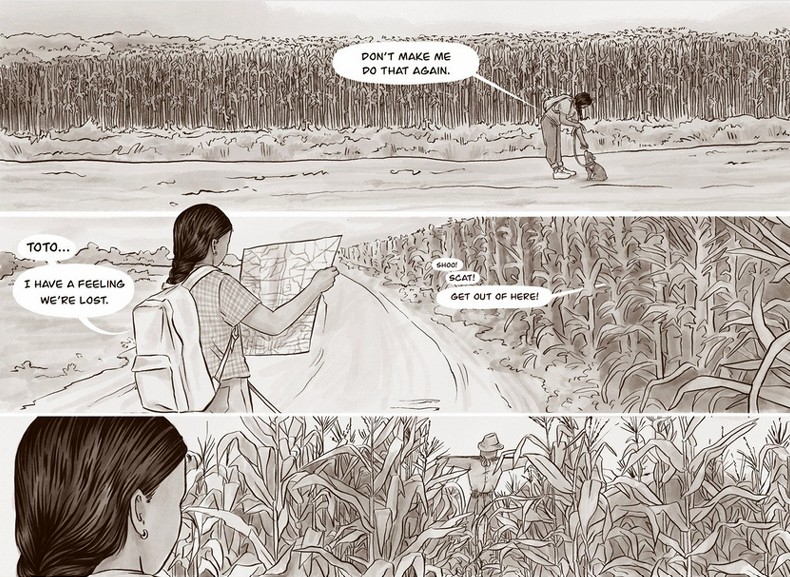
Angelo Thomas finds blue skies on the other end of the rainbow in ‘Somewhere…’
The filmmaker will join artist Rebecca Butterworth in celebrating the release of their new ‘Wizard of Oz’-inspired comic at Laughing Ogre from noon-2 p.m. on Saturday, March 14.
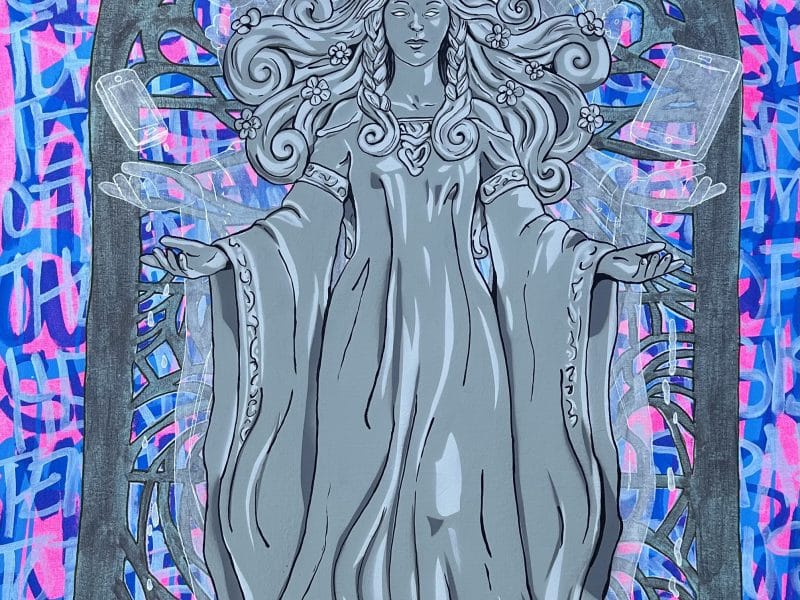
Stephanie Rond hopes to kickstart a larger conversation on AI with ‘Pink Waves’
The Columbus artist wants her new exhibition at Chaos Contemporary Craft to be the start of a bigger discussion regarding the divisive technology.