
Sahar Tarighi takes a more intimate look at displacement, identity
The artist’s new exhibition, which opened at the Franklinton gallery ROY G BIV in mid-November, will remain on display through Friday, Dec. 5.
In co-curating the exhibition “Fragmented-Recaptured” at Urban Arts Space earlier this year, Sahar Tarighi, a Post-MFA Scholar in the Department of Art at Ohio State University, maintained an expansive focus, with the displayed work featuring artists from all four corners of Kurdistan, a roughly defined geo-cultural region spread across four countries: Turkey, Iraq, Iran, and Syria.
“I have always been dreaming about it, to bring Kurdish artists from all parts of Kurdistan together,” Tarighi said from Urban Arts Space in July.
A new exhibition from Tarighi that opened at ROY G BIV in mid-November and runs through Friday, Dec. 5, takes a much more personal approach in contrast, tracing the artist’s struggles with displacement and identity, and what it means to repeatedly have to reestablish one’s roots in new, sometimes foreign places. (Tarighi’s in one in a trio of exhibitions currently on display at the Franklinton gallery, appearing adjacent to work by Esra Kanisicak and the duo of James Dennen and Chris Faur.)
A donation powers the future of local, independent news in Columbus.
Support Matter News
Upon entering the space, visitors are greeted by an outsized pair of fingerprints, both modeled on that of Tarighi. One is constructed of dozens of ceramic casts of the artist’s index finger, and the other of wooden dowels meant to replicate a loom. A pile of plaster dust sits at the base of the finger casts, while a plume of red yarn spills from the dowels, gathering in a massive tangle on the floor. “I’m using a lot of loop in my work,” Tarighi said of the installation, titled “Your Lines Set Me on Fire,” which can take on a different meaning if a viewer scans it from the top down as opposed to the bottom up. “Depending on which way you read it, it can be read like shaping and rebuilding or dissolving and losing.”
The works by Tarighi contained in the gallery expound on these ideas, often contending with displacement and how over time parts of a person’s memory and personality can be forgotten or potentially lost. For an installation titled “Show Me Where the Roj_helat Is?,” the artist took a number of the finger casts she made in her first studio in Delaware and “displaced” them to subsequent residencies in North Carolina and Maine, grafting some to amorphous clay bodies meant to represent organs and dissolving others in a river for a video that plays in a loop to an assemblage of these Frankenstein-ed figures.
Elsewhere in the exhibition, other parts of the body feature, with the backbone appearing in different contexts within multiple works. Witness “Eternal Bloom of Siler,” in which a red flower extends from a spine-like casting. “And that red flower, the Shler, it grows in a mountainous region in Kurdistan, and it’s a symbol of hope because it grows at almost the beginning of spring, when there is still snow everywhere,” said Tarighi, who packed purposely deep layers of meaning into every aspect of the sculpture, from the expanding foam used to fuse cast segments of the vertebrae and representative of the physical labor required of those whose work forces them to cross the treacherous borders dividing the regions of Kurdistan, to the black diamond sand on which the piece rests – a nod, the artist said, to the region’s oil-rich soil.
The spine also appears within “Soil (Re)Membered,” which consists of a video animation of the artist’s back and a suitcase-sized sculpture of a clay, backbone-like form hunched over a soil mound planted with growing Indian grass. “For this body of work, I collected clay here in Columbus,” said Tarighi, who dug the clay with permission from a construction site located on a plot of land that was long ago home to Indigenous people. “Because I’m always looking at things from an Indigenous perspective, from belonging, from ethnic cleansing. … And like the Shler, which is indigenous to my land, planting [the grass] is a way for me to explore the land I’ve been living in now for more than four years.”
The repeated forms, colors, and materials present throughout the exhibition – the same red yarn seen upon entry in “Your Lines Set Me on Fire,” for instance, also appears in the video footage the artist recorded for “Run for Our Right” – extend from the idea that people live in a constant state of discovery, evolving over time as new ideas are introduced or old beliefs fall off. “I think until we die, we explore,” Tarighi said.
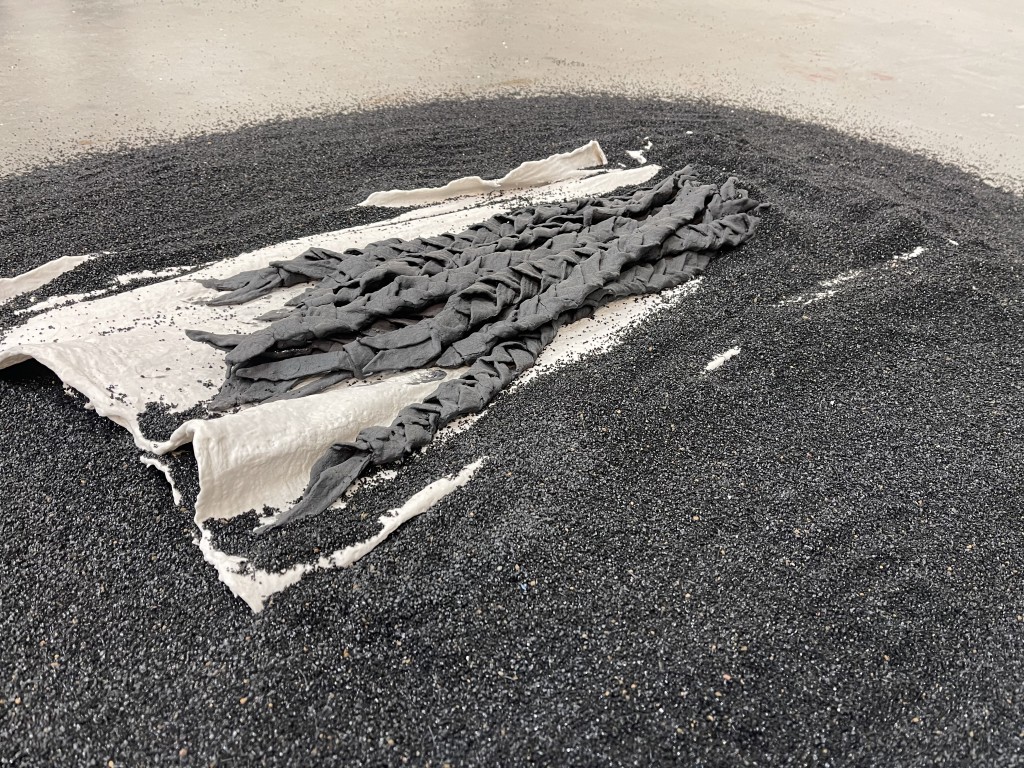
And yet, there also lives within this body of work a deep awareness of how the past continues to shape us even as we settle into new lives in potentially foreign lands – an idea perhaps best captured in “Inter(Lace)Land,” a series of sculptural braids the artist created by dipping fabric strips in clay, braiding them, and then firing the woven forms so that the fabric burned away, leaving behind the clay shell. “But something – the trace, the action, the consequences of that action – will remain,” Tarighi said. “And that juxtaposition is something I’m exploring, and that I would like to expand on more.”
Author

Related Articles
Kasmira Snyder reclaims the night in ‘Untethered’
The new exhibition from the Columbus artist kicks off with an opening reception at Wild Goose tonight (Friday, March 13).
Angelo Thomas finds blue skies on the other end of the rainbow in ‘Somewhere…’
The filmmaker will join artist Rebecca Butterworth in celebrating the release of their new ‘Wizard of Oz’-inspired comic at Laughing Ogre from noon-2 p.m. on Saturday, March 14.
Stephanie Rond hopes to kickstart a larger conversation on AI with ‘Pink Waves’
The Columbus artist wants her new exhibition at Chaos Contemporary Craft to be the start of a bigger discussion regarding the divisive technology.