
Shiva Addanki and Nikholis Planck continue the conversation in ‘American Inquisition’
The duo’s exhibition, now on view at No Place Gallery, looks both backward and forward, seeing echoes of this social and political moment in ‘the ruins of history.’
Friends and artists Shiva Addanki and Nikholis Planck are in constant dialogue, with Planck noting that the two require little stimulation to ignite an unending flow of conversation. “We could be in an empty room and that would be enough, and people would be like, ‘How have you been here five hours?’” said Planck, who joined Addanki for a mid-March interview at No Place Gallery, where the pair’s new duo exhibition, “American Inquisition,” opened last week.
This was certainly true of our conversation at the downtown gallery, where over the course of an hour the two discussed everything from the influence on their work of Marxist historian and author Mike Davis and the explosion of the sex trade that followed the fall of the USSR to the far-reaching harms of US colonization and the role the moped has played in protest movements across the global south. It’s a dialogue that continues within No Place even now that the artists have returned to their homes on the East Coast following last week’s opening reception, with the work on display serving as what Planck described as “a gas station, a stop on the side of the road” that offers viewers an opportunity to experience at least a sliver of the interaction between the two.
While the artists’ work takes different forms – Addanki’s paintings, drawn from historical photographs, tend to be more figurative, while Planck leans more heavily on still life and cityscapes imbued with meanings that extend well beyond the canvas – there exists at the core of each a similar ethical and ideological thrust, steeped in geopolitics and radical action and interested in interrogating the narratives to which people are commonly subjected. “We’ve talked about his work being the settler interior and mine being the imperial exterior view,” Addanki said. “And those two vantage points complement each other, and they kind of need each other to actually be understood in their full weight.”
A donation powers the future of local, independent news in Columbus.
Support Matter News
Witness a pair of paintings displayed on opposing walls of the gallery, each having its roots in Buda’s Wagon: A Brief History of the Car Bomb, by Mike Davis. Where Planck’s piece, titled “C.B #3,” reads like a close-up taken in the immediate aftermath of an explosion, all torn metal and bent framing, Addanki’s instead pulls back the lens. “Mike Davis is really instructive or really inspiring to me, just in the way he’s looking at history and how it bears out in the present,” Addanki said.
It’s an idea that surfaces most cleanly in Addanki’s “Border & Rule,” which pairs an image of police in full riot gear blocking the road to Krome detention center in 1981 with the exterior of the South Florida detention center nicknamed “Alligator Alcatraz,” opened in July 2025. “And I’m thinking about the historical amnesia that is around this kind of spectacle,” said Addanki, who in presenting these images on the same continuum manages to condense time in a way that captures the reality our nation has always been like this. “It’s an imperial consciousness, essentially, and also what we are haunted by as citizens of this place.”
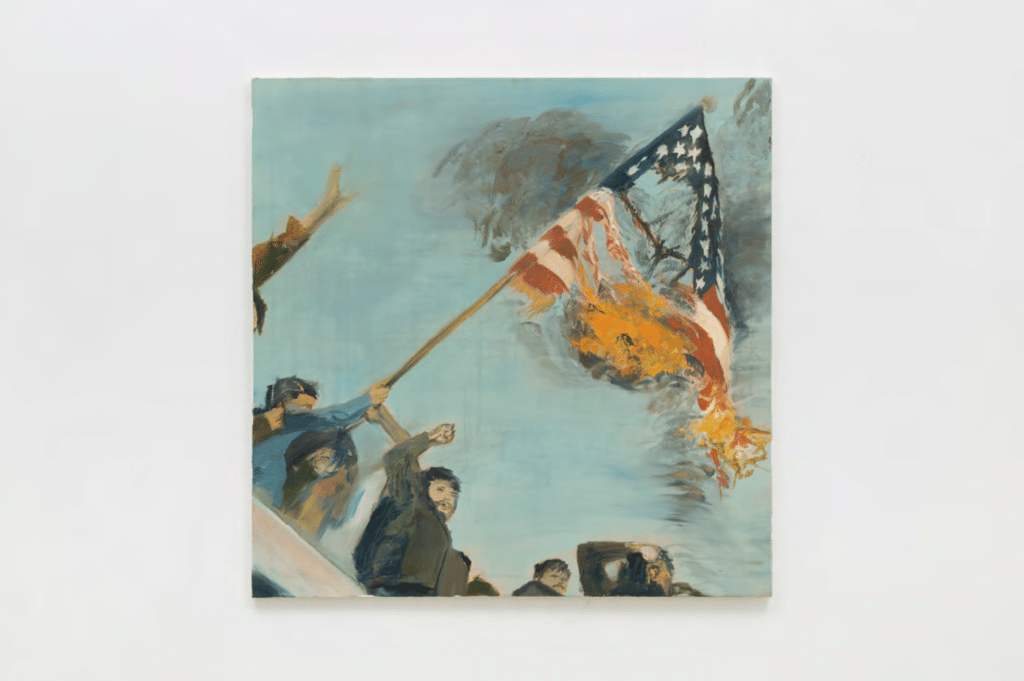
Other images on display within “American Inquisition” have been given unintended new resonance in light of current events, and in particular Addanki’s “The Great Satan,” which the artist based on a famed Getty photograph that shows Iranian demonstrators burning the US flag atop of the embassy in 1979. Addanki said the idea for the work arose from the 12-Day War of June 2025, adding, “I certainly never hoped we’d be landing in Columbus in the midst of an expanded version of that.”
“So, the topicality … had maybe gotten a little too on the nose in terms of the way the world has moved,” Addanki continued. “But we get no joy out of that. And actually [the work] is a critique of that spectacle. It’s trying to work through the ruins of history. … There are elements of this show where there’s something strange, or seemingly innocuous, or just off enough that it creates a double take.”
Planck untangles similarly complex ideas in a series of New York cityscapes painted both from Brooklyn and from “scummy Staten Island beaches,” and which see the artist wrangling with NYC as both a world city but also the Western financial center. “New York is great and it’s diverse and it’s amazing,” Planck said, “but the seabed is still kind of this sinister bloodlust.”
“American Inquisition” adapted its title from a statement released by the Popular Front for the Liberation of Palestine in the wake of the capture and detention of activist Mahmoud Khalil, which the political group signed off by writing, “Down with the American inquisition.” “And I thought, wow, that is such a brilliant way to describe this era,” Addanki said. “It was so down to a fine-tooth comb what my lifetime has felt like historically. … It has this way of making you understand history, but then also makes you understand the things that are shaping the present day.”
The same could be said of the work now on display at No Place Gallery, which even in presenting just a sliver of the ongoing conversation between the two artists manages to speak volumes.
Author

Related Articles
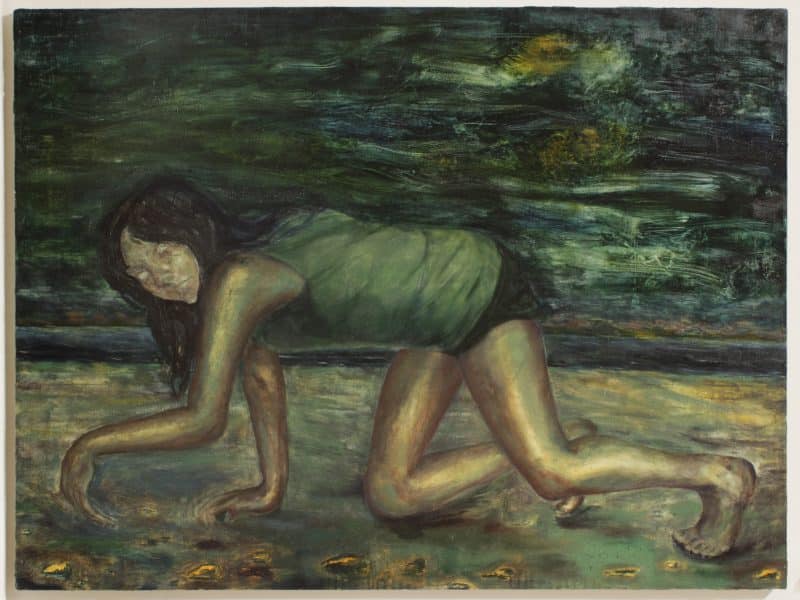
Kasmira Snyder reclaims the night in ‘Untethered’
The new exhibition from the Columbus artist kicks off with an opening reception at Wild Goose tonight (Friday, March 13).
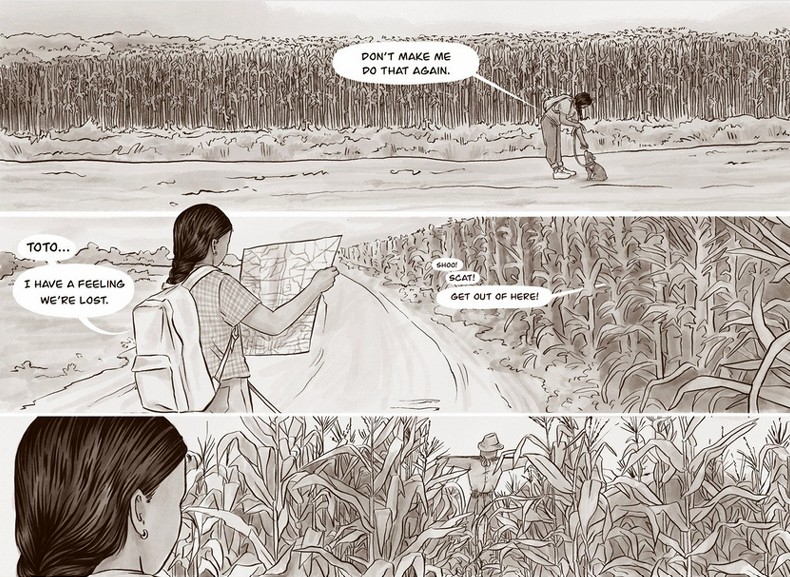
Angelo Thomas finds blue skies on the other end of the rainbow in ‘Somewhere…’
The filmmaker will join artist Rebecca Butterworth in celebrating the release of their new ‘Wizard of Oz’-inspired comic at Laughing Ogre from noon-2 p.m. on Saturday, March 14.
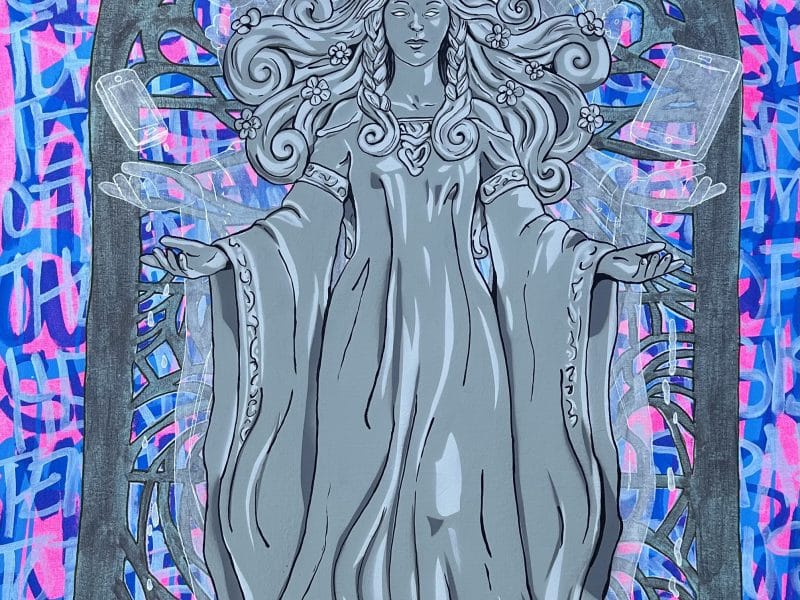
Stephanie Rond hopes to kickstart a larger conversation on AI with ‘Pink Waves’
The Columbus artist wants her new exhibition at Chaos Contemporary Craft to be the start of a bigger discussion regarding the divisive technology.