
Stephanie Rond hopes to kickstart a larger conversation on AI with ‘Pink Waves’
The Columbus artist wants her new exhibition at Chaos Contemporary Craft to be the start of a bigger discussion regarding the divisive technology.
Stephanie Rond compared life as an artist with riding a rollercoaster, recounting how periods of inspiration and creativity tend to be followed by lulls in which time and space are needed to recalibrate and see what hill might be worth climbing next.
Coming off of the exhibition “Spacewalkers,” which displayed at the McConnell Arts Center in September 2024, Rond entered into another of those stretches where she felt creatively emptied out, filling some of this void by beginning a deeper exploration of AI and its many impacts, both good and bad. “I mean, I knew all of the bad things about it, but I wanted to be better informed both for myself and as an artist,” Rond said in early March at Chaos Contemporary Craft, where her new exhibition, “Pink Waves,” will kick off with an opening reception from 1-4 p.m. on Sunday, March 8.
For Rond, these ills at least initially consisted of the way AI’s overseers have largely ignored copyright law, training their various models on works done by writers and artists absent compensation, as well as the environmental impact and the heavy water usage required of the technology, with Forbes reporting that a single large data center can use roughly 300,000 gallons of water a day. This particular revelation led the artist down an internet wormhole researching the inequities already present in water access, including the discovery that one in four women worldwide lack access to safely managed drinking water, according to UNICEF calculations.
A donation powers the future of local, independent news in Columbus.
Support Matter News
“So, water is a huge, feminist global issue, because women are spending so much time getting clean drinking water that it’s affecting them economically,” Rond said. “And it’s becoming an even larger issue with AI.”
These realities inspired the artist to create a series of “pink wave” paintings, which set outlines of stormy seas atop the outlines of Gothic, cathedral-esque windows – a means, Rond said, of linking nature with religion. “I just came back from being in Death Valley, and I haven’t slept that well in months,” she continued. “And it was because I was in nature, and I was connecting with nature every day.”
Rond’s research also turned up other flaws with the technology, including the racism, ageism and misogyny baked into the existing models, which reflect the racism, ageism and misogyny baked into our existing society. And yet, the artist continued to dig, exploring those spaces in which generative AI is proving transformative, whether in coding or in the medical field, understanding that while the technology has been introduced in an “irresponsible way,” as she explained it, AI is here to stay.
Operating with this knowledge, Rond began to use prompts to generate her own AI images, which she then painted to canvases – an act that generated within the artist a host of questions. “If I’m generating things in AI and then painting them in my style, is that art or is it not art?” said Rond, who worked on these experiments for the better part of a year before showing the results to anyone outside of her home.
For much of Rond’s artistic life, her work has been instilled with a degree of certainty, her strongly feminist paintings challenging the patriarchy, white supremacy, and various other societal ills. But with “Pink Waves,” there exists for possibly the first time an undercurrent of uncertainty, the work taking shape around the myriad questions and lingering unease that the technology and its deployment have inspired within the artist. “I’ve been a feminist artist since the ’90s, and I roll with a crowd that is very supportive of that,” Rond said. “And AI is a much harder conversation.”
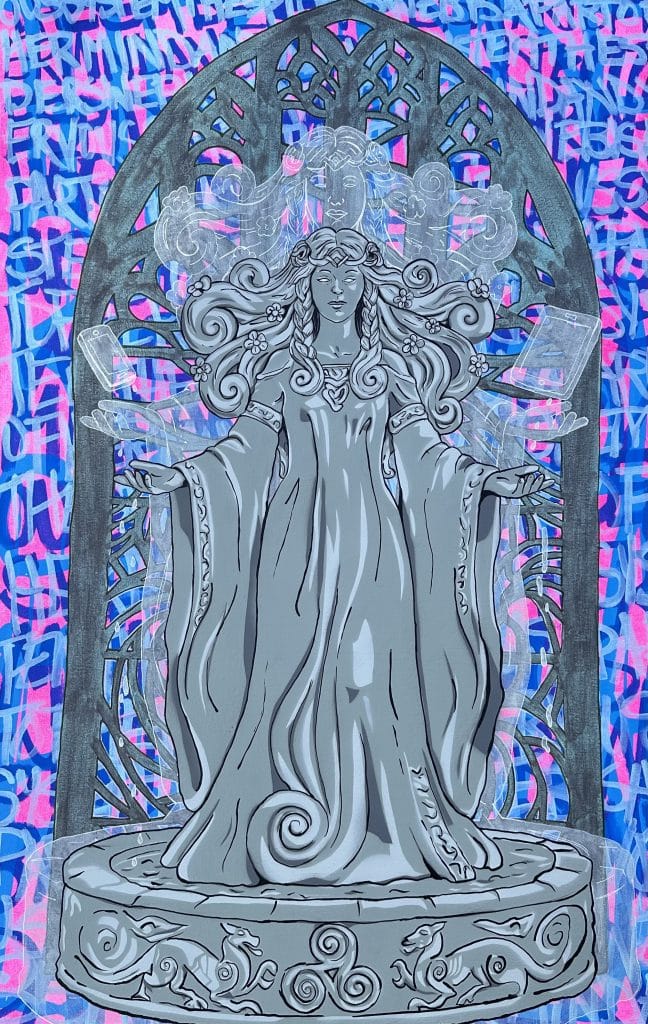
For the largest painting on display at Chaos Contemporary, Rond used prompts such as “Celtic folklore” to generate a feminine banshee character, which she then painted on to the canvas with select edits. The AI-generated hands were flawed, for instance, so she transposed them correctly and in her style. While in years prior these characters were based on human models, Rond said that brought with it “a real stress that the images were strong and positive and looked like the person.” With the generative AI freeing her from these concerns, she said she was able to focus her energies on the more philosophical elements in the work, in at least one instance considering the different realities in which we live.
“We have what I call this pinchable life, which is what you and I are doing right now,” Rond said. “Then there’s this online life, where it’s like, ‘Look at this, look at me, look at her, look at him.’ And then there’s our dream life, where we go to sleep and these wonderful and horrifying things happen.”
These universes collide within the banshee painting, which centers on a “pinchable” main figure haloed by a ghostly shadow holding a pair of electronic devices and set against a backdrop of repeated graffiti-esque writing that arrives as if from a dream (“The spider’s web is a part of her mind and her body’s nervous system”).
Rond’s newest body of work has been installed in Chaos Contemporary’s smaller Gallery D and will serve as a guidepost for a larger exhibition from the artist set to continue the conversation at the downtown gallery in 2027. To that end, Rond said, there is a potential that this fuller collection could take radically different shapes pending developments that unfold around the technology over the next year.
“I think we need to pay attention and educate ourselves on what AI is doing and what we’re using it for. And one of the things I’ve noticed most about the different AIs I’ve been using is that they’re very racist and very sexist. And that’s not AI’s fault. That’s society feeding it the way we are,” said Rond, who intends to create paintings that explore this idea for the larger exhibition. “But it’s something we have to talk about, because it’s here and it’s not going away. … So, while we may have reasons to fear it, we need to know why we fear it, so that we can fix it.”
Author

Related Articles
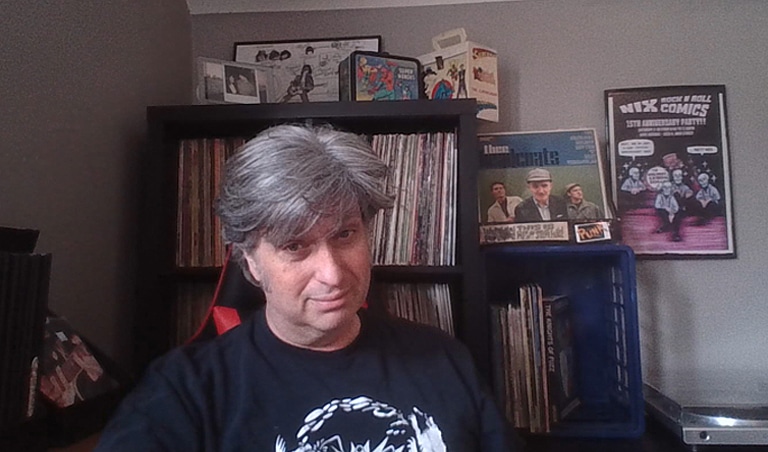
Fifteen years in, Ken Eppstein remains committed to Nix Comics
‘There’s just the improbability of 15 years, and all of the things that have to happen to end up where I am now, doing what I’ve done, and doing what I continue to do.’
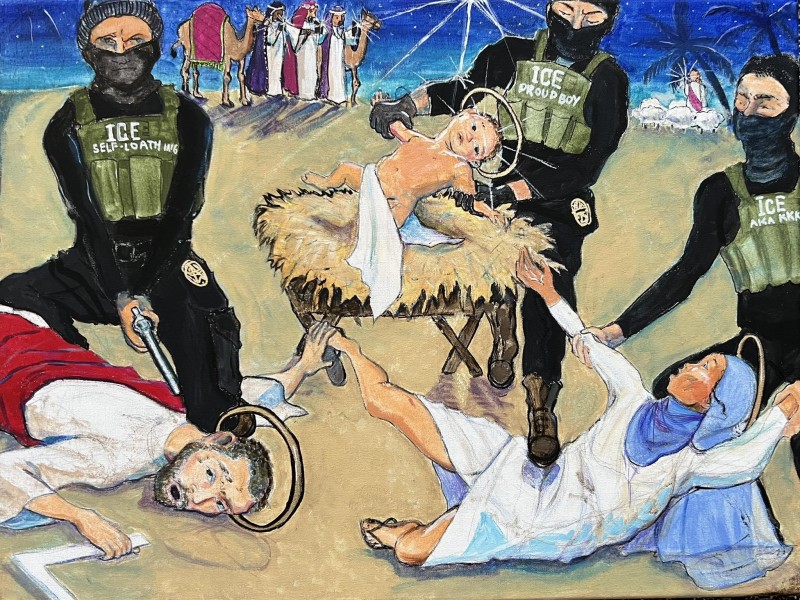
Gaye Reissland leaves no doubt about the circumstances shaping her work
The Columbus artist, who will take part in Aminah Day at the King Arts Complex this weekend, has taken to writing on the back of each canvas, explaining in detail the circumstances that gave rise to her paintings.
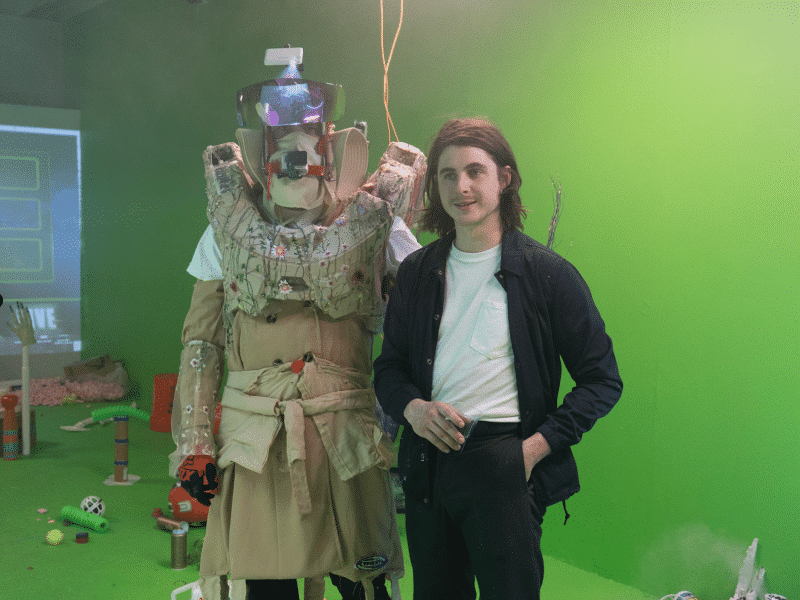
No Place Gallery turns 10
‘Between Fields and What Isn’t: A Decade Inside No Place’ will take over a pair of galleries beginning on Thursday, Feb. 12, with an opening reception running from 4-7 p.m. at Beeler Gallery and then continuing at No Place from 7-9 p.m.