
The disorienting world of Rob Robbins features in ‘Double Back Around’
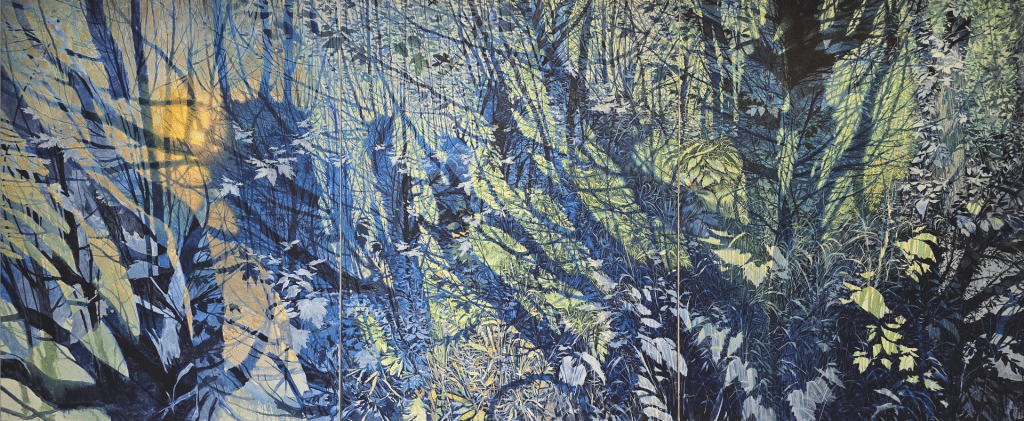
The artist and former CCAD professor’s new exhibition, which opens at No Place Gallery on Friday, Oct. 3, features dense, large-scale landscapes that simultaneously hold viewers at arm’s length while beckoning them closer.
Rob Robbins described the time he spent earning his master’s in fine arts from Yale University as deeply disorienting, recalling the two years he lived with an endless stream of visiting artists rotating through his art studio, each with a different critique of his work.
“And so, you end up confused, right? And after creating this environment that confuses you, they do these brutal end-of-semester critiques, so everybody leaves that program broken,” said Robbins, who moved back to Chicago following graduation (he grew up in the city’s suburbs) where this sense of destabilization continued to fester. “I got into an art studio and sat there for a few months thinking, ‘I have no idea what to do.’”
Frustrated by the lack of momentum and the countless hours wasted sitting in a Turkish coffee shop down the stairs from his studio, Robbins made a list of all of his favorite paintings and then began visiting art museums to see them in person. In doing so, he started to notice a theme emerging, finding himself innately drawn to works centered on the natural world, and in particular pieces by renowned landscape artists such as George Innis and Camille Corot.
A donation powers the future of local, independent news in Columbus.
Support Matter News
“And I was like, that’s it. When I get back to the studio, I’m going to draw a landscape,” said Robbins, a former CCAD professor who makes a return to Columbus with a new solo exhibition at No Place Gallery. Dubbed “Double Back Around,” the show kicks off with an opening reception from 6-9 p.m. on Friday, Oct. 3, and will remain on display through November 7. “And for some reason, once I started painting the environments I was interested in looking at, all the metaphors and the poetry and the aesthetic just clicked.”
The dense, forested landscapes that make up Robbins’ latest collection are radically different from the never-displayed pieces he first experimented with decades back, in which he attempted to replicate paintings done by Innis and Corot. The works also exist at a significant remove from the landscapes he experienced throughout childhood, the artist recalling the flat, featureless vistas that accompanied the weekly Sunday drives the family made between Downers Grove and Blackstone, Illinois, where his grandparents owned and operated a smorgasbord restaurant.
“In a way, those dense forests and lush, rolling hills were a fantasy, like, ‘Oh, this must exist somewhere out there,’” he said. “And then once a year we would load up the station wagon and drive up to northern Wisconsin for a week. And there it was dense and green and wet. And it was always the best week of the year.”
As Robbins continued to immerse himself in landscape painting, absorbing books such as Landscape Into Art, by Kenneth Clark, and Barry Schwabsky’s Landscape Painting Now, he began to interrogate the ways different societies and cultures relate to these vistas. “In the intro to his book, [Schwabsky] has an interesting observation that Eastern cultures paint as though humans are part of their landscape,” he said. “And in Western cultures … they paint the landscape as if humans dominate over it.”
Robbins said he was particularly drawn to the way Corot scaled back his landscapes, often presenting “three beads of land” rather than the unending vistas then more common to the form. As Robbins continued to work, he increasingly zoomed in with his own canvases, which he said began to reflect the nature of scientific discovery in which “we keep looking at smaller and smaller things.”
“The scale of the space that I put into my painting is actually pretty small. You’re just looking at this little patch in front of you, but one piece in this show (‘Neither Here nor There’) is 180 inches [wide],” said Robbins, who described his large-scale works as “maximalist,” containing layers and layers of paint that have the combined effect of slowing a viewer down, forcing them to sit and untangle the landscape in front of them. “They don’t have horizons, and they might have little apertures here or there where you can get in, but you can’t go very deep. And when you do see something deep, you don’t really have a path to get to that thing. You would literally have to find a path outside of the landscape. So, in a way, [the paintings] push you back as much as you’re trying to push into them.”
The vividly colored works on display within “Double Back Around” emerged from Robbins combining techniques he developed in two parallel series, the first focused on densely painted foliage and the second on images, usually cityscapes, that he would continue to layer on the canvas until they broke down and became virtually unrecognizable.
While Robbins’ landscapes could exist at any point in time, he views them as inexorably linked with the era from which they have emerged. Creating in the aftermath of the 2008 financial crisis, for instance, Robbins said he “hyper-charged” the colors in his paintings and injected them with easier access points, intent on creating a more inviting world into which viewers could escape. This contrasts with the paintings he created in these more recent post-pandemic years, which reflect aspects of the digital realm in which society is increasingly ensconced.
“When you’re doing a Zoom meeting, you’re usually doing three other things, and you have someone texting you and you’re looking at YouTube videos and it becomes layers and layers and layers of things until the symbol, the signifier, becomes lost in the mix,” said Robbins, whose current body of work straddles a line between inviting viewers in and holding them at arm’s length, as though the landscapes are being viewed from behind glass, or more aptly a screen. “And so, the new paintings, they’re a little more structured, there’s a more limited palette, and they sort of break down a bit more. And that gives them more of an uncanny valley feel, where there’s something that’s not quite right here, even if I don’t know what that is. So, certainly I’m having these formal shifts in the paintings relative to what seems like the condition of the world. Sometimes the world collapses and you go, ‘Well, I want to give everybody a treat.’ And sometimes the world collapses and you need a painting that feels like that collapse. Different answers for different days, I suppose.”
Author

Related Articles
Emily Morgan and Hannah Maltry rely on instinct for ‘We Did It Wrong’
The two artists will host an opening reception for their exhibition at High Road Gallery & Studios from 6-8 p.m. on Saturday, March 28.
Brian Canini takes stock of 25 years in self-publishing
The Columbus comics artist will unpack lessons learned over the last quarter-century in a weekend talk at SPACE.
New report recommends cutting GCAC funding to increase the Experience Columbus marketing budget
Under the current model, GCAC receives 29 percent of the funds generated by the hotel/motel tax, which a FRAC report calls for reducing to 0 percent. In return, the share allocated to Experience Columbus would rise from 43 percent to 72 percent.