
Mona Gazala walks a winding path to ‘Trail Markers’
The Palestinian artist’s still-in-progress film – a portion of which will screen at the Wexner Center for the Arts on Thursday, Sept. 5 – has its roots in a chance discovery at a museum in rural Ohio.
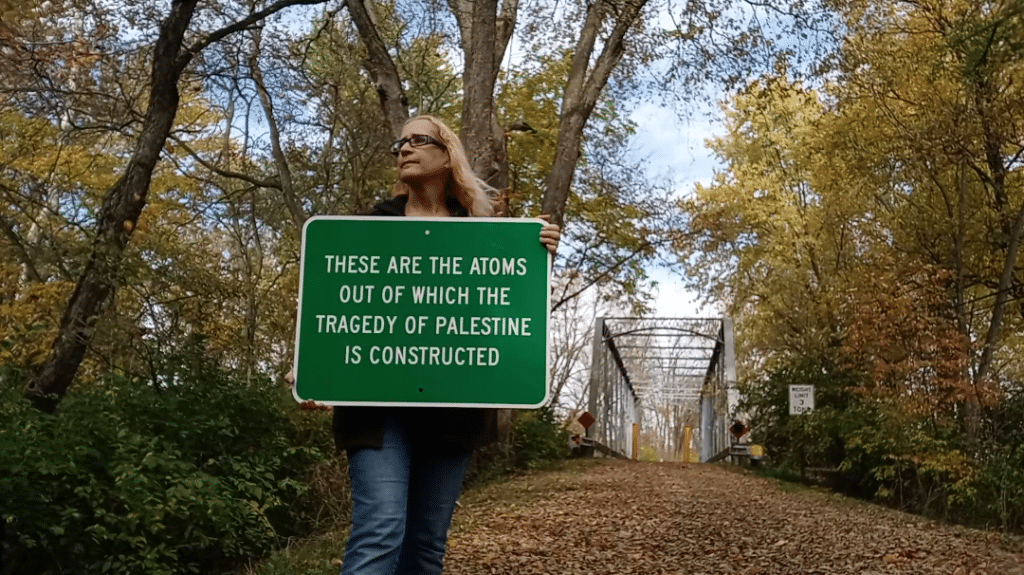
Mona Gazala said the initial idea for her new film, “Trail Markers,” stemmed from a chance discovery, with the artist happening upon an artifact of cultural significance to Palestine at the Garst Museum in Greenville, Ohio.
“I can’t remember how I first discovered the existence of the artifact, but I’m guessing I was going down some wormhole of online research and I must have plugged in ‘Palestine’ and ‘Darke County’ into a Google search to see if something would pop up besides myself,” said Gazala, who in 2022 moved 90 miles east of Columbus to Gettysburg, Ohio, where she opened the Palestinian-centered exhibition space Gazala Projects. “And surprisingly, something did.”
While rooted in this discovery, the still-in-progress “Trail Markers” – a portion of which Gazala will screen at the Wexner Center for the Arts on Thursday, Sept. 5 – has taken a far more winding path, with the artist weaving together bits or memoir and historical reflection with a deeper exploration of the threads tying the American Midwest to the dispossession of the Palestinian people. Gazala said she was struck, for instance, when a friend of a friend casually mentioned that they worked at a munitions plant – a sensation the artist described as “a punch in the gut,” and which forced her to confront the reality this person might be responsible for helping to manufacture the weapons currently being used to advance genocide against Palestinians in Gaza.
A donation powers the future of local, independent news in Columbus.
Support Matter News
Gazala has long explored these types of connections in her work, including her current solo exhibition “Backroads of Empire,” which opened in late August at Ohio University and includes a piece that reflects on the Boeing plant in Heath, Ohio, existing in such close proximity to the Hopewell Ceremonial Earthworks in Newark. “I was struck by the juxtaposition of the Great Circle being located only nine miles from this Boeing munitions plant which is working so hard to build weapons of destruction to be used against Indigenous Palestinians,” the artist said. “Our entire Ohio landscape is laden with these contradictions. We have this very banal, very peaceful looking rural landscape. But it was also the site of battles where Indigenous people tried to hold onto their land. It’s the site of entire Black settlements established in the 1800s that have since been erased. It’s part and parcel of the American landscape.”
The 42-minute version of “Trail Markers” set to screen at the Wex begins with footage from a BBC news production that followed Palestinian academic Edward Said on his last trip to his homeland prior to his 2003 death, during which he observed the remnants of a bombing and began to pick through the rubble. “These are the atoms out of which the tragedy of Palestine is constructed,” he says.
“And that phrase just really resonated with me and my own artistic practice,” said Gazala, who has long incorporated archeological elements into her own work, sometimes utilizing discarded architectural items in the pieces she created while living and working in Franklinton as a means of commenting on the accelerating gentrification of the neighborhood. “And it really struck me that he saw these physical objects as artifacts imbued with a collective significance.”
For the solo exhibition in Athens, Ohio, Gazala dug out a couple of pieces she initially created in 2018 while living in Franklinton – a pair of concrete chunks rescued from a demolished patio and stenciled with the words “place” and “power.” In the process of refreshing these pieces for display, Gazala said, the works gradually became another element in the film.
“This artwork, ‘place’ and ‘power,’ had never been properly displayed in a gallery setting, so I knew this was the moment I needed to reconstruct it,” said Gazala, who was initially drawn to the way the ripped-up patio reminded her of the rubble that existed in the aftermath of past Israeli bombings in Gaza. “And those words were significant to me because they spoke to the struggle for spatial justice in many different places, both in the gentrifying neighborhood where I was living then and in the colonized homelands my parents had come from. … That politicized landscape has always been significant in my artwork. Neighborhoods and cities are erased in the name of power and progress. Marginalized people are pushed off that land. And the histories on that land are erased.”
In creating physical artworks, Gazala said she has often embraced a “hunting and gathering” approach, mining found materials from abandoned buildings and forgotten neighborhoods. And she applied a similar process to construction “Trail Markers,” incorporating news reels, archival footage and slice-of-life vignettes filmed from the windows of Gazala Projects that capture aspects of the rural setting.
Gazala relocated to rural Ohio a couple of years back owing in part to her desire to connect on a deeper spiritual level with her ancestors, who lived on the land in Palestine. And in a way, she said, the move has brought her closer to her heritage and introduced a deeper sense of peace than she has experienced in a long time.
“I feel more connected both to the land here and by proxy to the place where my parents and grandparents lived,” said Gazala, who described this search for connection as an ongoing, lifelong pursuit. “As a person of the diaspora, I’ve always, in many ways, shapes and forms, tried to connect with the place my parents came from, which is a place that in all practicality I will probably never be able to visit. And I don’t necessarily see that as a personal tragedy. I feel like my search for these things in the diaspora is kind of a compass point, and it serves to define who I am and what I find important in life.”
Author

Related Articles
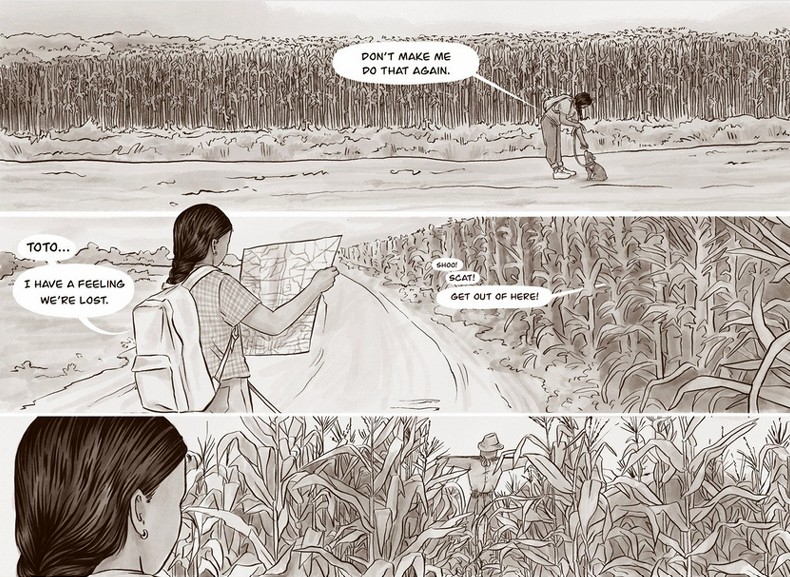
Angelo Thomas finds blue skies on the other end of the rainbow in ‘Somewhere…’
The filmmaker will join artist Rebecca Butterworth in celebrating the release of their new ‘Wizard of Oz’-inspired comic at Laughing Ogre from noon-2 p.m. on Saturday, March 14.
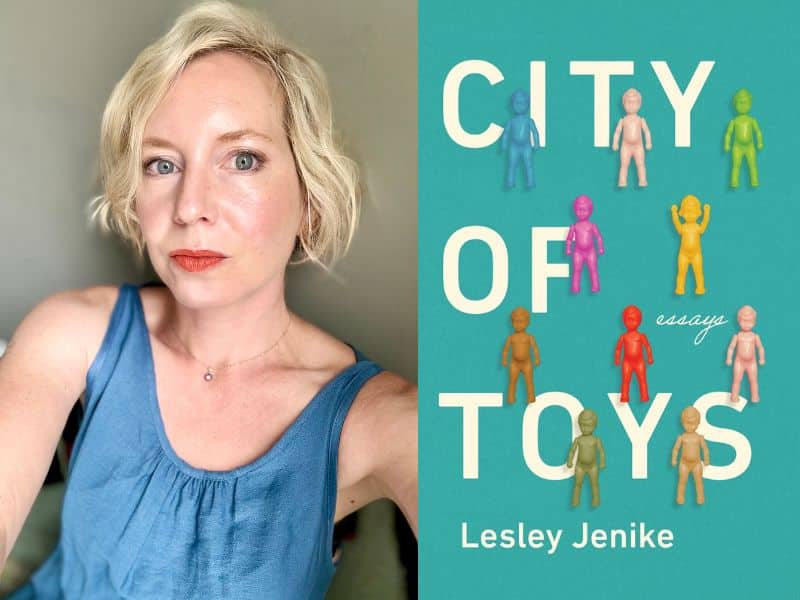
Lesley Jenike scrapes away the veneer with ‘City of Toys’
In her new essay collection, out today (Monday, March 9), the Columbus author said she opens up ‘in a way I don’t in my everyday life.’

Rashad Thomas looks God in the eyes with ‘I Was Told There’d Be Gold’
Written over a 10-year stretch, the latest record from the Columbus producer, singer, and rapper finds him expounding on spirituality, the nature of love, and the need to find heaven here on Earth.