
John Calvin Abney takes a spin through the past on ‘Transparent Towns’
Released today (Friday, Sept. 19), the latest album from the Tulsa-raised, Columbus-based musician finds him wrangling with the memories of the places he once dwelled.
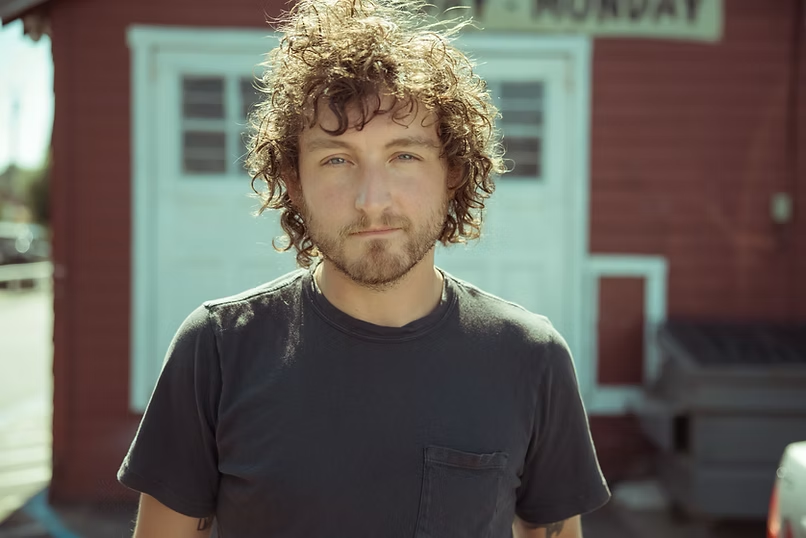
In recent days, John Calvin Abney has come to view his last three albums as an accidental trilogy, of sorts, threaded together by geography and the ways that memories that can tie us to specific places.
The singer and songwriter described Familiar Ground, from 2020, as more broadly about home, with its follow up, the 2022 album Tourist, arriving out of those itinerant early Covid months when he lingered on the idea of revisiting places he had previously been under these newly alien circumstances. Now, with Transparent Towns, out today (Friday, Sept. 19), the singer and songwriter emerges with a batch of heartfelt songs in which he frequently questions his memories of the spaces he once dwelled.
“It’s asking how do these places change over time? And how have I changed?” said Abney, reached by phone the evening before catching an early morning, mid-September flight to Nashville to begin a swing of tour dates opening for Kentucky singer-songwriter S.G. Goodman.
A donation powers the future of local, independent news in Columbus.
Support Matter News
The tunes populating Transparent Towns frequently open by introducing a narrator who is carrying some impossibly heavy burden, whether they’re trapped working the graveyard shift (“Last Chance”), resigned by circumstances to life’s gutter (“Wait for Us to Be Home”), or running perilously low on the will to carry on. “My well’s run out of ink,” Abney sings at the onset of the patient front porch lament “Jump the Gun.” Then there’s the title track, a duet with his partner, the Columbus singer and songwriter Lydia Loveless, which begins with the narrator requesting all of their possessions be piled up and set aflame once they’ve finally released their grip on this world.
And yet, there exists throughout an acknowledgment that these characters, many of whom could have populated the kinds of rural towns familiar to Abney from his upbringing in Tulsa, Oklahoma, aren’t resigned to their fates. “Love can change, and people grow, come off the mountains of what they know,” Abney sings a few bars into “Jump the Gun.”
“What is that old adage? When you cross a river and come back to that river to cross it again, the river’s not the same and neither are you,” said Abney, who was born in Reno, Nevada, grew up in Oklahoma, and now makes his home in Columbus. “I mean, we’re all scar collectors in some way. And, God, I don’t want to spout off some cliche about how we heal and we’re better for it, but I do think we keep moving. And the scar may not make us better or stronger, but it’s the fact that we’re not done yet.”
At times, these scars can be literal, with Transparent Towns emerging in the wake of a nearly year-long stretch in which Abney had to refrain from singing following surgery on the hemorrhagic polyps that developed on his vocal cords amid an expansive, globe-trotting tour in support of Tourist. “I woke up the morning of the third to last show, and I was literally coughing up blood,” he said.
During this forced downtime, Abney made field recordings and experimented with creating ambient instrumental music on piano, slowing his pace in a way that helped to fuel the reflection evident throughout his latest. “I was doing a lot of meditation on the fact that I couldn’t very well use language or my voice to proffer meaning, so I think there was a lot of… self-discovery isn’t the word, but maybe some introspection,” Abney said.
In making this inward turn, the musician said the writing process necessarily forced him to reckon with the person he once was, as well as the people who have supported his growth along the way, be it friends, family members, or romantic partners. This idea bleeds into a number of the songs on Transparent Towns, with Abney’s troubled narrators – the bulk of whom are in some way shaped by the musician’s own experiences – buoyed from going under by a connection existent within their life, even if from a great distance.
“I think I heard someone say this once, or maybe I saw it in a movie or read it in a book, but it’s this idea … that happiness is only real when shared,” said Abney, quoting a line Christopher McCandless wrote prior to his death in the Alaskan wilderness, later documented in the Jon Krakauer book Into the Wild. “When you open yourself up to the group experience, or to who you’re with at the time, whether it be a stranger, the person you love, or a friend or family member, I feel like those experiences make us more resilient to the tides of time, or maybe even put up a bulwark against chaos. … To have someone there, in any sense of the word, helps to solidify that this is happening.”
The ease with which Abney moves throughout Transparent Towns – a record that fully sounds as if it had to be lived in order to be laid to tape – reflects a more relaxed understanding of what he hopes for his music moving deeper into the next stage of life.
“I think I’ve really moved past that youthful, bombastic idea that I need to make a name for myself,” said Abney, who has also carved out a robust career as a touring guitarist for artists such as S.G. Goodman, Ben Kweller, and longtime friend John Moreland, who drops by to deliver backing vocals on new album track “Who You Thought I Was.” “I mean, who in their 20s doesn’t feel the need to write their magnum opus? But now I’m at a point … where I’m just documenting who I am and how I perceive things, for better or worse. And it’s nothing in any grand sense but more trying to kind of feel my way through things. Most days I still wake up and feel like I’m just walking out of the cave.”
Author

Related Articles
The top 20 Columbus albums of 2025
Here are the albums this writer found himself returning to the most often over this last calendar year.
Jay Swifa just wants to make his teenage self proud
The rapper and producer will celebrate the release of new album ‘Palo Santo’ with a listening party at Rehab Tavern on Saturday, Dec. 20.
The paradox of Big Fat Head
The Columbus band, which released the excellent ‘Mind Your Head’ EP in late November, will perform as part of the Matter News benefit show at Cafe Bourbon Street this weekend, joined by Van Dale and Corey Landis & the Finer Things.