
Mark Lomax revisits the past and comes away with lessons for the future
The Columbus drummer and composer will join the Urban Art Ensemble at Wexner Center for the Arts this week to perform ‘The Unity Suite’ – a piece he first composed more than two decades ago and recently reworked to better speak to this social and political moment.
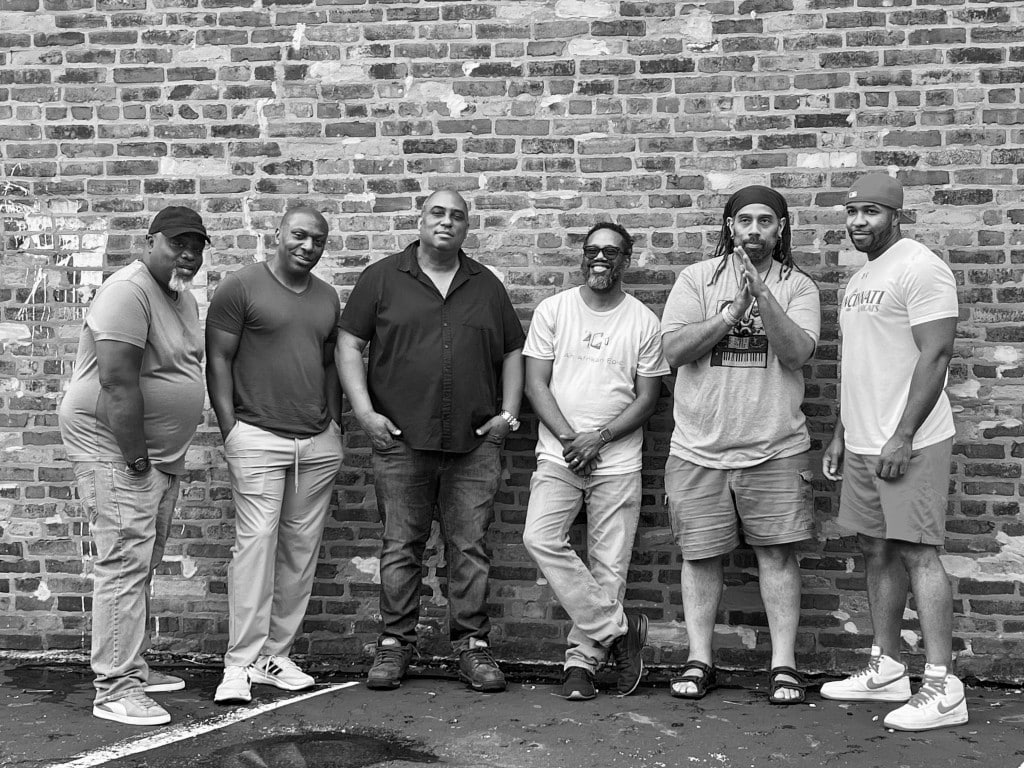
In the run up to the 2024 presidential election, drummer and composer Mark Lomax surveyed the growing political rift in the country and became convinced that a radical shift in approach was needed in terms of how we communicate as a society.
“The Republican-Democrat dichotomy, I guess it works for what it is. It’s political theater, and it has real world consequences that are dire, but I think we’re all having the wrong conversation,” Lomax said in a late September phone interview. “I wanted to focus on the conversation that I think we need to be having, and that is one that centers what we all have in common, regardless of our ethnicity, our economic status, our background or education. It’s our humanity.”
In considering these ideas, Lomax turned to music, a form he has always leaned into as a means of expressing those concepts and emotions for which he didn’t have the language. And for months, he came up empty, unable to hit on a sound that clearly crystallized these thoughts. “And then something told me to look at things you’ve already done,” he said, “so I went deep into the archives.”
A donation powers the future of local, independent news in Columbus.
Support Matter News
In doing so, Lomax discovered a MiniDisc recording of The Unity Suite captured during a 2003 performance in Cincinnati. Written two years earlier, the composition initially emerged as the musician wrestled with the terror attacks of Sept. 2001 and the birth of his oldest daughter a month later – a series of events that left him considering how to best move forward on newly unsteady ground.
“Within a month, these two life-changing events had taken place within my family,” said Lomax, who will premiere a revamped version of The Unity Suite at Wexner Center for the Arts on Thursday, Oct. 2, performing alongside the Urban Art Ensemble: trumpeter Kenyatta Beasley, saxophonists Rob Dixon and Edwin Bayard, pianist Dr. William Menefield, and bassist Dean Hulett. “We were living in this post-9/11 world, and I’m looking at this baby, trying to make sense of things. … I didn’t even know who I was, let alone what this new world was going to be.”
Lomax described his 23-year-old self as someone who knew their purpose but not yet how to go about it. He had already dropped out of college twice at the time. And though he was a decade into a career as a professional musician, he had recently been fired from a handful of prized drumming gigs because, as he put it, “I had my own ideas about what it meant to be an artist.”
And yet, the youngster was overflowing with an ambition that has remained a constant for Lomax, and which led him to channel the conflicted mix of loss and hope he felt in those chaotic months into an early version of The Unity Suite. Structured to mirror a Black church service, Lomax intended the composition to stretch over three CDs in its original form, encompassing a praise and worship section, a sermon, and a benediction. But when he premiered it at his former church in 2002, the impact fell far short of his grand expectations for the piece.
“I thought that by producing this work, I would help others find meaning. And I know for a fact that at that time, nothing happened,” Lomax said, and laughed. “Ten people showed up, and the church had more than 1,000 members, so we got about one percent of the congregation to come out.”
When a second performance on a snowy night at the University of Cincinnati campus – the one recorded to MiniDisc for posterity – attracted a similarly scant crowd a year later, Lomax shelved the project until modern political realities led him to unearth the work in 2024. In revisiting the recording, Lomax said he was struck by how well the composition held up, hearing in it the bones of how he wanted to speak to this particular moment.
“And it was time to work it into this space and where I am at 46 instead of at 23,” said Lomax, who has evolved greatly in everything from his approach to the drums to how he views the term “unity” in the years since he first composed the suite.
The musician began by spending long hours immersed in the work, refamiliarizing himself with it so that he could more easily discern those essential elements and prune those aspects he no longer viewed as relevant. “It was about crafting a tighter, more powerful artistic statement,” said Lomax, who naturally brought different shades to the composition via his drumming, which has shifted considerably in its language over the years. “I was reluctant at age 23, as a so-called jazz musician, to lean into the gospel side of drumming where now it’s like, well, that’s a part of who I am. And I’ve also cultivated a language on the drums that is my own and is evident on the recording now, where back then I was working through the language of Tony Williams and Elvin Jones and Max Roach.”
Even the word “unity” has taken on a radically different context for the musician, who in that post-9/11 world viewed the concept in stricter Christian and nationalist terms. “I was thinking about the Black Christian church perspective and then how to bring America together, uniting not because of a tragedy but based on the ideals present in the founding documents,” said Lomax, whose re-recording of The Unity Suite alongside the Urban Art Ensemble will be available digitally via CFG Multimedia, a new website launched by the drummer as a home for his musical archives, in addition to a vinyl pressing with cover art from Marshall Shorts. “And now it’s about the globe and humanity at large, and how by centering our humanity in the conversations about power, about politics, we can begin to see the world in a different way.
“There’s a word, ubuntu, which has been popularized in the last 10 or 15 years, but it’s an African concept that says, ‘I am because you are and because you are I am,’ which is different from this Eurocentric frame, ‘I think, therefore I am.’ I centers me, where humanity, ubuntu, centers we. And that begins to shift everything, because once your perspective shifts, the way you think shifts, and therefore your actions and the outcomes of those actions shift. I would be really interested to see how American politics would change if people just started sitting down and saying, ‘Okay, we’re human beings. What do we need as human beings to survive and thrive?’ And not, ‘What do I need more than you?’”
The musician attributed his change in perspective to factors that include the natural maturation process, being a parent, and having distanced himself from the religion that shaped him as a younger man, struck by teachings that positioned him as distant from people of other faiths, which didn’t square with the reality that some of his favorite musicians were Muslim, and he viewed in them a shared purpose and humanity that superseded these perceived boundaries taught in church.
At the time that Lomax shelved The Unity Suite back in 2003, he might have described the project as a failure, its two live performances reaching barely two dozen people. Now, however, the existence of the recording and its value in this moment have served to reaffirm the afro-futurist concepts that the musician explored in 400: An Afrikan Epic, from 2019.
“With 400, I was composing with the idea of putting forth sounds and intentions that will find us in the future, because we have to build the future,” said Lomax, who for that project took inspiration from authors such as Octavia Butler, James Baldwin, and Toni Morrison. “And that’s something I literally did with The Unity Suite. I wrote something 20 years ago that was not for that time, but it started resonating with me, and now it’s resonating with other people that have heard it now in ways it never did then. … I very literally wrote my way into the future.”
Author

Related Articles

Rashad Thomas looks God in the eyes with ‘I Was Told There’d Be Gold’
Written over a 10-year stretch, the latest record from the Columbus producer, singer, and rapper finds him expounding on spirituality, the nature of love, and the need to find heaven here on Earth.
In a fraught time, TAKAAT fearlessly pushes toward the edges
Mdou Moctar members Mikey Coltun and Ahmoudou Madassane will perform together as a duo at Cafe Bourbon Street on Sunday, March 8, supported by Idioms and Winston Hightower’s Perfect Harmony.
Church of the Red Museum resumes service for Lost Weekend Records anniversary show
The sprawling Columbus band will bring its ramshackle murder ballads to the stage for the first time in 16 years when it performs at Natalie’s Grandview on Saturday, March 7.