
Thirty years on, Cheater Slicks revisit the tumultuous making of ‘Don’t Like You’
The influential garage-punk veterans will celebrate a trio of archival releases in concert at Cafe Bourbon Street on Saturday, Sept. 6.
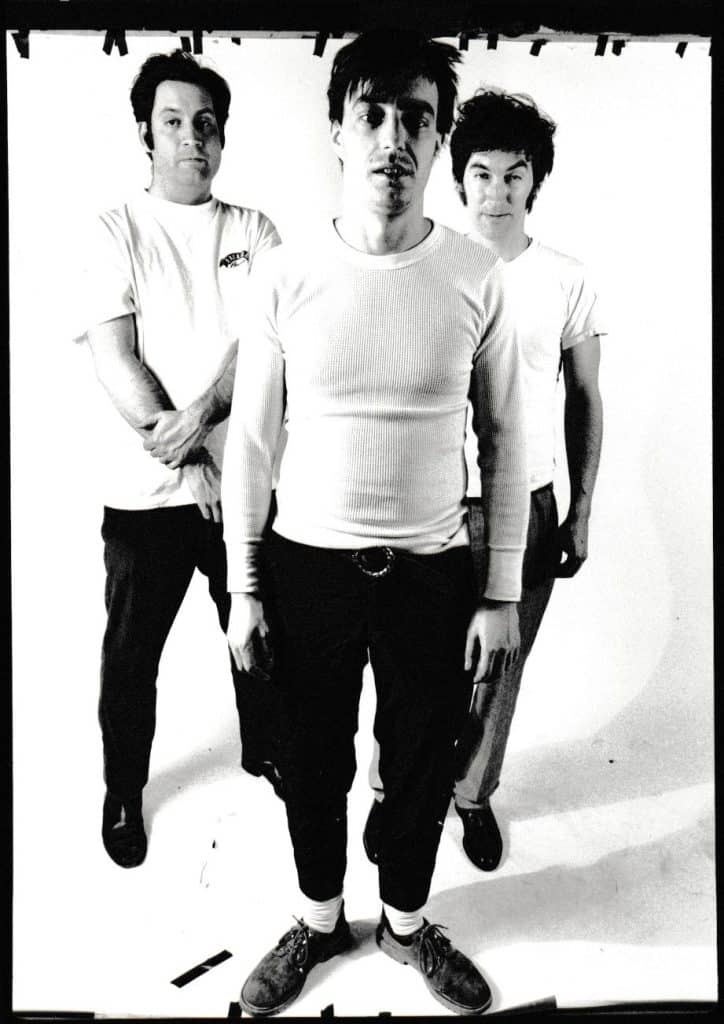
The mid-90s were a turbulent time for Cheater Slicks.
Then living as musical outsiders in Boston, the band members struggled paycheck-to-paycheck, outfitting their apartments with furnishings rescued from alleys and dumpsters. Life on the road wasn’t any easier, requiring time off work and often long drives from the East Coast to play for generally meager sums. Making matters worse, in the months leading to the recording of the band’s fourth album, Don’t Like You, from 1995, singer and drummer Dana Hatch briefly departed the group, leaving the future of Cheater Slicks in temporary limbo.
“It was hard to keep the band going, because Dana was such a central part of it,” said Cheater Slicks guitarist Tom Shannon. “We did try to work with another drummer, and we wrote some songs in that period, but it just didn’t have the same spark, it didn’t have the same feel. It never got to the point where it felt like the band was done, but it created a dilemma, because things were just so different without Dana.”
A donation powers the future of local, independent news in Columbus.
Support Matter News
Adding to the pressure, Jon Spencer, who had lobbied the band to produce Don’t Like You, said he would only move forward with the making of the album if Hatch was still on board, which led Shannon and his guitarist brother, Dave Shannon, to stump for the drummer’s return. “And also, we wanted Dana to come back, obviously. We had been friends with him for years,” Shannon said. “So, we reached out to him, and luckily he agreed to come back.”
Reunited, the band members decamped with Spencer to New York City and the now-defunct Funhouse Recording Studio, located in the basement of the East Village building that owner/operator Jerry Teel lived in at the time. Shannon described the space as a crude, windowless room crowded with instruments and overlooked by a loft that contained the recording equipment. The claustrophobic setting, along with the conditions the band members were forced to deal with throughout their short stay in NYC, added to the combustibility of the takes they laid to tape during the sessions.
“David and Dana, I think, slept in the loft in the studio, since we didn’t have a place to stay,” Shannon said. “And I stayed out in the van, where it was like 100 degrees, because it was August or September and it was just outrageously hot. And we were used to those kinds of things, because we had always kind of been on that level, but it pushed things to extremes, for sure.”
As a result, the instrumentation on Don’t Like You sounds somehow crankier, Hatch’s sneering vocals more pronounced – traits further exaggerated by Spencer’s approach to production, which led the Blues Explosion frontman to amplify the more out-of-control elements Cheater Slicks were then prone to embraced onstage.
“Jon had, from the beginning, said he wanted to capture what he heard out of us live,” said Shannon, who will join Cheater Slicks in concert at Cafe Bourbon Street on Saturday, Sept. 6, supported by Married FM, Pink Reason, and Abandon Planet. (The show will serve as a three-pronged release party celebrating the 30th anniversary reissue of Don’t Like You, plus a pair of live albums: Live at Reitschule, recorded in 1998, and Live at Double Happiness, from 2015.) “I think he was trying to emphasize those moments … when things are more chaotic with our sound, where my inclination in the studio is always to control those kinds of elements, at least to a certain degree.”
The sessions with Spencer were a departure from how the long-running Columbus garage-punk band had typically operated, requiring the musicians to cede control in the mixing stage, which was handled entirely by Spencer and completed without the band’s input. “Jon kept the tapes after we recorded, and then he went back in over a period of six months and did the mixing,” Shannon said. “He really got in there and did some different types of mixes, and he would add things to make [the songs] even more over the top than they already were. … We didn’t even know what might be coming out until he started to send us cassette tapes with his mixes on them, which were pretty overwhelming. I mean, the record has a definite sound.”
The contrast is further highlighted by the new reissue, out now via In the Red, which pairs the Spencer-produced record with a second LP of album demos recorded by the band, which Shannon said struck him as “a bit looser, a bit more natural.” “We were able to establish some longer interplay in the songs, like the way we would normally play them,” he said.
Cheater Slicks’ more recent archival turn, which is set to continue with forthcoming live records sourced from different eras of the band (2008, 2014 and 2025 included), initially focused on the mid-90s “in part because if there’s an arc or progression to the band, that’s probably [the time] when we were most well-known,” said Shannon.
It also marked a period of intense creative evolution, with the version of the band captured onstage at CBGB’s in 1992 standing in stark contrast to the one that performed at the Kulturzentrum Reitschule in Switzerland just six years later. “1992 was really different from ’95 for us, which was different from ’98,” said Shannon, who welcomed the subsequent slowdown that accompanied the musicians’ decision to relocate to Columbus in the wake of making Don’t Like You. “When we got to Columbus, we were happier, just in terms of being able to settle down and to not have as tumultuous a life. None of us had ever made any money off the band, so we decided we were going to keep being creative, but we were going to do it on a lower level. … And then it was like we could more slowly put these songs together, because there was the time to do it and there wasn’t as much pressure and so forth.”
In this comparatively placid stretch, multiple band members got married and started families, which led to what Shannon called “quite a long hiatus” and then a gradual return to playing shows, writing, and recording. “And now we’re at our retirement age and things are in this weird upswing, where there’s a little bit more going on again,” he said. “And that’s good, because in a certain way we can devote more time to it now. And we’re still playing really well, and we certainly still have things to express.”
Author

Related Articles
Lilly Hiatt captures the restlessness of settling down with ‘Forever’
The Nashville singer and songwriter headlines a concert at Natalie’s Grandview on Thursday, July 30.

‘The whole time we were chasing our dreams, we were actually living the dream’
Long-running Columbus power-pop band Watershed will celebrate the reissue of Joe Oestreich’s memoir ‘Hitless Wonder’ with a conversation at Used Kids Records and a sold-out concert at Natalie’s Grandview.
Read Rob Harvilla’s foreword to the 15th anniversary edition of ‘Hitless Wonder’
‘[This] is a book about how and why this wonderful and awe-inspiringly resilient band won’t ever stop.’