
The Composers’ Collective at the Ohio Theatre
The revolutionary roots of the Aaron Copland ballet ‘Appalachian Spring,’ recently performed by the Columbus Symphony Orchestra.
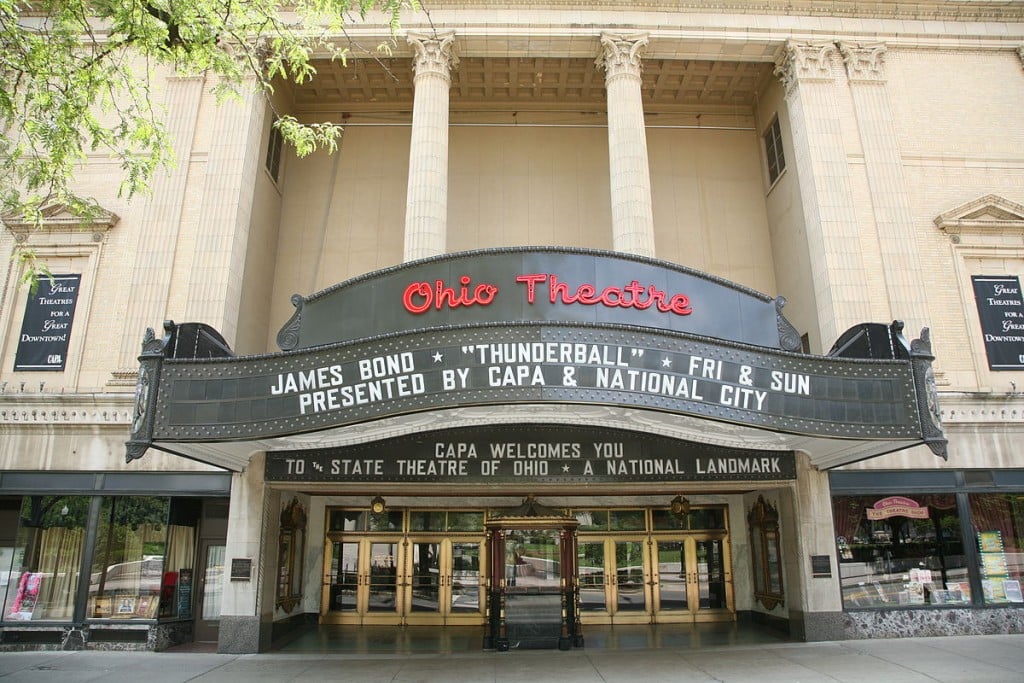
It’s uncommon to find the nosebleeds in the Ohio Theatre full, or at least partially so, but such was the state of the upper deck on a recent Friday in late February. The Columbus Symphony Orchestra was playing Appalachian Spring, one of Aaron Copland’s best known and appreciated works. Both the name and the composer, however, are a bit deceiving. The music had nothing to do with an Appalachian spring and when Copland created the piece, his mind was occupied with something far from the rolling hills of Pennsylvania – namely, the cultural role of music in a time of political upheaval.
Composers’ Collective
One night in the winter of 1931, American composer Henry Cowell visited composers Charles and Ruth Seeger. They sat down and discussed the guilt they felt for not being able to connect their work with the dire economic situation surrounding them. One of their solutions, they decided, was to partake in the Composers’ Collective.
A donation powers the future of local, independent news in Columbus.
Support Matter News
The Composers’ Collective was, as quoted in Michael Denning’s The Cultural Front, “a group of professional musicians whose weekly meetings [were] devoted to the performance and round-table criticism of each other’s current productions in proletarian music.” All of the members and associated organizations were tied either indirectly or directly to the Communist Party USA. In their most active years between 1933-1935, a dozen or so composers gathered weekly (including Charles Seeger, Earl Robinson, Marc Blitzstein, Elie Siegmeister, Aaron Copland, and others) in dusty unheated lofts throughout lower Manhattan to show and critique each other’s compositions on two merits, according to Seeger biographer Ann Pescatello, overall musical technique and “its suitability for the masses.”
Their music was composed, Pescatello argued, “to be revolutionary in content and form, aimed toward redirecting and refining the workers’ musical tastes.”
Their intentions were often challenged by cultural figures in the Communist Party, especially by the writer Mike Gold who argued with Charles Seeger in the pages of the Daily Worker, believing that American workers were singing ballads and listening to jazz. “To leap from that to Schoenberg seems to me a desertion of the masses,” Gold wrote.
These debates were important at the time because there was no blueprint. With the Popular Front period coming into prominence – a time when the Communist Party sought to cast a wider net to effectively combat fascism – artists on the left were constantly struggling with these kinds of questions. This is what brought American composers to the German Communist composer Hanns Eisler and Gebrauchsmusik (“music for use”).
Since many of the members were trained in orchestral music at Ivy League schools and Julliard, most shared a distaste for folk music. “They were less interested in writing music for ordinary people to perform than works for people to hear, even though they had established workers’ choruses,” Pescatello wrote.
But some of the members became open to folk influence. Collective member and Copland’s student Earl Robinson said that the political situation of the time was so urgent that they had to bring Popular Front strategies to music. “We just couldn’t wait for the masses to catch up to us and our cherished modernity,” Robinson wrote. “We had to communicate our global anti-fascist viewpoint now.” Elitist tendencies aside, the Collective posed an important question for cultural figures: Can artists with middle-class and “bourgeois” audiences engage in class struggle on the side of the downtrodden?
Robinson explained that it wasn’t an easy task. To take artists full of prejudices and individuality and have them engage passionately in sharp criticism in hopes of helping the class struggle required a new kind of composer. “For artists brought up in Western ego-culture,” Robinson wrote, “this was indeed not far from heroic.”
Although the Collective fell short of their revolutionary aspirations, they still altered the trajectory of music in America. Multiple members led worker choirs, created songs that were picked up on picket lines, and in the case of Marc Blitzstein, created the hit play The Cradle Will Rock, inspired by his conversations with Bertolt Brecht. And while the collective eventually fizzled out, each member went on to become an influential artist in their own right, always carrying with them the influence of class struggle.
Copland, the Marxist
Copland was of course a member of the Composers’ Collective, but the degree of his engagement with the group has been contested. According to Howard Pollack’s biography on Copland, Seeeger and Siegmester have given conflicting views on if he “officially” joined, and there was one occasion where he only stayed at a meeting for five minutes. These kinds of debates on whether or not someone was a card-carrying member of an organization are futile when examining their daily life and beliefs. Pollack went on to reflect on Copland’s socialist politics, observing that he was an avid reader of Lenin, voted for Communists, and wrote for the Party’s cultural magazine, New Masses.
“Those of us who wish to see music play its part in the workers’ struggle for a new world order,” Copland wrote in a 1935 New Masses review of the Workers’ Music League’s Workers’ Song Book, “owe a vote of thanks to the Composers’ Collective for making an auspicious start in the right direction.” Copland became one willing to conduct crowds in a different way after giving a political speech at a communist picnic in Minnesota. “I was being gradually drawn, you see, into the political struggle with the peasantry!” he wrote to Israel Citkowitz in 1934.
By the 1950s, Copland had been coerced into political ambiguity. After seeing the Communist Party leadership imprisoned and so many of his fellow artists blacklisted and berated by the House Un-American Activities Committee, Copland, a man who once spoke to communist farmers in the Midwest, became fearful of getting wrapped up in anything vaguely left-leaning. He omitted any mention of leftist politics in his autobiography and on one occasion after his friend pitched attending a march sponsored by communist youth in Budapest in 1969, he nervously discouraged his friend. While he rejected anticommunism and the war in Vietnam and supported the Civil Rights movement, he was no longer drawn into the political struggle with the proletariat as he once was.
Appalachian Spring
In 1943, Copland was in Hollywood working on the music for The North Star. This was one of the three major Hollywood films aimed at fostering allyship between the Soviet Union and the U.S. during WWII. With Lillian Hellman writing the script, Copland writing the music, and Lewis Milestone, it was a stacked crew of leftist artists. And while the film received warm reviews, Hellman disowned it after the film was smeared as Soviet propaganda amid script alterations and the advent of the Cold War. (Right-winger William Randolph Hearst replaced a positive review in his newspaper, the New York Daily Mirror, with a negative one.)
It was during this time that Coplan started working with the dancer and choreographer Martha Graham on a project. After years of delays and collaboration, he finished a composition set to Graham’s ballet script. He initially called the composition Ballet for Martha. Copland would go on to memorialize the story of how it earned its more widely known name.
Just days before the premiere, Copland asked Graham, “Martha, whatdya call the ballet?” She responded, “Appalachian Spring,” explaining that she got it from a Hart Crane poem. “Oh,” he said. “Does the poem have anything to do with the ballet?” “No, I just like the title and I took it,” she replied.
Graham’s original script was intended to take place in Pennsylvania, tracing her Quaker ancestors’ arrival in the state through the Civil War. In fact, the script was littered with revolutionary references. In the “Fear in the Night” episode of the ballet, a runaway fugitive is supposed to represent the “spirit of John Brown and Harpers Ferry,” Pollack said.
The ballet became a huge hit and resulted in multiple subsequent versions of the music from Copland. The composition earned him a Pulitzer Prize and became an American classic.
Sitting near the top of the illustrious Ohio theater with its golden archways and opulent chandelier listening to the Columbus Symphony perform one of the many versions of Copland’s Appalachian Spring, I couldn’t help but wonder if Mike Gold was, to a certain extent, right. As my neighbors started to nap and the well-dressed attendees in front of me started to slouch, I wondered where the revolutionary aspirations of Copland and the Composers’ Collective ended up. At the same time, I wondered if there’s not something revolutionary about timelessness. To hear Copland under a new wave of fascism is itself something worthy of esteem. That his most famous works were made not during his politically ambiguous years but in the Popular Front period certainly says something about music designed for working people to hear.
Related Articles

Louise Robertson emerges from grief with ‘Body. Voice. Mind. Mouth.’
The poet will celebrate the release of her new collection at Two Dollar Radio Headquarters on Friday, Feb. 6, reading alongside Sayuri Matsuura Ayers, Jessie Scrimager Galloway, and Mikelle Hickman-Romine.
Healing & Peace delivers ‘A Treatise’
‘“The album is written from the perspective of someone who has spent 15 years in and around an art scene.’

‘Dolly Parton is in the foundation of society’: Columbus musicians pay tribute to the country great
‘Grindstones and Rhinestones,’ set to take place at Natalie’s Grandview on Friday, Jan. 30, features performances from Moe Reen, Mery Steel, and the Hen & the Crow.