
Brian Canini takes stock of 25 years in self-publishing
The Columbus comics artist will unpack lessons learned over the last quarter-century in a weekend talk at SPACE.
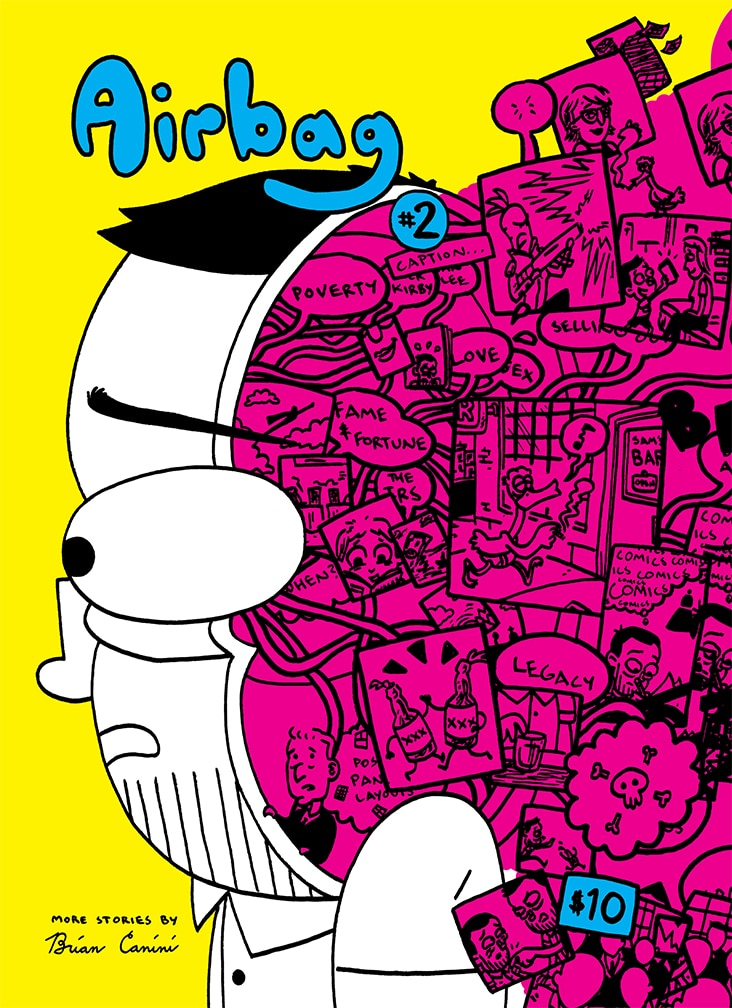
Brian Canini said he started making and publishing his own comics in high school and never stopped. Now, 25 years later, he’s prepared to share some of the lessons he’s gleaned along the way in a weekend talk at the long-running Small Press and Alternative Comics Expo (SPACE), which takes place this year at the Makoy in Hilliard on Saturday and Sunday, March 28 and 29.
“I’ve made well over 100 comics, and it’s been interesting looking back at the growth from teenager to 40-something,” said Canini, whose discussion will take place at 1 p.m. on Saturday. “It just seemed like the appropriate time to look back and figure out the lessons I learned so that I can hopefully help people avoid making some of the same mistakes along their way.”
This included his decision to self-fund the printing of 3,000 copies of the first issue of Ruffians – a choice the comics artist described as “overzealous” in retrospect. “I was in my early 20s and was like, ‘Yeah, 3,000, no biggie. I can sell out of that and then have enough money for the next print run, and then I can pay rent,’” said the Columbus-born Canini, who was living in San Diego at the time. “I still have boxes of [that first issue] insulating my attic.”
A donation powers the future of local, independent news in Columbus.
Support Matter News
And yet, the artist continued to print Ruffians until he ran out of money seven issues in, attributing his inflexibility to having been overly headstrong as a younger man. Once his funds had been depleted, Canini approached a publisher about continuing the comic, which might have worked had he not immediately revisited the issues he’d already released.
“And at that point, I had drawn seven issues, and I was no longer happy with issue one,” he said. “And so, I made probably one of the stupider decisions of my life to try to redraw the first issue. And that’s when I started second guessing myself, and after five years I only had like 28 pages done.”
As a means of overcoming this creative stalemate, Canini eventually began to draw daily diary comics featuring simple scenes culled from his day-to-day experiences – a radical shift from the world of Ruffians, which one reviewer described as “the Care Bears movie directed by Quentin Tarantino.” “It’s a hit man story with foul language starring a cartoon bear,” Canini said. “So, in a way you’re already cutting yourself off at the feet, because it’s a cartoon character kids can’t read because they’re dropping f-bombs like nobody’s business.”
In pivoting to diary comics, Canini gradually learned to accept imperfection as part of the process, shaking off the creative stagnation that had taken hold and in time uncovering deeper layers to his artistic voice. “It really opened my eyes to what was possible with storytelling in comics. And then it pushed me to use new tools, and, most importantly, it got me comfortable with making mistakes, because there was definitely a period where I got hung up on making everything look perfect, which is death,” said Canini, who has continued to revisit the diary form at various transitional times in his life, including the stretch he spent in a long-distance relationship with his now-wife and another that led to a collection he termed “adulthood in a book” because it documented the 18-month stretch in which the couple got married, bought a house, and became pregnant with child. “It was like, ‘Hey, here’s all your adult,’ and it was all in one swoop.”
Canini traced his love for comics back through early childhood, recalling how at age 6 he discovered the run of Teenage Mutant Ninja Turtles published by Archie Comics and immediately took to drawing the characters. As a kid, Canini and his friends would even play a game called “comics company,” gathering to draw panels for their imagined imprint. “So, it shouldn’t surprise that when I got to be a senior [in high school] and had some extra time that I was going to self-publish,” said the artist, who took part in his first SPACE in 2001 after discovering a flier seeking exhibitors displayed at the Laughing Ogre. “And so, I blindly sent off a check and whipped together three comics, because three seemed like the magic number.”
The excitement and drive Canini felt in that moment skyrocketed when Bone creator Jeff Smith ambled by and purchased one of his comics and hasn’t really dimmed in the decades since, even as the form his work has taken has continued to evolve.
“I started out with superhero parodies and then figured out the stories I wanted to tell from there, which have definitely become more personal,” Canini said. “I think in the beginning, the motivation was just to make things entertaining and now it’s more self-discovery, where I want each story to say something about me. And don’t get me wrong, I don’t want it to come on like everything is super serious and deep, and there are silly stories that I think say volumes about my humor. But I definitely went through that phase where I was like, ‘I’m not very comfortable, so I’m going to do a million cross-hatching lines to show off and hide whatever inadequacies I have as an artist.’ And I’ve gotten past that. And I’m more comfortable in my own skin after 25 years, thankfully.”
Author

Related Articles
Sarah Schulman believes solidarity movements would benefit from embracing imperfection
‘If we can reconceptualize solidarity as a series of errors and self-criticisms and changing paths, I think it becomes something much less scary for people,’ said the author, who will discuss ‘The Fantasy and Necessity of Solidarity’ at Thurber House on Thursday, March 26.
‘Rollerderby’ creator Lisa Carver takes a rare look back
Attendees will portray everyone from Courtney Love to Carver’s mother in reenacting interviews from the landmark zine at Two Dollar Radio Headquarters on Friday, March 27.
Angelo Thomas finds blue skies on the other end of the rainbow in ‘Somewhere…’
The filmmaker will join artist Rebecca Butterworth in celebrating the release of their new ‘Wizard of Oz’-inspired comic at Laughing Ogre from noon-2 p.m. on Saturday, March 14.