
Graphic novelist Kayla E. transforms childhood trauma into ‘Precious Rubbish’
The North Carolina-based artist will appear throughout this weekend’s Cartoon Crossroads Columbus, beginning with a discussion at the Billy Ireland Cartoon Library and Museum at 11 a.m. on Friday, Sept. 19.
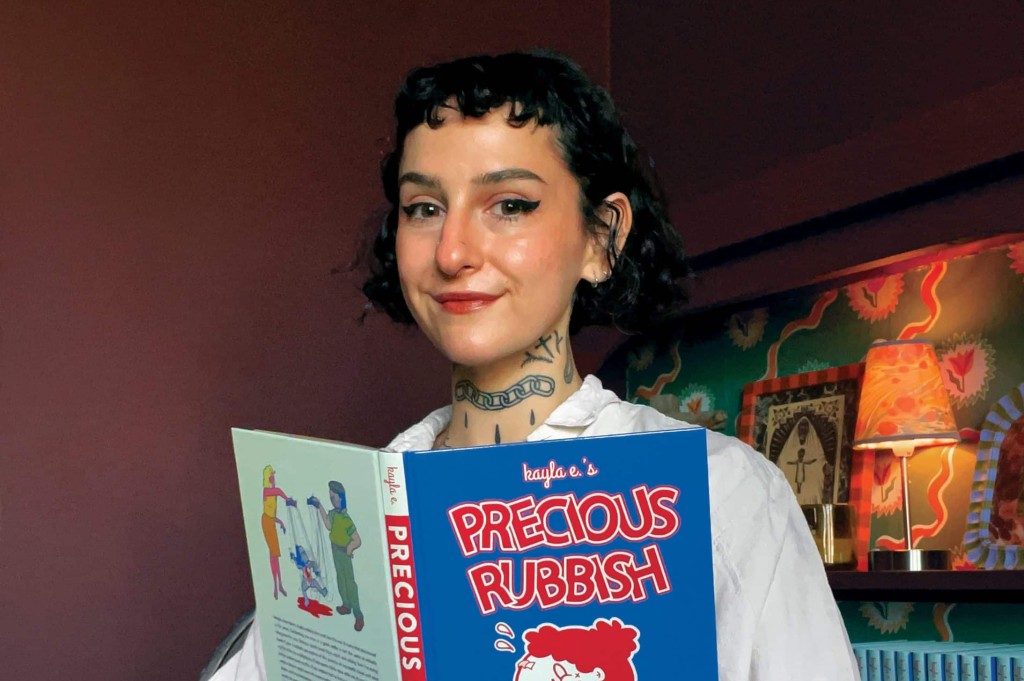
Kayla E. created the first image that would eventually become her debut graphic novel, Precious Rubbish (Fantagraphics), in 2013, shortly after graduating from Harvard and moving back in with her family in Dallas, Texas.
“And the very first thing I drew, which appears on page two, was me having died by suicide,” Kayla said by phone in mid-September. “My first attempt was when I was 10 years old, and that was the first thing I drew, so clearly Kayla was in pain, trying to figure out what was going on. … And I wouldn’t have even told you at the time that I had a bad childhood, and I didn’t realize I was a survivor of incest, sexual assault. I mean, I had no language for any of it.”
Then self-medicating with booze and drugs, the artist leaned into digital art as a means, she said, of “trying to understand what happened to me without the tools for healing or even the language of what I had survived.” At the time, Kayla had no interest in sharing the images, describing the developing panels as a secret she needed to safeguard in order to maintain “the very ratty thread” that then connected her with her biological family.
A donation powers the future of local, independent news in Columbus.
Support Matter News
“It wasn’t until years, years, years later, after moving away from my family, coming out, being in therapy for many years, and getting sober … that I began to think of the work as something other people could potentially read, and which offered something to someone outside of myself,” said Kayla, now nine years sober, who will appear throughout this weekend’s Cartoon Crossroads Columbus, beginning with a discussion at the Billy Ireland Cartoon Library and Museum at 11 a.m. on Friday, Sept. 19. (A full schedule of CXC venues and events can be viewed by clicking here.)
Awash in bright primary colors, Precious Rubbish finds Kayla wedding the look and feel of mid-century children’s comics such as “Little Lulu” to an unbroken stream of traumatic occurrences, the artist’s playful approach to form bringing pleasure even as she wrangles with the deeply unpleasurable. There are word games and cutouts, along with a stream of fake advertisements, many for products geared toward self-conscious girls and young women (see: a Tite ‘n’ Rite corset designed to “banish the bulge”).
The book also eschews a more traditional narrative structure in favor of one that time hops through the artist’s memories – an approach Kayla said fell in line with the way these traumatic events returned to her.
“The structure of the book is totally integrated with the idea of what I’m doing, which is trying to remember what happened to me,” said the artist, whose parents overlooked and excused the sexual abuse she experienced as a child at the hands of her older brother. “The way trauma-impacted memory works for people who have experienced the type of abuse I’ve experienced is that it comes a little like shattered glass, arriving in shards over time. And sometimes these shards connect, and sometimes they don’t. And years later, you may remember something clearer or see it from a different angle.”
As a result, Kayla said she continued to edit and refine the text up to the moment of her deadline, which she pushed back a handful of times because “the vibe of the book wasn’t quite right.” This often meant erasing entire panels of text and then rewriting it an in effort to drill down as deep as possible to the source of these accumulated hurts. “And because I’m a digital artist, I could copy and select an image, delete it, and start over,” she said. “It was a living, breathing document until it couldn’t be anymore.”
In the decade-plus Kayla worked on Precious Rubbish, she also went through a series of drastic personal transformations, some of which were either brought on or intensified by her creative process. In the earliest days, the act of crafting a new panel could be intensely traumatizing, pushing the artist to spiral deeper into her addictions. “I think the work is probably what led me to rock bottom,” said Kayla, who in this low turned toward a 12-step program – something that would previously have been unimaginable to her. “And that was when everything in my world pivoted on its axis. And everything good I have now came from that first step of walking into recovery and saying out loud, ‘I’m an alcoholic.’”
During these first few years of her recovery, Kayla paused work on Precious Rubbish, which allowed her to step back into the collection with a radically different perspective. The time away also helped the artist to develop a greater sense of empathy for that younger version of herself, having become aware of the concept of an inner child while engaged in therapy. “And the practice of conscious empathy for her in my personal life had a direct influence on the writing of this book,” Kayla said. “And now that I’m done with the book, I feel like I’ve done such a service to my child self. I’ve finally released her of the burden of holding onto secrets she was forced to keep her whole childhood. She’s liberated. She’s free. And I can’t quite articulate enough what a profoundly beautiful experience that has been.”
Author

Related Articles

Fifteen years in, Ken Eppstein remains committed to Nix Comics
‘There’s just the improbability of 15 years, and all of the things that have to happen to end up where I am now, doing what I’ve done, and doing what I continue to do.’
Danny Caine pushes back against book bans
In the newly released ‘How to Defend Books and Why,’ the Columbus writer offers practical advice on the best ways to fight against the book bans currently being championed by the right – with increasingly damning consequences.

Wali Crowder gets in character for Harlem Renaissance Remix
The Columbus poet will appear in the guise of Harlem Renaissance writer Countee Cullen at Streetlight Guild this weekend.