
Louise Robertson emerges from grief with ‘Body. Voice. Mind. Mouth.’
The poet will celebrate the release of her new collection at Two Dollar Radio Headquarters on Friday, Feb. 6, reading alongside Sayuri Matsuura Ayers, Jessie Scrimager Galloway, and Mikelle Hickman-Romine.
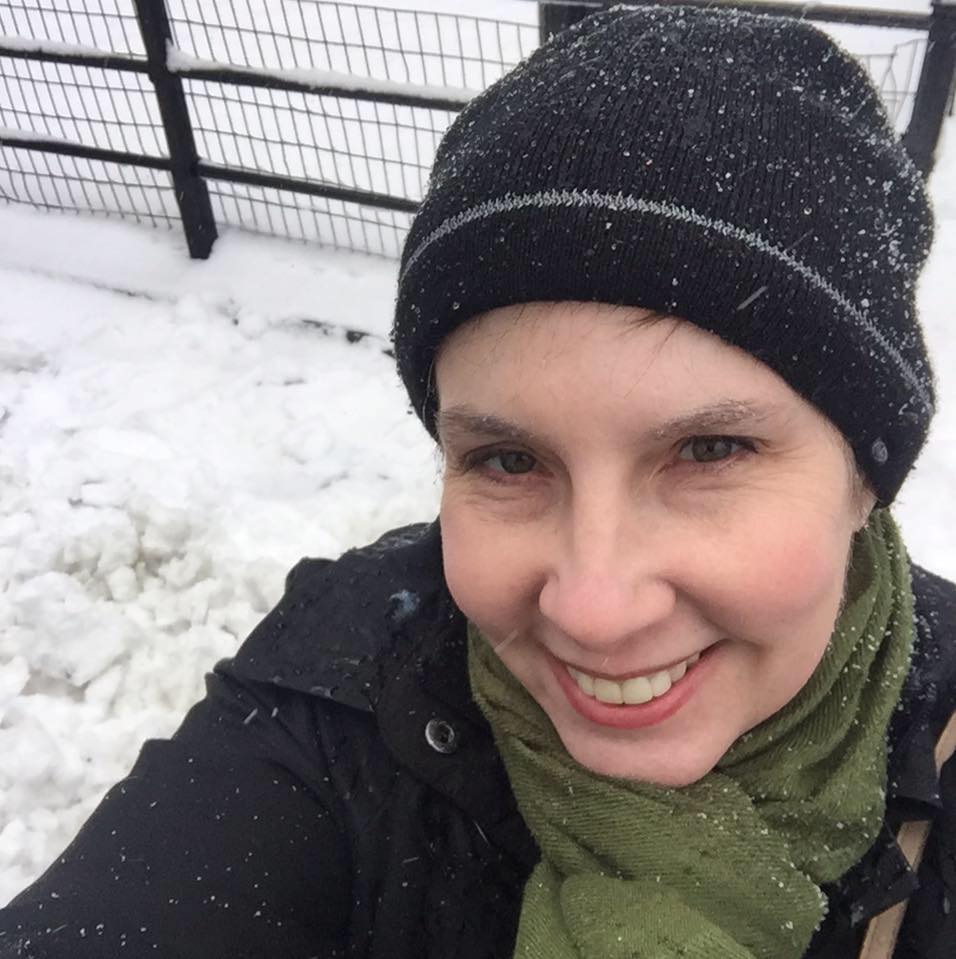
The seed for Louise Robertson’s new book, Body. Voice. Mind. Mouth., was planted more than a year ago when the poet’s dentist posed a simple question during a routine visit: How was your year?
“And I’m like, ‘Well, my mom died but I met the love of my life,’” said Robertson, who will celebrate the release of her new collection at Two Dollar Radio Headquarters on Friday, Feb. 6, reading alongside Sayuri Matsuura Ayers, Jessie Scrimager Galloway, and Mikelle Hickman-Romine. “And then I started to ask, ‘How does that cocktail of emotions get put together?’ … After my mom passed away in July of 2024, I started to write about that [loss] as a way to just sort of flog through the emotions. So, some of it was written in this pre-formed grief, and then things progressed over the year.”
Poems such as “My Mother’s Highest Goal” sit immediately adjacent to this loss, Robertson capturing a point in time at which she felt completely unmoored. “I’m not sure I know what to do/with myself now that there’s/no one to think I shouldn’t/do what I want or be what I want,” she writes.
A donation powers the future of local, independent news in Columbus.
Support Matter News
Other verses precede her mother’s death, with Robertson writing of how the elder maintained a sharp mind even as her body began to fail her – a rarity in the poet’s family, in which death has often followed the decay of memory. “My mother is not leaving through the door of Alzheimer’s,” Robertson writes in one poem. “Her sister did. Her father did. Her father’s sisters and brother did.”
“[My mother] would call me up and we would have a conversation about ‘Dexter,’ all seven seasons, all the characters, all the details. And at the end she would be like, ‘Do you think I have Alzheimer’s?’ And it was like, no,” Robertson said, and laughed. “But it was something that followed her throughout her life, and it’s funny that something she feared never caught up to her.”
As an adopted child, Robertson said she felt divorced from similar worries, though she acknowledged that watching other family members struggle with the likelihood that their minds could one day give way instilled in her a greater awareness of memory, which exerts a steady tug on the poems populating Body. Voice. Mind. Mouth. As the collection unfolds, Robertson lingers on the sensation of biting into the greasy-crisp skin of her mother’s fried chicken, the nicotine-glazed tint taken on by the windows in her late father’s white station wagon, and the time in childhood when another kid in the neighborhood chipped a tooth while using a batting practice contraption rigged by the poet’s mother.
“I witnessed somebody else’s struggle with the idea that Alzheimer’s and trouble with memory would come for them,” Robertson said. “And one of the things you get as a gift when you’re adopted is you don’t know what’s coming for you. … And in regards to Alzheimer’s, I saw it as something that wouldn’t necessarily be coming for me in the same way.”
The book’s weighty reflections on grief, family, and loss are entwined with heart-fluttering verses born of new love, Robertson capturing the weightless sensation of again falling head over heels in poems such as “Sex with a Painter, Lesson Number 1” and “What Has Been Reported to Me.” “To learn that, for one person/my back is a meadow of freckles,” she writes on the latter, “caught me by surprise.”
“To find someone who can partner with me so well this late in the game, it changes even the way I view former relationships,” said Robertson, whose new romance doubled as a stabilizing force in the months when her mother’s death left her feeling adrift. “When you’ve lost both of your parents, you end up with this feeling that you’re loose in the world. It’s an untethering that is hard to think about.”
Writing also served an anchoring role, as it always has, with Robertson tracing her fascination for language back through childhood, recalling how she has long felt a tug to “get language exactly right, exquisitely accurate.” “I wanted to get the right vocabulary word, the right grammar, the right everything,” she continued. “And I feel that has always been there. It’s the genesis of being a poet.”
Within her new collection, however, there are a number of instances where Robertson purposely breaks from this pursuit of perfection. Witness “True Statement from Two Grandmothers about Two Grandsons,” a two-page poem that she said follows the pantoum form almost all the way to the end. “And then I kind of mess it up,” Robertson said, “as I like to.”
And yet, Robertson said she didn’t see any tension existent between her long-held dedication to precise language and this fondness for disrupting traditional poetic forms, describing it as another means to heighten the emotional sentiments at the core of a piece. “I think reshaping the form to suit the moment is what I’m trying to do,” she said. “It’s expressing the chaos and connections that happen when things get pulled apart.”
The same could be said of Body. Voice. Mind. Mouth.
Author

Related Articles
Fifteen years in, Ken Eppstein remains committed to Nix Comics
‘There’s just the improbability of 15 years, and all of the things that have to happen to end up where I am now, doing what I’ve done, and doing what I continue to do.’

Danny Caine pushes back against book bans
In the newly released ‘How to Defend Books and Why,’ the Columbus writer offers practical advice on the best ways to fight against the book bans currently being championed by the right – with increasingly damning consequences.

Wali Crowder gets in character for Harlem Renaissance Remix
The Columbus poet will appear in the guise of Harlem Renaissance writer Countee Cullen at Streetlight Guild this weekend.