
‘Rollerderby’ creator Lisa Carver takes a rare look back
Attendees will portray everyone from Courtney Love to Carver’s mother in reenacting interviews from the landmark zine at Two Dollar Radio Headquarters on Friday, March 27.
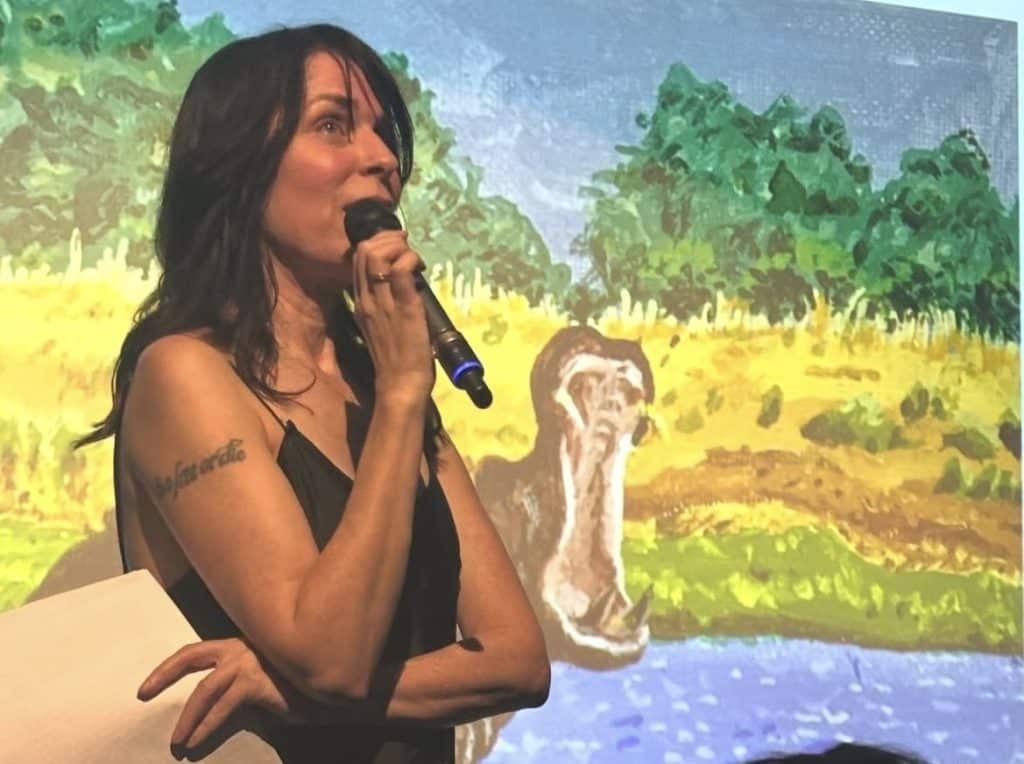
Lisa Carver published the first issue of her landmark zine Rollerderby in 1989, beginning with a print run of 30 that her mother photocopied in her office at the Navy Yard. By the time Carver stepped away from the publication a decade later, that number had ballooned to 10,000 copies an issue, requiring a significantly more business-minded approach that ultimately doomed the whole endeavor.
“And it all really changed. And it wasn’t because I got bigger, it was because the whole thing got bigger. … And then everything that made it more professional also made it more complicated and more expensive to produce,” the author and musician said by phone in mid-March. “And so, I had to learn things that I didn’t want to know and that I was not interested in. And that’s eventually why I stopped, because it was too slick, and I didn’t want to handle the business side of it anymore.”
Once publication ceased, Carver moved on to the next thing, describing herself as someone deeply resistant to revisiting the past. “Once I’m done with something,” she said, “I’m done with it.”
A donation powers the future of local, independent news in Columbus.
Support Matter News
In light of this, Carver surprised even herself when she agreed to take part in a live Rollerderby reenactment in New York City earlier this year, helping to recruit a group of participants who took on roles that ranged from famous musicians (Courtney Love, Bill Callahan) to members of Carver’s immediate family and even a stray, letter-writing woman struck with psoriasis.
“So, we got 24 players, and they all acted out interviews from Rollerderby. Or in one case it was a housewife who had written to Reader’s Digest about her really Shakespearean saga of dealing with psoriasis. … And Reader’s Digest rejected it, but Rollerderby went for it,” said Carver, who will recreate the experience at Two Dollar Radio Headquarters at 7 p.m. on Friday, March 27, joined by Columbus author and Anyway Records founder Bela Koe-Krompecher. (As of this past weekend, Carver was still looking for locals to play Callahan, GG Allin, and Jerry Wick, among other roles.)
As one means of preparing for the initial NYC performance, Carver revisited the zine for the first time in decades, struck by how rapidly the tone could swing not just within a given issue but within individual interviews, deep, intellectual discussions giving way to crass asides. “I was surprised by the concepts we would discuss in the middle of the bar, both of us blitzed out of our minds,” Carver said, and laughed.
Of course, these kinds of wild conversational pivots were precisely what Carver had in mind when she launched the zine as a teenager, frustrated by her freelance work for publications such as Maximum Rocknroll and Your Flesh, whose editors commonly restricted her to the subject at hand. “If I reviewed a film, it was supposed to be about the film. And if I reviewed a band or an album, it was supposed to be about the music,” she said. “And I wasn’t that interested in that. I wanted to know about people’s sex lives, and their beauty habits, and how they wanted to die.”
Rollerderby, in turn, afforded Carver a space in which she could ask musicians for makeup tips, or masturbation tips, her lines of inquiry driven not by concerns about what might make for a good story but whether or not it held her interest. “Rarely do interviewers ask what they really want to know,” said Carver, who traced this natural curiosity in part to a traumatic childhood that frequently left her feeling detached from the rest of humanity. “I felt like an alien spying on humans, and I wanted to do a really good job at pretending to be human so that no one would kill me, like in ‘Invasion of the Body Snatchers.’ So, I asked questions like, ‘How do you human?’ And that’s over, and I feel human now.”
Carver attributed this progress to a range of therapies, sharing how she experimented with everything from fasting and somatic therapy to more extreme tactics such as taking ayahuasca under the guidance of shamans in Peru and spending five days on a darkness retreat in Italy.
“And that was more intense than anything I’ve ever done, because all that was there was me. And can you imagine how horrible it would be to just be with you? No distraction, no interruption, just you, you, you, you, you,” said Carver, who described the tricks her mind played on her in that moment, making her believe the blackened room was somehow fully illuminated. “The brain can’t handle being without light, so it creates it. And it was so bright that I couldn’t sleep, and I was hallucinating like crazy.”
Emerging from the dark on wobbly legs into a tiny Italian town, Carver recalled how she had to wear sunglasses when she went out for dinner that first night, and how she peppered her table conversation with musings on God, the Hindu goddess Kali, and “other things people don’t want to talk about at dinner with strangers.”
No such limits existed within Rollerderby, which found Carver interviewing musicians, profiling random neighbors, and bellying up at the bar to capture her conversations with blue-collar locals. “It was famous people and totally not famous people, and sometimes it was going into bars and talking to people who were not fanzine people at all,” Carver said. “I just want to know what people think, how they think, how they work. I want to know how their brains work, how their hearts work. They don’t have to have something special. I’m just interested in everybody.”
Author

Related Articles
Brian Canini takes stock of 25 years in self-publishing
The Columbus comics artist will unpack lessons learned over the last quarter-century in a weekend talk at SPACE.
Sarah Schulman believes solidarity movements would benefit from embracing imperfection
‘If we can reconceptualize solidarity as a series of errors and self-criticisms and changing paths, I think it becomes something much less scary for people,’ said the author, who will discuss ‘The Fantasy and Necessity of Solidarity’ at Thurber House on Thursday, March 26.
Angelo Thomas finds blue skies on the other end of the rainbow in ‘Somewhere…’
The filmmaker will join artist Rebecca Butterworth in celebrating the release of their new ‘Wizard of Oz’-inspired comic at Laughing Ogre from noon-2 p.m. on Saturday, March 14.