
Chaos Contemporary Craft and Rivet Gallery venture together into the past
An exhibit opening in Chaos’ new Gallery D on Sunday, Nov. 16, extends from a conversation the two gallery founders had about revisiting artists who once exhibited in long-gone Short North spaces.
A new collaborative exhibit between Rivet Gallery and Chaos Contemporary Craft will mark the debut of Chaos’ newly christened Gallery D, located to the rear of the main gallery space and allowing for the showcase of what owner Margaret Wunderlich described as more experimental concepts.
“I have a whole year of exhibitions lined up that are different from what I’m doing in the new gallery,” said Wunderlich, whose Gallery D will debut with an exhibition featuring the work of two Rivet-associated artists: Chris Austin and Mar Hernandez. (The opening reception takes place from 2-4 p.m. on Sunday, Nov. 16.) “It’s a bit of an experiment, but it’s fun, and it allows me to do a lot more than I’d be able to do otherwise.”
This initial collaboration extended from conversations between Wunderlich and Rivet founder Laura Allison, both of whom have roots in the Short North arts scene (Wunderlich previously worked at the now-defunct Sherrie Gallery, while Allison opened Rivet in the Short North before closing it and later reopening within Blockfort.)
A donation powers the future of local, independent news in Columbus.
Support Matter News
“It sparked this conversation where I asked if she’d be interested in collaborating on an exhibition where we sort of brought back some of those artists,” said Allison, who for this exhibition chose to feature Hernandez’s illustrative work opposite sculptural pieces crafted by the Toronto-based Austin. “When I was in my original space, I really tried to focus on the things I gravitated toward and not necessarily things that were popular at the moment. So, for me, I loved [Austin’s] sculptural direction but also the message in the work. And just being this far out, it’s nice to revisit it. It’s like you’re bringing it out of the vault and seeing things again, but maybe with different eyes.”
Austin said he created most of the work on display at Chaos Contemporary beginning in 2016, describing that as a point in time when he began to experiment with materials “in a more raw and immediate way.”
“Around that time, I was thinking a lot about how we construct and destroy simultaneously – how our progress often comes at the expense of the natural world,” Austin said via email. “These sculptures began as a way to materialize that tension, capturing both beauty and imbalance in physical form.”
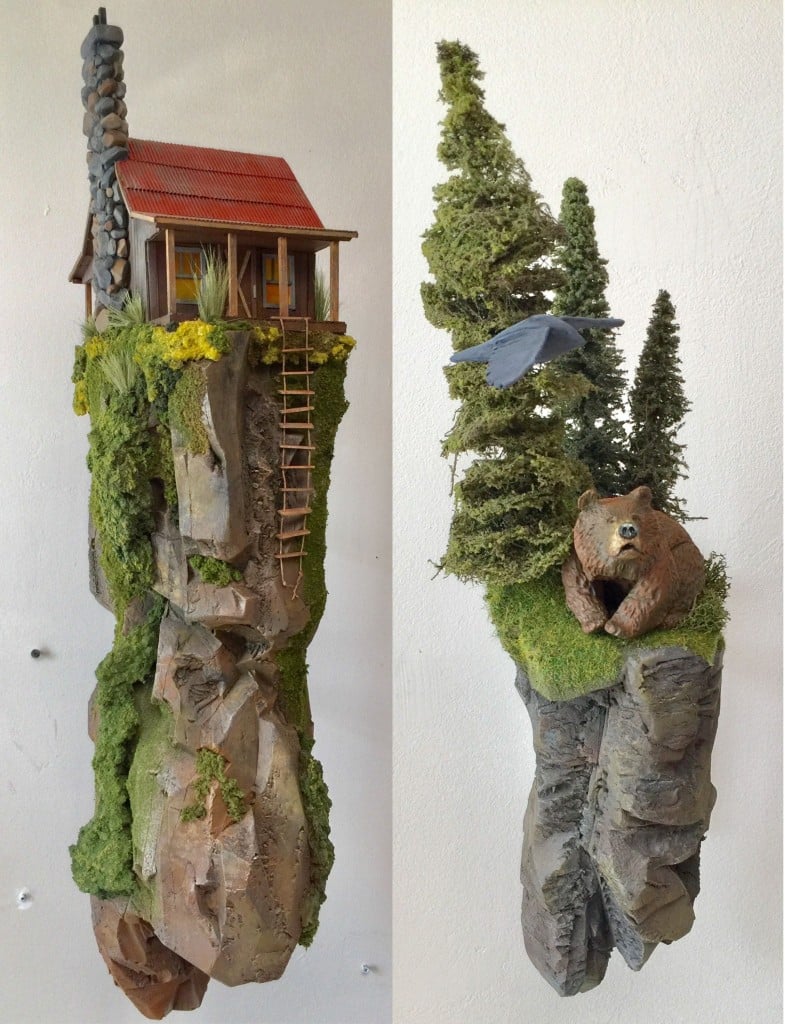
Two larger sculptures include intricate wooden homes, which are positioned on rocky outcrops that look as though they could have been ripped from the Earth. The sculpted and painted foam bases are made to resemble jagged rock formations stretching down to the planet’s core, drawing into greater relief the connection present between humankind and the place we inhabit. “I wanted to remind viewers that what we see on the surface is only a fraction of the story – that our existence depends on vast, unseen systems beneath us,” Austin said. “By exposing that cross-section, the work becomes almost geological, as if we’re peering into the Earth’s subconscious. It’s both a metaphor and a reality check about how deeply our actions penetrate.”
Austin traced his interest in exploring these connections back through childhood, recalling the hours he logged outside exploring parks, playing beside rivers, and seeking out those “small patches of wilderness” that existed around the city. Indeed, his interest in global warming extended not from data-rich articles or news reports, but from those things he observed navigating his surroundings as he grew older, noticing shifts in weather and in animal behavior, and in how people seemed increasingly disconnected from the natural world.
“The sculptures were a way to process that unease – to externalize something that felt both personal and planetary,” said Austin, who in revisiting the work almost a decade later acknowledged he has discovered layers he wasn’t consciously aware of in their initial creation. “Time has a way of revealing layers that weren’t consciously there at first. What once felt like a response to a specific environmental or political moment now reads more universally to me – almost like a reflection on endurance, decay, and renewal. I see more humanity in them now.”
Author

Related Articles
Keith LaMar seeks release in Freedom First concerts
The Cleveland-born author, musician, and poet will phone in from death row at the Ohio Correctional Penitentiary during an improvisational jazz concert at Antioch College on Sunday, Oct. 26.
Thirty years on, Cheater Slicks revisit the tumultuous making of ‘Don’t Like You’
The influential garage-punk veterans will celebrate a trio of archival releases in concert at Cafe Bourbon Street on Saturday, Sept. 6.
Susan Josephson uncovers ‘Bliss’ in career-spanning exhibition
The former longtime CCAD philosophy professor, who has rarely displayed her work in public, features in an exhaustive new show at the Church of the Sparkling Unicorn, curated as an 80th birthday surprise by her husband, John.