
Tracing the fascist roots of the Nazi demonstration in the Short North
Fascism has always found its footing in moments of societal and economic strain, mobilizing a charged middle-class to physically get the message out.
The Short North is one of the main arteries of Columbus’ commercial life, often serving as a gauge for the perceived health of downtown, and in association the city as a whole.
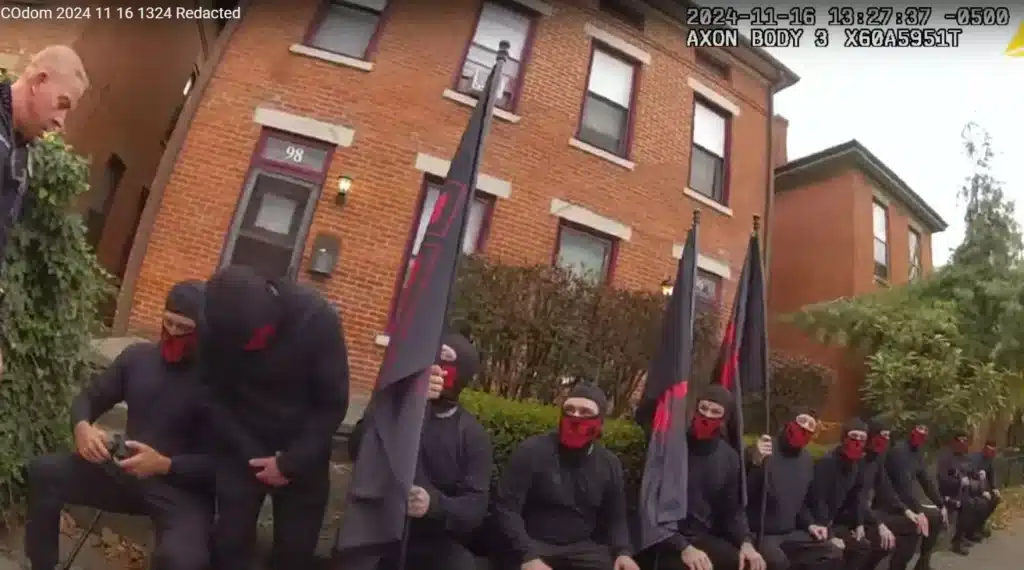
For this reason, it has also emerged as a focal point for protests aimed at disrupting business-as-usual and drawing the attention of residents. Historically, such strategies have been employed by left-leaning movements, including Black lives matter, protests against the war on Gaza, and others. But on Nov. 16, the tactic was adopted by the far-right. Marching down High Street, a small group of a dozen masked Nazis, some carrying swastika flags, shouted racial slurs and white supremacist slogans. A number of stunned onlookers filmed the display, while others responded by hurling cans and vegetables at the group.
The propaganda stunt is hardly central Ohio’s first in recent years – last May, neo-Nazis protested a drag brunch at Land-Grant – but the timing and history of this march is important. For onlookers, the spectacle was shocking, but for many students of history, it was disturbingly familiar.
A donation powers the future of local, independent news in Columbus.
Support Matter News
Fascism has always found its footing in moments of societal and economic strain, mobilizing a charged middle-class to physically get the message out. But to understand why these far-right movements are rising today, we first must trace their roots.
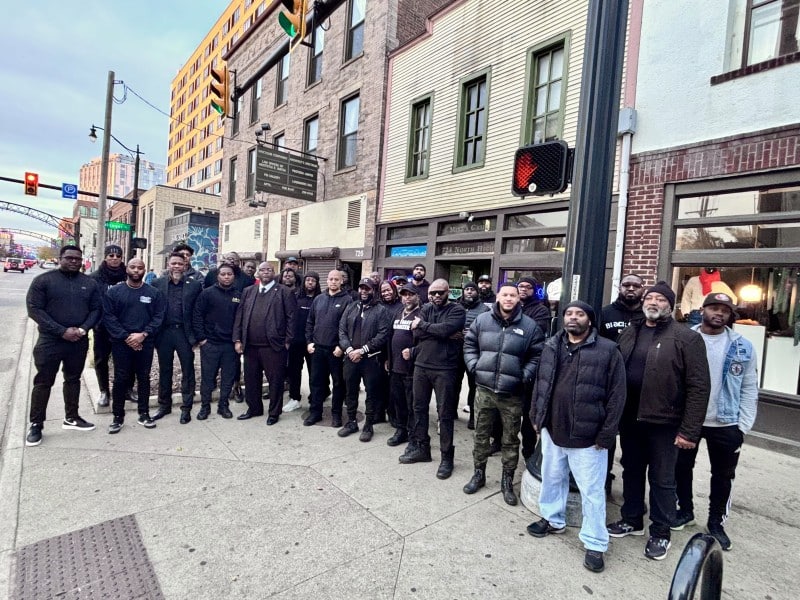
As Daniel Guerin wrote in the 1930s, fascist movements in Europe emerged not as mass political parties but as gangs hired by industrialists. In post-World War I Italy, Benito Mussolini’s Blackshirts were notorious for attacking union meetings and disrupting strikes. These groups acted as mercenaries for the elite, silencing the growing socialist and communist movements that threatened their profits. Similarly, in Germany, Adolf Hitler’s Brownshirts terrorized left-wing activists and intimidated workers demanding fair wages.
“At first, the fascist gangs have the character of anti-labor militia entrusted by the capitalist magnates and country landlords with the mission of harassing the organized proletariat and destroying its power of resistance,” Guerin wrote in Fascism and Big Business. “Fascism confronts the power of numbers with “audacious minorities,” and the amorphous and generally unarmed working masses with disciplined, well-armed squadrons.”
The transition from street thugs to political power was seamless because their violence served the interests of the industrialists who funded them both before and after taking power. Far from being a grassroots rebellion, early fascism was a top-down lashing out against the Left’s response to the post-WWI economic crisis. It transformed worker solidarity into fear and division, ensuring that the working class remained fractured and fearful.
While we may not be experiencing a Great Depression today, the United States is experiencing a rise in labor organizing. In recent years, workers have unionized at Starbucks and Amazon, while staging strikes across the entertainment and auto industries. These 2023 strikes demonstrated that labor is not only alive but gaining momentum, challenging the entrenched power of corporations and building toward a potential general strike in 2028.
This rise in labor power coincides with the growth of far-right movements that, while not directly attacking unions, employ tactics reminiscent of their predecessors, specifically anti-immigrant rhetoric and policies that scapegoat “the other” as the cause of real economic concerns. That so many venture capitalists and old money interests in Columbus happen to be backing anti-union candidates while sitting on the boards of local art institutions who tried to break unionization efforts shouldn’t be surprising.
Donald Trump started his 2016 campaign by retweeting a racist meme from Nazi outlet The Daily Stormer, founded by Worthington native Andrew Anglin. (Anglin’s suspended Twitter account was restored after Elon Musk purchased the company, and then subsequently banned again.)
“White supremacy has taken many forms over the course of Ohio’s history,” Michael E Brooks writes in A History of Hate in Ohio. He traces that history from before the states’ inception up to 1960s student Nazi groups like the National Youth Alliance, which was active on the campus of Bowling Green State University for years.
That legacy has continued with new movements, some directly mirroring 20th Century fascist movements and others seeking to obscure those connections. In the second part of A History of Hate in Ohio, Bob Fitrakis looks at contemporary movements and how so many of them seem to lead back to Ohio, using as one example James Alex Fields Jr., the 20-year-old from Maumee, Ohio, who in 2017 rammed his car into Unite the Right counter protesters in Charlottesville, Virginia, killing Heather Heyer and injuring others. More recently, Hilliard native Christopher Brenner Cook was sentenced last year in a white supremacist plot to attack the power grid, with conspirators planning to fire ghost guns at electrical substations nationwide in the hopes of creating mass blackouts and igniting a race war.
Far-right movements thrive in moments of inequality and discontent, presenting themselves as defenders of tradition while protecting the status quo of concentrated power. The resurgence of labor movements is a challenge to that power. Trump’s financiers such as Musk and railroad magnate Timothy Mellon recognize this and have made their desires to dismantle any labor protections very clear.
The Nazis who marched in Columbus represent more than a hateful fringe; they echo a historical alignment between far-right violence, racism, and economic interests. And while they might not make up Trump’s cabinet yet, they certainly seem to be rather close friends with some of them. Between 1924 and 1929, German business interests funded the fascist bands only enough to survive, Guerin argued in his book. With Trump’s GOP coming from the most reactionary ranks of America’s big capitalists, the message to fascist bands here has also been to “stand back and stand by.” What comes next might be uncertain, but history doesn’t paint a pretty picture.
Many have argued that because our situation does not exactly match Germany’s in the 1930s that we have to abandon the fascism label altogether. In fact, Brian Kuklick, the author of Fascism Comes to America, argues that since fascism bundles so many ideologies, we shouldn’t try to define it at all.
However, there are others like Ruth Ben-Ghiat who argue that this refusal to take on the definition and parallels of fascism today only reinforces its rise. She argues that just because current fascist movements haven’t yet succeeded in fully dismantling democracy, that doesn’t make them “post-fascist.”
“[Viktor] Orbán’s name for his governance [in Hungary], “illiberal democracy,” is his way of escaping the fascist label,” she argues in her article titled “What is Fascism?” “Yet there are profound continuities between the policies and platforms of leaders like Orbán and those of historic fascists, from personality cults to racist demographic policies designed to protect “white Christian civilization,” to anti-Semitism and persecution of LGBTQ+ populations.”
Recognizing fascism and its varying stages is the first step in fighting back to defend the gains we’ve made in the last century.
Related Articles

Local Politics: Are we Charlie Kirk?
Here’s what Columbus educators have to say about the proposed Charlie Kirk American Heritage Act.
Opinion: Columbus City Schools and the looming iceberg
It’s time for the City Council and the mayor’s office to provide a long-term fix to the school system and take responsibility for CCS.
What two Canadians can teach us about the United States’ broken drug policy
What Jeremy Kalicum and Eris Nyx did was a legit shot across the bow and a reminder that there are ways to save lives other than arresting people or blowing up boats.