
Mukiss slows down, emerges with ‘Everything That Shakes Is Changing’
Columbus musician Caeleigh Featherstone documents a transformative stretch of years on her new full-length album, which releases on Friday, Sept. 26.
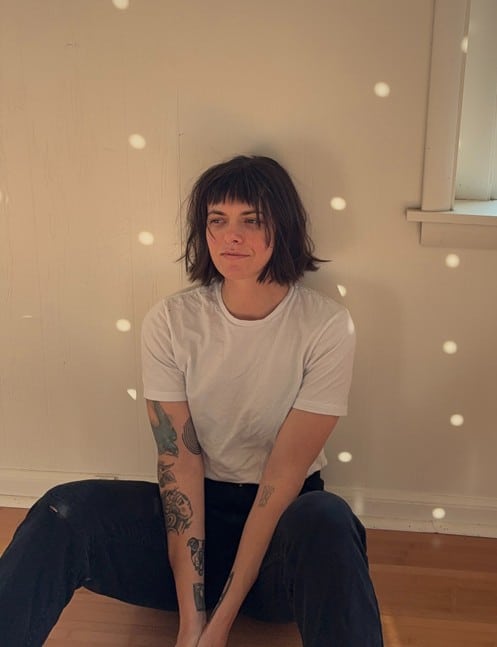
Hiking alone outside of Chillicothe in 2021, Caeleigh Featherstone paused to watch some hawks circle in the sky overhead, struck in the moment by a sense of euphoria that led her to write “Hawk,” a warm, enveloping acoustic number that lands toward the end of new Mukiss album Everything That Shakes Is Changing, out Friday, Sept. 26.
“I never felt safer in my whole life,” the Columbus musician and recording engineer sings on the sun-kissed track, “than right there without you by my side.”
“I was out in the woods on my own, reflecting on multiple past relationships where I’d chosen to put that time in other people instead of taking it for myself,” said Featherstone, reached in mid-September on the road in Asheville, North Carolina. “And I was thinking about how good being alone feels in comparison to being around people who take energy from you. And then I’m just watching these hawks crush it. And it was like, the hawks get it, man. The hawks know what’s going on.”
A donation powers the future of local, independent news in Columbus.
Support Matter News
At the time, Featherstone was enrolled in classes at the Recording Academy, and she initially leaned into the full-length as a means of experiencing the act of creation from seed to harvest, going on to write, record, produce and mix the album entirely on her own. In doing so, the musician also managed to document a stretch of years that she described as personally and professionally transformative.
“I think it’s common to have that experience where you finish a record and you’re like, ‘I’m just so different than this now,’ but I’m hearing all of those changes when I listen back to it,” said Featherstone, who pointed to everything from the different recording techniques she experimented with in crafting the album (“It really sounds like me figuring things out”) to the multiple songs in which she embraces the reality that change is inevitable.
“I swear with every little step,” she sings on album highlight “Blackberry Bush,” “I’m closer to the me I’m trying to impress.”
That particular song, Featherstone said, has its roots in the years she spent growing up in Apple Creek, Ohio, informed by her memories of picking blackberries from the bushes that lined the creek adjacent to the family’s home, and which stained her fingers a dark magenta. These childhood scenes came flooding back years later, when at age 18 the musician spent a season working as a wildland firefighter in the mountains of Northern California, sustaining herself on eggs gifted from a nearby neighbor and the blackberries she picked from the bushes scattered in the surrounding wilderness.
“And in that, I was thinking about nourishment, and the ways I learned to nourish myself as a kid that I do now as an adult,” Featherstone said. “And that’s kind of the theme, or at least the thought process, behind a lot of this record.”
The songs populating Everything That Shakes Is Changing can be warmly nostalgic, Featherstone singing about trawling for crawdads on the childhood-evoking “In Your Room,” as lush and musically comforting as a pillow fort. But like the berry bushes from which Featherstone once snacked, this sonic sweetness can sometimes obscure barbs. Witness the gently surging “Spring Fever,” on which the musician sends her well wishes to an ex – “I hope you see me and I hope you feel like you matter,” she sings – before swiftly pulling the rug from under them: “I hope life gets a little bit harder.”
References to the natural world exist throughout, with Featherstone singing of rivers that carve ever-changing paths, hawks circling the skies, and sunsets so glorious they can make the concerns that cloud our heads feel wholly insignificant. “I think that appreciation for nature was given to me very young. … Growing up, I was definitely out in the woods, building forts, playing in the river, climbing trees, learning to identify them,” said Featherstone, who also credited the slowdown of those early pandemic years with forcing her to pause and take in her surroundings. “Once the pandemic hit, I went into scheduling mode. And I would visit the park every day, and feed the geese every day, and go home and play guitar and write songs. And being able to slow down and experience feeding yourself in that way, where you’re a bit out of the rat race, was huge for me.”
The idea of hitting pause is something that has never come naturally to Featherstone – “I’m sorry that I’m bad at slowing down,” she sings atop a wiry acoustic strum on “Refuge” – and she confessed that in most cases taking a step back in one area generally leads to her shouldering in elsewhere. Most recently, she said she’s begun to counter these forced stretches of stillness with long, punishing runs, having just wrapped one in the intense Asheville heat in the moments before hopping on our call. “And it becomes like, oh, I really haven’t slowed down. I’ve just changed the way I’m doing it,” she said, and laughed. “It’s like, how can I keep distracting myself?”
And yet, it was in these unhurried moments in which the bulk of these new songs emerged, Featherstone recalling the hours she logged sitting in the sun with a guitar in her hands, feeding her dog cilantro from the garden, and waiting to see what form the music might take.
“And I think that’s why [the album] took as long as it did, because I was allowing space for things to surface,” she said. “There’s an intuitive, gut feeling when you’ve hit the right thing and you’re in the pocket. And I still think I have a lot to learn around that concept, but I’m zeroing in on it, and I want to keep working with it so I can get to know that feeling more.”
Author

Related Articles
Church of the Red Museum resumes service for Lost Weekend Records anniversary show
The sprawling Columbus band will bring its ramshackle murder ballads to the stage for the first time in 16 years when it performs at Natalie’s Grandview on Saturday, March 7.

Trek Manifest lives out the stages of grief onstage with ‘Tosca’s Boy Session Part 1’
The Columbus rapper’s new live album, the first in a planned trio, is out now on Bandcamp and hits the remaining streaming services on Monday, March 2.

Stefan Doke puts his back into the making of new Forever Strange EP
The Columbus rock quartet will celebrate the release of ‘EP 2’ at Rambling House on Saturday, Feb. 28, supported by Wax Teeth and Brian Damage.