
CMHA housing pivot a byproduct of the times
The Columbus Metropolitan Housing Authority’s recent decision to purchase a large downtown property nearly a decade after stepping back from that model emerged from being caught in a swirl of a growing need for affordable housing, changes in federal policies, and new ways of looking at housing needs.
Nearly a decade ago, the Columbus Metropolitan Housing Authority sold the 11-story Bollinger Tower for $14 million, displacing residents of 100 low-income apartments. The agency wanted to step back from owning large developments and focus on voucher programs, and on collaborating with developers to include affordable apartments in new housing developments around the city.
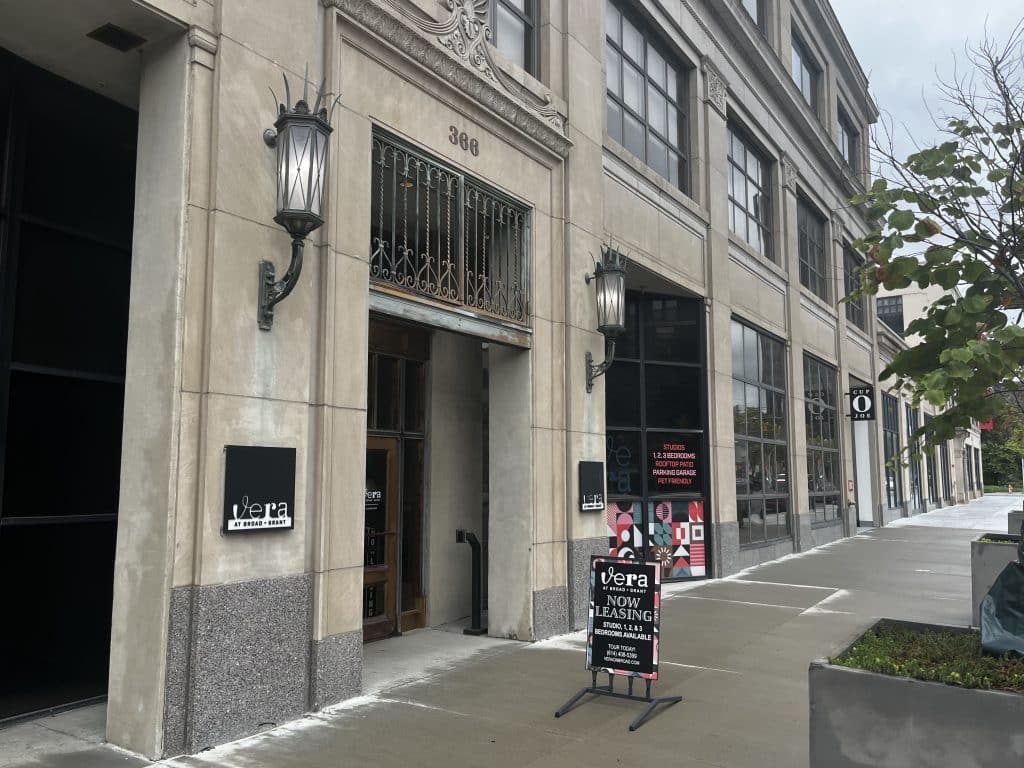
Then two months ago, CMHA announced that it would spend twice that amount – $29.3 million – to buy the 114-unit Vera at 366 E. Broad St. from the Finance Fund. The sale includes a three-story mixed-use building constructed in 1926, which is connected to an eight-story apartment building completed in 2023.
On the surface, it might appear that CMHA got big bucks from Short North fatcats – forcing low-income elderly people to find new homes in areas that did not have the rich mix of transit options available at Buttles Avenue and High Street – and suddenly this year switched policy gears and got back into buying apartment buildings near downtown.
A donation powers the future of local, independent news in Columbus.
Support Matter News
But, looking more deeply, the agency has been caught in a swirl of a growing need for affordable housing, changes in federal policies, new ways of looking at housing needs, and developing mixed-income buildings and neighborhoods.
It’s not just Columbus and CMHA. Federally backed housing authorities have made radical changes in recent decades, largely eliminating the high-rise “project-based” towers and sprawling complexes that were infamous in large cities across the country. In Columbus, this included the Poindexter Village townhome development and the Latitude Five25 high-rises (formerly Sawyer Towers) on the Near East Side. The Poindexter homes, built in 1940, were mostly demolished in 2013 to make way for other housing in the area. The towers, built in 1965, were sold in 2009 and, under a succession of out-of-town investors, finally shut down amid deterioration and mismanagement during Christmas 2022.
For decades CMHA and its counterparts around the country have evolved toward managing voucher-based apartments scattered across metropolitan areas
But even at the height of occupancy in those projects, CMHA housed only a fraction of the households it serves today.
Scott Scharlach, CMHA’s chief operating officer, said the agency owned and operated 1,900 homes 10 years ago. Today, it owns more than 6,000 units of all types – the most the agency has ever had. That’s in addition to the 13,500 homes occupied by families using housing-choice vouchers. All in all, CMHA houses about 160,000 people.
Public housing in the United States has been through decades of transformation – from large high-rise projects and clusters of garden developments to voucher-based apartments scattered across a metropolitan area and now to mixed-income buildings developed by public-private partnerships.
“We serve everybody in our community,” Scharlach said. “We do new-build for people at different levels” through a mix of strategies with a variety of public and private partners. In working with traditional developers as well as non-profit housing organizations, CMHA provides equity loans, construction loans, and issues bonds for developments that will serve renters who receive housing vouchers.
“We’re a fully integrated company,” Scharlach said, noting that this is a new direction among public housing agencies.
In the Near East Side area once served by CMHA’s project-based Poindexter Village and Sawyer Towers, the agency in recent years provided loans and other support for such housing as:
- Harriett’s Hope, a $15 million project with 52 one and two-bedroom affordable apartments for people who had experienced chronic homelessness or human trafficking.
- Scholar House for Former Foster Youth, an $8 million project with 30 apartments for people aged 18-24 who are attending an accredited two- or four-year college or university.
- Legacy Point at Poindexter, an $88 million development with 336 one- and two-bedroom apartments developed by nine public- and private-sector partners.
- Poindexter Place, a $17 million project with 104 apartments for seniors.
As part of its new public-private strategy, CMHA has collaborated with private developers to include affordable mixed-income apartments in many projects beyond buying Vera. These include:
- Scioto Ridge, a 152-unit development north of Hayden Road on Riverside Drive
- Aspire at 360 S. Third St., a new, $39 million, four-story building developed by CMHA with 82 one-, two- and three-bedroom units on the site of the former United Way building. Scheduled to open next year, 38 percent of the apartments are available through vouchers for renters with income at 30 percent of AMI.
- River & Rich, a $71 million project with 200 apartments and 24,000 square feet of retail space for which CMHA put up $47 million in loans. Casto Communities was among several development partners.
- Westrich, a new, $70 million, 234-unit expansion of River & Rich in partnership with Casto Communities. It will open next year with a mix of studio and one- and two-bedroom apartments. The project includes a four-story apartment building and a neighboring five-story building with commercial space and a parking garage.
Throughout the years of changes in national and local housing policies, and amid projected population growth that already has made affordable housing a bigger problem in Central Ohio, CMHA is well-positioned to meet the emerging needs, said Michael Wilkos, vice president of community impact at United Way of Central Ohio. The current climate is exacerbated by federal policy that does not place affordable housing high on its agenda.
While CMHA serves people of all income levels, its current work is not heavily focused on people with incomes below 30 percent of AMI. Much of that effort falls to other nonprofit entities, including Homeport. The Community Shelter Board (CSB), which focuses on people on the lowest rung of the housing ladder (those making the transition from unhoused to basic shelter) is another agency that CMHA expects to work with more closely.
“CMHA is a valued partner to Community Shelter Board and one of the most innovative housing authorities in the nation,” said CSB CEO Shannon Isom. “A Franklin County healthy housing continuum of care is obligated on our partnership and its ability to optimize shared federal resources, aligned with increasing our capacity to respond to the needs of this region.”
Isom said the general housing shortage hits hardest among those at lower income levels.
“In this challenging federal environment,” she said, these local partners “are meeting to keep pace with the needs of the region, from risk-mitigation pools and project-based vouchers to non-congregate shelter and housing-centered initiatives to preserve and produce more deeply affordable homes.”
Going forward, Scharlach said, CMHA’s latest purchase will stick with Vera’s original mix of housing for renters earning 60 percent to 120 percent of the area median income, with an average rent at 80 percent. Scharlach said the building will preserve the “vast majority of units for people under 100 percent of AMI.” Vera has a mix of one, two, and three-bedroom apartments, and is expected to assure affordability into the future.
Fifty years ago, the blocks just north of Vera and just west of CCAD were filled with traditional rowhouses and apartment blocks not unlike the older housing in the Ohio State University neighborhoods.
By pure location, Scharlach said, Vera will be attractive to students, as well as graduates and other people making $15, $20, or $25 dollars per hour. He said people working downtown just out of college are a segment of the population that has long been priced out of downtown.
Vera, Aspire, and other projects finally may fulfill a promise made by Mayor Michael Coleman’s administration 25 years ago, when he unveiled a downtown housing initiative based on an analysis of potential demand, conducted by a Columbus-based national company.
The consultant, Ken Danter, said in the early years of the initiative that “million-dollar condominiums in Miranova are just a small part of the Downtown mix.” He stressed that the strategy for downtown housing “must include new buildings, renovated old ones, lofts, townhouses, high- or mid- rise buildings and houses. A combination of rented and owned units is needed to serve residents of all incomes.” He described it as a “continuum” of housing types that represent all stages of urban living.
It’s a vision with a chance to come full circle.
Correction: The original article stated that the building at 360 S. Third St. was developed under the name Inspire rather than Aspire. Matter News regrets the error.
Related Articles
On Development: Developing better health care and hospitals
Despite the hospital construction projects all over the state, residents across most of Ohio are no closer to health care – and many are even further removed from hospitals.
‘I am not going to stand before God and say, well, I chickened out’: Reflections on building caring coalitions
More than three years after the City of Columbus bulldozed Camp Shameless, one of the founders of the encampment offers their perspective on the housing crisis and the people working at the grassroots to give aid to those routinely left behind.
New affordable housing investments may leave Columbus’ most vulnerable properties, and tenants, behind
Even as new bonds approved by voters hope to transform housing development for years to come, a desperate shortage of affordable units continues to push low-income renters into the lowest-quality homes.