
Staff discontent with leadership continues to grow at Ohio State’s Wexner Center for the Arts
In late August, 13 employees at the Wexner Center signed on to a letter sent to university officials in which they expressed a vote of no confidence in the leadership of executive director Gaëtane Verna.
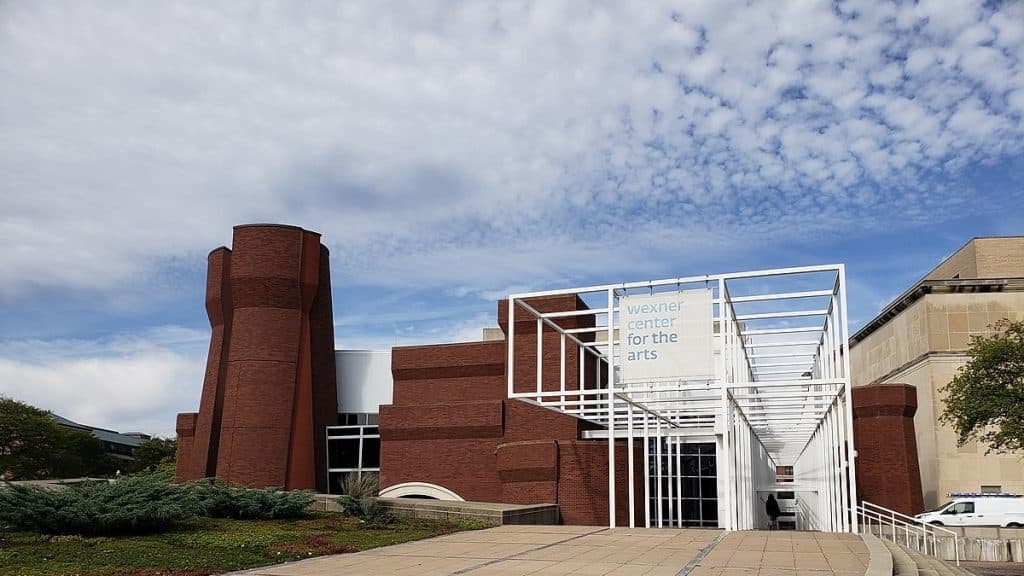
In late August, staff members at Wexner Center for the Arts sent a letter to Ohio State University executive vice president and provost Ravi V. Bellamkonda in which they expressed a vote of no confidence in the leadership of executive director Gaëtane Verna.
“Over the past three years, it is our opinion that her approach has resulted in high turnover, organizational dysfunction, financial instability, and reputational harm,” reads the letter, a copy of which was obtained by Matter News.
Ohio State spokesperson Ben Johnson said the university had “received the letter, takes the allegations seriously, and is reviewing through our established processes.”
A donation powers the future of local, independent news in Columbus.
Support Matter News
The letter was signed by 13 current staff members at the Wexner Center, which Johnson said employs 70 regular workers. Of these, 27 belong to Wex Workers United, whose members were not approached to sign on to the missive, since the union has its own channels for communicating concerns to museum leadership. “Wex Workers United has not been presented with the letter,” the union wrote in response to a request for comment from Matter News. “However, we support our Wexner Center colleagues in working to create a healthy, equitable, and sustainable workplace.”
The letter from Wexner Center staff members to Bellamkonda was dated for Aug. 25 – nearly a year to the day after The Columbus Dispatch published a report in which sources detailed “a culture of dysfunction perpetuated by the museum’s executive director” that at that point had led to the departures of more than two dozen employees. Hyperallergic, a national arts publication headquartered in Brooklyn, New York, followed a month later with a report that included additional accounts from former Wexner Center employees who alleged staff mistreatment, financial mismanagement, and impulsive decision making by Verna.
The Wexner Center workers reiterated a number of these claims in their letter, detailing further instances of what they termed financial mismanagement, including the Wexner Center having been given a financial “red card” by the university for financial instability and the pursuit of a major capital project with a budget publicly listed at $1 million absent “transparent budgeting, staff consultation, or a completed feasibility study.” The letter also raised concerns with Verna’s decision to direct university funds toward a series of exhibition catalogues, a project the workers said will cost more than $200,000 and raised “serious questions about fairness, transparency, and responsible budget use.”
Additionally, the workers wrote that continued mass attrition among staff had “eroded institutional knowledge, disrupted operations, and severely damaged morale.”
“Since Verna’s arrival, nearly 50% of staff have departed, including experienced department heads and senior professionals,” the letter reads. “Former staff have consistently cited her leadership as a factor in their departures.” The letter also noted that seven members of the Wexner Center Foundation Board of Trustees had resigned in the past year, “further destabilizing governance and continuity.”
“I strive to create a respectful workplace where everyone feels comfortable sharing thoughts and ideas. This approach has been consistent throughout my leadership, including at the Wexner Center for the Arts and previous institutions,” Verna said in an emailed statement sent to Matter News in response to a detailed list of questions. “I understand the university is reviewing the letter through its established processes, and I cannot comment further at this time.”
Mark Spurgeon said he resigned as Director of Visitor Experience in May 2025 owing to what he described as the “toxic” environment that developed under Verna’s leadership. Spurgeon said the executive director could be impulsive, prone to outbursts, and dismissive toward staff ideas and concerns – issues he said he raised with HR prior to his resignation, and which he later recorded in a letter he provided to the university during his exit interview, a copy of which was obtained by Matter News. (“The Executive Director has created the most toxic culture I have experienced in a professional environment, marked by a lack of empathy, the belittling of staff, and a dismissive attitude toward other’s expertise and ideas,” the letter reads, in part.)
In a series of interviews, multiple former employees said they also brought their concerns with Verna to OSU through either the school’s anonymous tip line or in formal complaints filed with HR, though it never appeared to the workers as if further administrative action had been taken. “When I talked [to HR], they acknowledged there had been a lot of different complaints and that the information I was sharing was not new to them,” Spurgeon said. “And that was constantly the talk: Is anything going to be done? Is anyone going to do anything?”
One former Wexner Center employee of more than two decades, who preferred to remain anonymous owing to a fear of professional repercussions, similarly cited Verna’s leadership as the primary reason they resigned from their position. The worker described the museum’s executive director as inclined to outbursts that could materialize over even comparatively trivial issues, citing as one example a weeknight in which they said Verna called them at home sometime after 7 p.m. because there was a line of visitors waiting for popcorn ahead of a film screening at the Wex, an account confirmed in interviews with two other former employees. “And the level of anger was so disproportionate that I walked away being like, okay, if this is the kind of reaction I get because people are having an issue with popcorn, what will happen if we have an actual problem?”
The issues raised by both current and former Wexner Center employees mirror the complaints made by workers at Verna’s previous stop, where she served as the director of the Power Plant Contemporary Art Gallery in Toronto, Canada, a number of which were recorded in a document compiled by the Power Plant Union and obtained by Matter News. (Reached for comment about the letter sent by Wexner Center employees to administrators at OSU, the Power Plant Union replied via email that the claims made within were “very concerning and unfortunately familiar.”)
Tammy Eckard, who served as the accessibility manager at the Wexner Center for 13 months beginning in July 2024, said her tenure was marked by uncertainty, with Verna moving her between departments and undercutting her role in ways that she said left her feeling unsure of how to carry forward in her work. (Eckard started in Visitor Experience and resigned from Learning and Public Practice – a departmental move also documented in Spurgeon’s exit letter.)
“And then, of course, I started asking questions, like, why was I moved? Is there something wrong? Do we need to fix something,” said Eckard, whose Wexner Center desk was located in what had formerly been established as a joint comfort room for museum visitors by her predecessor, Helyn Marshall, and which Verna reclaimed as full-time office space. “So, Gaëtane decided to cancel that room and no longer have it as a comfort room, and there was no real reason, and nobody could really explain to me what was happening with accessibility here [at the Wexner Center].”
Eckard said this confusion with her role grew when she sought final sign-off on the purchase of a handful of sensory-inclusive bags – kits that would have been made available to visitors upon request and that would have included things such as ear plugs, weighted lap belts, and sensory devices to help people who felt overwhelmed communicate – a purchase that had already been scoped, researched and approved, and which Eckard said Verna terminated in the final stages.
“And so, I asked for a meeting, [and during the meeting Verna] said she was the executive director and the buck stops with her. And then she said, ‘It’s not never. It’s just not now,’” Eckard said. “And that made me question my role. It was like, why am I here if I can’t initiate, if I can’t research? I have a budget that says I can pay for these things. It’s been scoped. It’s been through the right people. And then [Verna] comes in and axes it out of nowhere. … And this was literally a $1,200 project, so imagine trying to spend the $50,000 that my budget allowed me to do. At that point it was like, I know where I sit and I know where this position sits, and I have no value here.”
Furthermore, after Eckard emailed Verna to request a meeting, she said she learned that the executive director responded by calling her direct supervisor to ask that Eckard be reprimanded for insubordination, informing her boss that Eckard needed to go through the proper chain of command rather than reaching out to Verna directly, a series of events confirmed in conversations with multiple former Wexner Center employees.
“[Verna] creates this system where she’s constantly changing the goals, constantly moving the goal posts. … And as a result, everybody was always unsure what we were doing, what the priorities were,” said Spurgeon, who logged more than 18 years at the Wexner Center over two separate stints, the first from April 2001 through May 2016, and the second from Nov. 2022 through May of this year. “And then you’re working for this person who can fly off the handle at any time. So, walking on eggshells is almost an understatement. … It was easily the most toxic culture I’ve ever had to work in or be around.”
Author

Related Articles

The death penalty in Ohio stands at a critical juncture
For more than a year, Gov. Mike DeWine has teased an announcement related to capital punishment in the state. With his term winding down, advocates fear the time for action is beginning to run short.

On Development: Of salad greens and sensible growth
Many developers and sellers confuse demand for a certain type of housing and a willingness to buy. There are hundreds of thousands of people in central Ohio who prefer older houses and apartments.

Evolved Body Art wrestles with accountability
In interviews with Matter News, former staff members described what they termed a history of inappropriate behavior within the shop enabled and perpetrated by owner Nick Wolak, who said the business is ‘putting in the work to make Evolved Body Art better from the ground up.’