Micah Schnabel and Vanessa Jean Speckman go west
When a rent increase pushed the two musicians from their longtime apartment in Old North, the pair developed plans to relocate to California, moving in with family to better assess future plans. But first, they’ll commune with friends for a farewell show at Rumba Cafe on Thursday, Oct. 23.
The bulk of the songs written over the last 13 years by Micah Schnabel (Two Cow Garage) and Vanessa Jean Speckman (Call Me Rita) have been in some way shaped by the view the pair shared from the window of their apartment in Old North – a short stretch of city blocks that Schnabel described as sitting at an eternal crossroads.
“We’re in this weird little section where it’s not Glen Echo and it’s not quite campus. And it’s people like us, working their hardest, trying to hold on, trying to keep the dream alive,” said Schnabel, who joined Speckman for an interview earlier this week ahead of the pair’s farewell show at Rumba Cafe on Thursday, Oct. 23. “In our neighborhood, they drop the 24- and 48-hour psych holds off right on the corner there with their clear plastic bags of their stuff. And that’s what’s outside of our window every day. I always feel like whatever is happening in America is happening right there in that back alley. I can tell you how things are going. During the pandemic, I saw the brand-new Kia Souls driving through, and it was because the people around us were starting to have a little money for the first time.”
“Todd May asked us, ‘Are your songs going to be different now that your windows will be different windows?’” Speckman said. “And that’s a sincere concern that I have.”
At the end of October, Schnabel and Speckman will become privy to a new view once they finish packing up their belongings and drive cross-country to Santa Cruz, California, having made the difficult decision to abandon Columbus and move in with Speckman’s parents. The two first broached the idea in June after receiving word that their landlord would be increasing the rent on their apartment to “bring it in line with market rates,” raising it to a point that would have required the pair to focus more explicitly on finances rather than keeping the creation of art and music at the fore of their existence.
A donation powers the future of local, independent news in Columbus.
Support Matter News
“At first it was flipping the table. And then it was looking for jobs. And then it was looking for apartments. And then it came back to, well, what do we really want to be doing right now? And if we want to stay 100 percent with the art, what are we willing to compromise?” said Speckman, who described the move to California as a way “to triage the chaos,” buying the two additional time to regain their footing, assess the creative landscape, and figure out what might be next.
“We’re very privileged to be able to move in with Vanessa’s parents for a bit to kind of see what’s shaking in the world, because at least on our side of things, it’s crumbling,” said Schnabel, a touring artist of multiple decades who in recent years has watched the club scene in which he long sustained a career begin to erode more rapidly amid a combination of post-pandemic drag, skyrocketing real estate, and deepening economic uncertainty.
The way these economic realities can weigh people down, leaving them kicking and straining just to keep a head above the surface, has long bled into the songs written by the two. Witness “This Is a Stick Up!” by Speckman’s band Call Me Rita, on which the artist and poet twists blandly generic executive speak (“You have to spend money to make money”) into a lacerating indictment of our capitalist system. Then there’s Schnabel’s solo album, The Clown Watches the Clock, from 2024, which untangles a version of the American dream corroded by greed and increased social isolation, the musician breathing three-dimensional life into characters who could live on the same Old North block as he and Speckman (see: the struggling artist in one song who waters down the shampoo to extend the bottle just a few more washes).
“These are first-hand experiences, and they’re things that, especially in American society, people don’t really talk about,” Schnabel said last year. “So, in talking about those things, I hope it allows people to laugh and to have a moment of not feeling alone.”
The two have gradually discovered a similar comfort in talking about everything from their decision to move to the realities of what is required to eke out a life within the art world and how thin the line between survival and destitution can be for so many now existing day-to-day in our country.
“There’s a lot of shame and embarrassment, because I’m 43, and most of our friends own homes or have at least settled with things,” Schnabel said.
“And I think talking about it has been helpful for me, personally,” Speckman said. “A few people have reached out and said they’re moving through similar situations. And then also talking about where things come from, like where people get down payments for homes, and where people get support in caring for their children so that they’re still able to work.”
While the narrators populating the pair’s tunes are often jaded by their living situations, the songs never fall over into cynicism, frequently buoyed by a sense of humor and an unshakeable belief that brighter days could still be possible on the other side of the grind. For the two, this idea manifested in the last-minute recording of a new album, which involved taking the 10 songs written in these recent years of political and economic instability and then transforming them into defiant, celebrational outpourings alongside the Columbus musicians who in many ways have become family.
“It feels like we captured this sense of urgency, and a moment in time in our lives, a moment in time in America,” Speckman said of early October sessions for the new full-length, which the pair hope to release digitally in early December ahead of an extensive tour planned for 2026. “I guess I just feel excited to say the things that I think we’re all feeling. … And you can sing or speak about heartbreaking things and put it to music and perform it live, and it can be fun and rebellious and defiant. … Even in the making of the record, we would all be talking, like: ‘I’m not sleeping so good right now’; ‘My anxiety’s been really bad’; ‘I’ve been drinking too much.’ And it was like, ‘Guys, I don’t think we’re doing too well right now. And that’s the topic of the whole record, and I think it’s why we’re all here.’ But even just in those few days that we practiced and in the few days of recording, in our little community of four or five people, we were able to get our heads above water, and there was this sense of dedication and focus and joy.”
Author

Related Articles
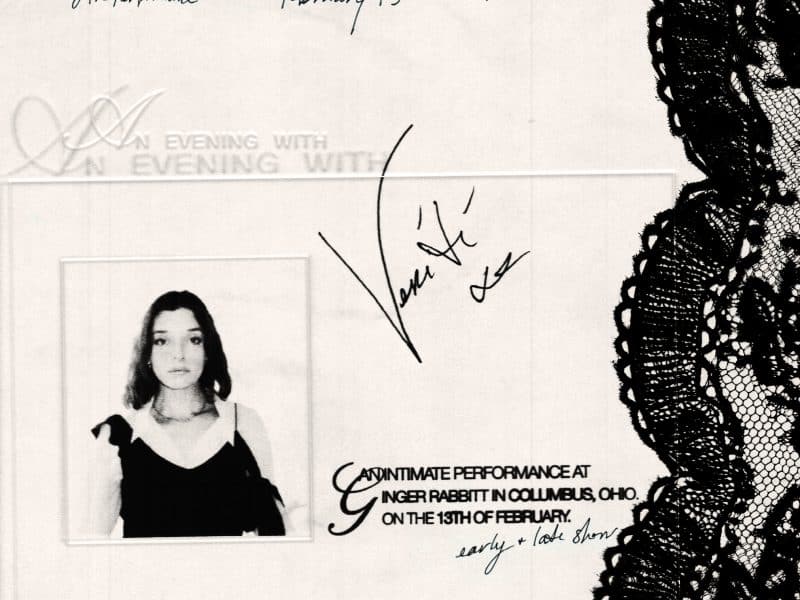
Vérité strikes up a connection with the debut of June’s Room
The new bi-monthly music event makes its debut on Friday with a pair of sold-out Ginger Rabbit shows from New York-born musician Kelsey Byrne, aka Vérité.
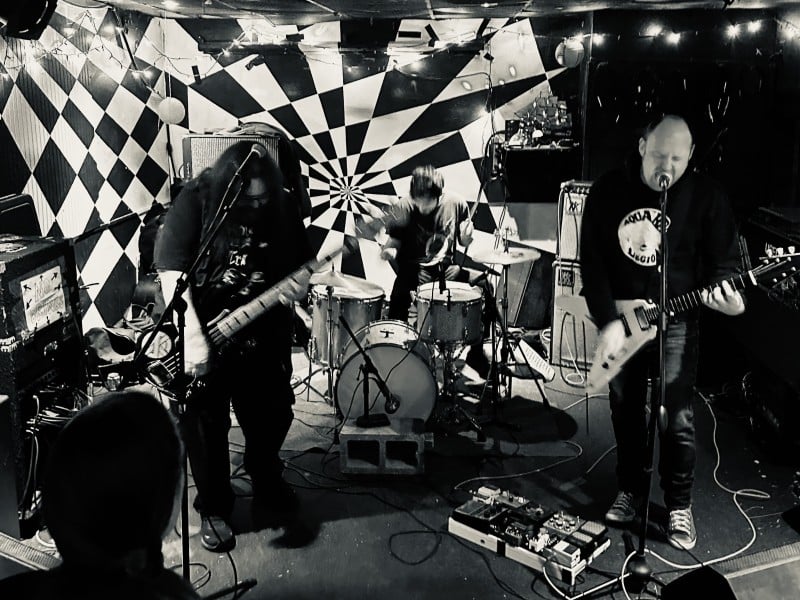
Unemployee rages against the daily grind on ‘Cassette Tape’
Longtime Columbus musicians Bo Davis, B.J. Holesapple, and Mat Bisaro make a marvelous racket on their debut release, which will be available for preorder beginning on Saturday, Feb. 14.
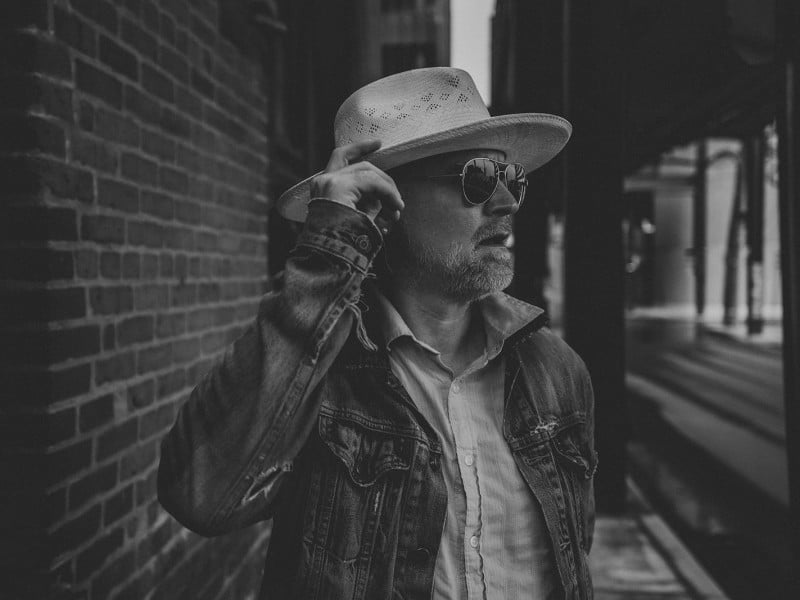
Billy Peake holds to hope while navigating these ‘Manic Waves’
The Columbus musician will celebrate the release of his new solo LP in concert at Natalie’s Grandview on Saturday, Feb. 7.