
Tim Rutili continues to mine connection in Califone
Still on the hunt for answers to unknowable questions, the musician will join his bandmates in concert at Rumba Cafe on Saturday, April 11.
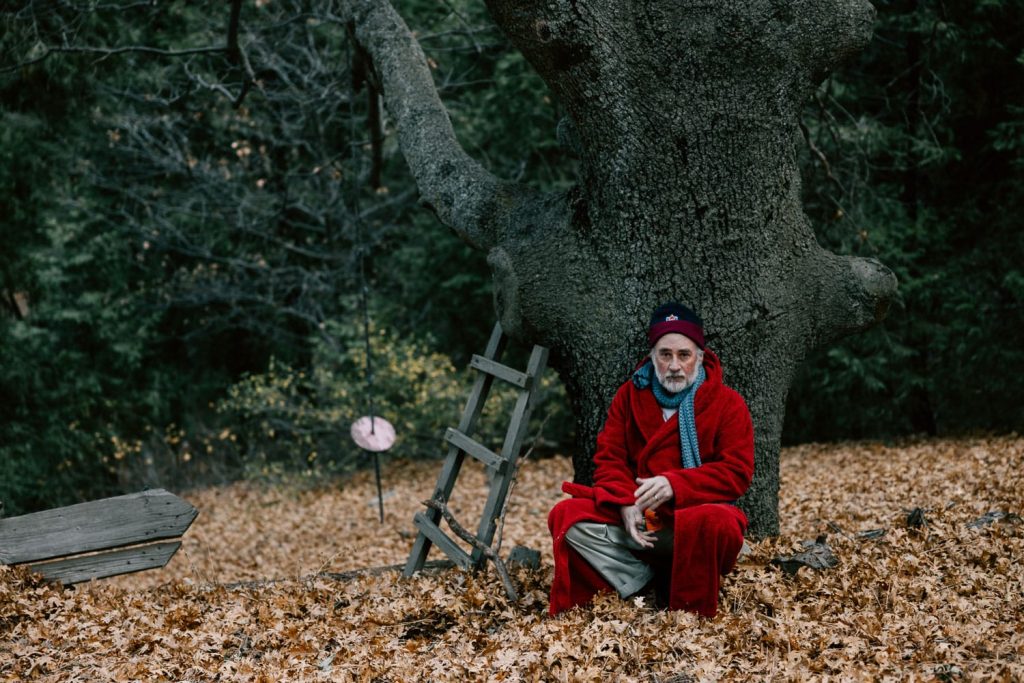
Early in the pandemic, Califone’s Tim Rutili began to toy around with a handful of covers, including “Crazy as a Loon,” by John Prine, and Mecca Normal’s “Family Swan,” with Rutili later recalling the first time he saw the Canadian duo in concert in the late ’80s, and how it made him feel as though he wasn’t so alone in the world – a concept to which he might have been trying to maintain grasp as Covid took root and drove people deeper into isolation.
But the undertaking also caused deeper aftershocks, cracking Rutili open and leading to a creative outpouring that helped to shape a pair of albums: Villagers, from 2023, and last year’s The Villager’s Companion, which included both the Prine and Mecca Normal covers among its tracklisting.
“Learning those songs and getting into them really made me think and really inspired me to write, for sure,” said Rutili, who will join Califone bandmates Max Knouse (guitar), Joe Westerlund (percussion), Brad Dujmovic (bass), and Rachel Blumberg (drums) for an early show at Rumba Cafe on Saturday, April 11, supported by the Columbus rock band Moviola. “I think both of those songs are stories with characters, and they made me dig a little bit deeper into the lyrics and try to give my songs, whether they seem abstract or not, more of an arc, like a movie or a book.”
A donation powers the future of local, independent news in Columbus.
Support Matter News
There has long been a surrealist bent to Rutili’s songwriting, which the musician traced in part to the inspiration he has always found in overheard snippets of conversation and fuzzy recollections of his own fractured dreams. “All my friends are half-gone birds,” he sings atop rickety acoustic strumming and the lilting pluck of piano on the steadily building “Funeral Singers.” “Are magnets, all my friends are words.”
“Sometimes things stick in your head for seemingly no reason, and those are the things I sometimes fixate on,” said Rutili, who will occasionally linger on a phrase for no other reason than the sound the consonants make bumping up against one another. “Sometimes the words just have this ringing musicality to them that lends themselves to a song. … And sometimes it doesn’t mean much ever. And sometimes it’ll be years later, playing the song at a show, and you’re like, ‘Okay, that’s it.’ And then it’s not about the past; it’s all about the present. You’re sort of working through your subconscious brain a little bit.”
For Rutili, music has always existed as a space in which he can begin to unpack those things he doesn’t fully comprehend, the singer describing his creative practice as an attempt “to put into form something that’s too abstract for words.”
These motivations have remained steady throughout the years, with Rutili acknowledging a desire to suss out and capture those rare moments of transcendence. “I’m still searching, and I’m still looking,” he said. “And that’s probably why I continue to do this.”
It helps, of course, that the ideas turned up in these excavations can begin to crystallize given the benefit of time and distance, and Rutili said he can now discern in Villagers everything from his reflections on aging to the thoughts dredged up by a move that left him considering the places from which he’d come. The Villager’s Companion, in turn, ripples through with a mistrust of technology that has only intensified for the musician amid the increased prevalence of AI. “There’s a feeling in those songs of being overwhelmed and trying to remain human,” he said. “And that’s something we’re all trying to deal with – that feeling of helplessness when the whole world is going way faster than it can handle into fascism, or into some weird tech sci-fi shit.”
Given the relentlessly chaotic nature of this modern world, Rutili has increasingly leaned into Califone’s concerts as a place of respite and connection – “It feels really good to play human music to humans in this weird day and age,” he said – developing a conversational approach with his bandmates that has imbued the performances with natural fluidity as the players twist, mold, stretch, and extrude the songs like sonic Play-Doh.
“There’s room to improvise, and everything is sort of elastic, where we’re adapting to where we’re playing, whether it’s someone’s house or a bar or a little theater or whatever,” said Rutili, who noted a similar spirit taking hold in the band’s concerts no matter the venue. “I know that when we go play shows, it’s usually to people who want to hear the music. And when there are a bunch of people together in a room all paying attention to the same thing and maybe putting down their phones and shutting off their brains for a little while, I think that’s a good thing. … I don’t know. In this moment, dancing is probably more important than ever. And we don’t get a lot of people ripping it up and dancing at our shows, but it does feel like a good thing to be doing, even on our small scale.”
Author

Related Articles

Eric Rollin finishes what he started with ‘The Ego Scout’
The Columbus rapper will celebrate the release of his new album at the Royal Oak Initiative on Thursday, April 9.
How a Columbus trio ended up backing Tenacious D’s Kyle Gass
Mt. Air teamed with Gass for a string of Midwest dates that includes a stop at Rumba Cafe on Saturday, April 4.
Wednesday speaks for the people on the fringes at King of Clubs
Performing in Columbus on Monday, the North Carolina band displayed a knack for giving three-dimensional life to those out-of-sight folks who are often victims of circumstance.