
Anduril teach-in highlights Ohio State’s long-developed military connections
The fight over the Arsenal-1 plant is a part of a larger struggle for the future of the country but also the soul of one of America’s largest public universities.
On each corner of Ohio State University’s football stadium, there are massive banners displaying the text “DEFEND THE ‘SHOE.”
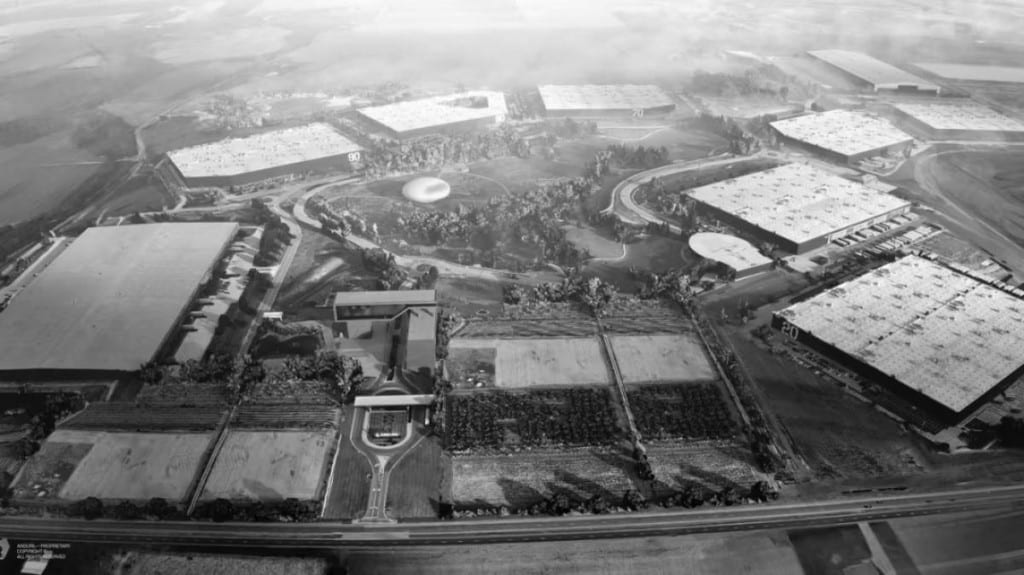
The tagline is a rallying cry for the football team, but it’s also a play on words referencing the university’s newest sponsor. In August, the AI-weapons contractor Anduril Industries signed on to sponsor the university’s athletic department in a multi-million-dollar deal. The sponsorship is a part of a campaign to introduce the company to locals after it announced plans to build a massive factory called “Arsenal 1” on Columbus’ South Side.
Anduril’s sponsorship is the latest, and perhaps the most brazen, example of defense companies partnering with the university. The history of that lineage was the focus of a December teach-in delivered on campus in Denney Hall. Titled “Academic Military Industrial Complex,” the event was organized by a coalition that included Students for Justice in Palestine, Faculty and Staff for Justice in Palestine at OSU, and the group No Anduril Plant (NOAP), and was led by PhD candidate in Geography, Kat Finneran, who’s from Findlay, Ohio, the corporate home of Marathon Petroleum. It was through studying fossil fuels that she arrived at the connection to the military.
A donation powers the future of local, independent news in Columbus.
Support Matter News
“These connections, at first, I wasn’t necessarily looking for, but they just kept popping up,” she told the packed room. Over the course of an hour-long presentation, Finneran tracked the history of the university’s entwinement with the military from the run up to WWII through today, arguing that Anduril is not an anomaly but rather part of an ongoing legacy.
From WWII to the Cold War Geodesy
Finneran framed the presentation with a definition of the Academic Military Industrial Complex by scholar Henry Giroux: “The ways in which militarization is shaping university life, and focuses on the growth of militarized knowledge and research, the increasing development of academic programs and schools that serve military personnel, and the growing influence of the CIA on college campuses.”
At OSU, Finneran argued, this complex is powered by “logistics, transportation, aviation, proximity to industry but also … Buckeye Nationalism” – the intense, sports-driven culture of institutional loyalty that can silence dissent.
In 1936 the Ohio State University Research Foundation was established and became the backbone of what was to come. “It becomes the structural base for future defense contracts,” Finneran said. That funding became essential during WWII, when research was needed for mapping Japan, radar studies, and the Manhattan Project. In these early years, OSU built its own airport to train pilots. “The pilot program is specifically deeply tied to the Air Force,” Finneran said. (The lead pilot who dropped the “Little Boy” atomic bomb on Hiroshima, Paul W. Tibbets Jr., even lived his final years in Columbus.)
Established in 1947, OSU’s Mapping and Charting Research Laboratory (MCRL) was funded almost entirely by the Air Force and became an essential part of the Cold War. The Geodesy department was studying Soviet and German geodetic maps and providing the groundwork for war with the Soviet Union. In the 1950s, the Institute of Geodesy, Photogrammetry, and Cartography (IGPC) grew to national prominence when it earned Department of Defense funding to study gravity data intended to assist ballistic missiles and satellites. The Institute of Polar Studies helped develop warning systems and submarine systems in the 1960s around the same time the campus’ nuclear reactor was activated – a research reactor that’s still in use today. “It was here at OSU where we mapped the Earth for nuclear warfare,” Finneran said.
This entanglement often operated under what scholars call the “shutter box model,” where, as Finneran put it, “the passage of people, money, and data back and forth between the worlds of academia and national security” is hidden from public view. Another example of the shutter box model included two secret CIA-funded studies carried out by OSU professors, one of which involved controlling the behavior of professors.
“So, the presence of the CIA at OSU is particularly strong,” Finneran said. “And I’ve been told for years that we’re a CIA feeder school.” In 2022, the College of Arts and Sciences at OSU hosted an information session titled “Career Paths with the CIA – From Analysts to Auditors and So Much More.”
Campus Nuclear
One of OSU’s most embedded entities is Battelle, a 501(c)(3) nonprofit charitable trust “organized for charitable, scientific and education purposes.” Headquartered just south of campus, the nonprofit is connected to the university directly through the Battelle Center for Science, Engineering, and Public Policy, located in Page Hall. Founded with the mission from Gordon Battelle of Columbus Iron and Steel “to benefit mankind through science,” the organization is simultaneously a cornerstone of the U.S. nuclear weapons complex.
“Things that come out of Battelle are things like the N95 mask,” Finneran said. “So, this is the problem with Battelle: They have these really cool things that they also do on top of managing six nuclear weapons laboratories.” (Battelle currently runs six of the 17 nuclear weapons laboratories in the United States and receives billions of dollars for nuclear weapons research and development.)
Battelle is only one nuclear investor at OSU. The American company Centrus Energy, which owns a nuclear plant in Southern Ohio that was instrumental during the Cold War and has been connected to higher cancer rates in the region, invests heavily in research for its nuclear fuel and technology. The French energy company Engie, which runs the campus’ energy infrastructure, also operates nuclear energy facilities throughout Europe.
Anduril
“I wasn’t 100 percent sure it would actually be developed until I saw that it donated all that money to the athletic program,” Finneran said of the Anduril plant. “And that’s when I knew for sure it was coming.”
For Finneran, the arrival of Anduril is a logical progression of the decades-long culmination of Cold War research in Central Ohio and at OSU.
The founder of Anduril has been outspoken about his ambitions to use the company’s AI weapons in a war against China, continuing the legacy of the Cold War. Anduril also plans to manufacture its “Lattice system” in Columbus, an “AI-powered iron dome” that utilizes drones and cameras to defend borders such as America’s southern border with Mexico, and is similar in concept to Israel’s Iron Dome, designed to stop missiles before they land. Finneran highlighted one of OSU’s largest benefactors, Max Fisher, who was an investor in illegal Israeli settlements in Palestine and a good friend of Henry Kissinger. (The Fisher College of Business is named after him.)
Resistance and Legislation
In February, a group gathered outside of Rickenbacker International Airport to protest the proposed Anduril plant. “If you would like to see foreign policy not made by weapons manufacturers, then we must take this seriously,” one of the protesters said under a flag that read “Veterans for Peace.”
Since then, a coalition has grown to pressure local officials to halt the construction of the plant, with efforts focused on halting needed zoning changes and permit approvals. They’ve called for opposition to Ohio House Bill 292, which would create a state “Defense Commission” funded by interest payments from Israel Bonds to fund research and development of the defense sector in Ohio.
The introduction of Anduril on campus is the latest iteration of a “Cold War campus” that could build the intellectual and political infrastructure for the next generation of warfare and surveillance. It’s through presentations like Finneran’s that the present is demystified through an analysis of history. These efforts also bring into greater relief that the fight over the Anduril plant is not just part of a larger struggle for the future of the country, but also for the soul of one of America’s largest public universities.
Related Articles
On Development: Developing better health care and hospitals
Despite the hospital construction projects all over the state, residents across most of Ohio are no closer to health care – and many are even further removed from hospitals.
Local Politics: Proposed trade partnership with Israel draws criticism
A bill to create an Ohio-Israel trade partnership is under review in the State Senate. Reactions in the city have been mixed at best.

‘I am not going to stand before God and say, well, I chickened out’: Reflections on building caring coalitions
More than three years after the City of Columbus bulldozed Camp Shameless, one of the founders of the encampment offers their perspective on the housing crisis and the people working at the grassroots to give aid to those routinely left behind.