
On Development: Nudge the market to get the city we need
While designed to enable small and large developers to meet the needs of a growing city, Zone-In stops short of encouraging some of Columbus’ development needs.
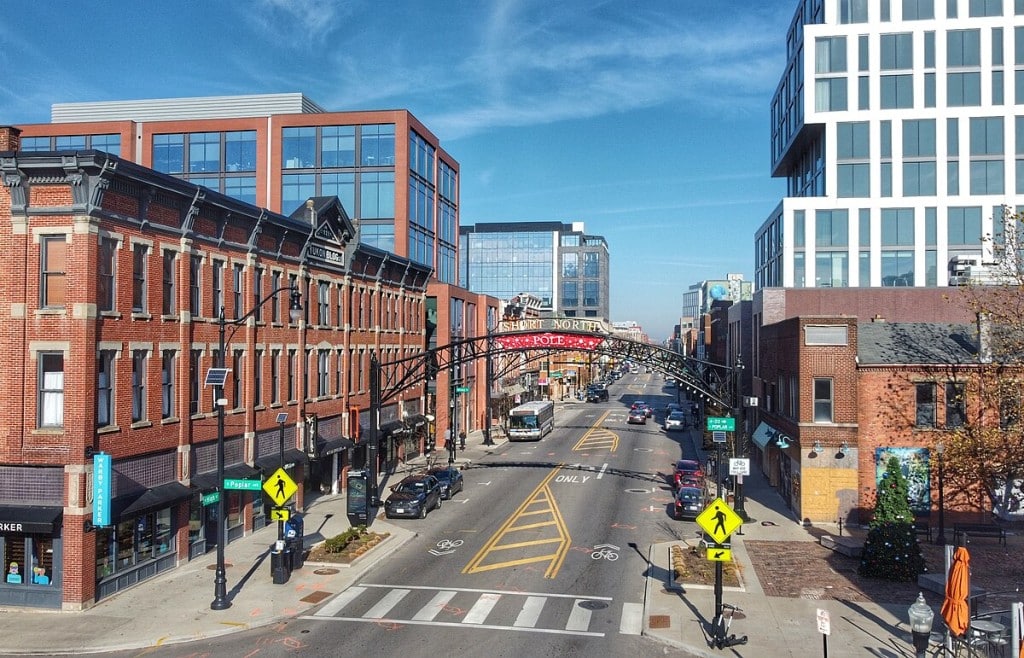
The intersection of Lane Avenue and High Street gets all the attention.
On the northeast corner, Georgia-based Landmark Properties wants to build a 16-story tower on the site of a CVS pharmacy. CVS would reopen in the new building, with apartments above.
Across High Street, just north of Lane at W. Norwich Ave., Austin-based American Campus Communities wants to build a nine-story apartment tower on the site of The Little Bar, along with a connected apartment building at 50 W. Lane Ave. on the site of University Baptist Church. That project was shelved amid opposition before the City Council approved a new zoning code last year.
A donation powers the future of local, independent news in Columbus.
Support Matter News
This comes amid a frenzy of campus-area development over the past decade – during years when off-campus growth was expected to slow due to an Ohio State University rule requiring sophomores to stay in campus housing.
Two miles north, Clintonville has its own busy intersection at North Broadway and High streets. The lanes are wide to accommodate traffic – including COTA bus routes on both thoroughfares. But while the intersection of Lane and High is becoming overbuilt, the Broadway corner is clearly underbuilt. Broadway has the same zoning as Lane but is dominated by suburbia: a Kroger and huge parking lot; a phone store and small parking lot; a small, four-story office building set back from the sidewalk; and a couple of throwaway commercial structures with a bank, a fitness center, a chain barbershop, and a restaurant.
While designed to enable small and large developers to meet the needs of a growing city, Zone-In stops short of encouraging some of Columbus’ development needs. City leaders have often talked about the need to have more housing on transit routes. In fact, that’s the crux of LinkUs, the far-reaching initiative to add COTA bus-rapid-transit to major growth corridors. This is being planned on the assumption that more-intense development will occur on those corridors.
Maybe Columbus needs more than an assumption that the development will follow. Maybe Columbus should include minimum height restrictions in addition to maximum height limits on transit corridors. It’s not a radical idea. It’s called “transit-oriented development,” and it’s become more common across the country in recent decades.
Sound Transit – COTA’s counterpart in Seattle – has a development arm that sells unused or under-used agency-owned land below market rates to developers who build affordable housing on transit lines. In Cleveland, the push for new development along transit lines got a boost through a Transit-Oriented Development Loan Program established by Cuyahoga County. The gap-financing loans cannot exceed 40 percent of the project cost. It’s aimed at mixed-use projects that increase density along transit lines.
City planners and other officials stress that Zone-In seeks to remove barriers to development, while height minimums would increase restrictions. That’s a point I heard from Harvey Miller, director of the Center for Urban and Regional Analysis (CURA) at OSU. He said the market would decide when taller buildings were warranted at a commercial intersection along a major transit corridor.
That could be true, assuming that developers act strictly on rational decisions about citywide and regional housing needs. But developers are highly specialized and recreate in one city something that they have done in another. Developers of student housing don’t look at young families or part-time students living in neighborhoods, like Clintonville, that are beyond the campus scrum.
When I drive or bike past the intersection of Broadway and High streets, I look at asphalt and low roofs and see unbuilt affordable housing. But I see unbuilt affordable housing everywhere.
This includes the Near East Side, where the last two of the 33 Poindexter Village public housing apartment buildings constructed 85 years ago are slated to become a museum. Even though hundreds of new apartments have been built on and near the Poindexter site, I thought the last 15 or 20 units of Poindexter Village could honor their heritage by becoming modernized affordable housing.
While Miller and I agreed to disagree on transit-oriented development, this time he convinced me that a housing museum is a great idea.
Miller sees the irony of turning housing into a museum about the loss of housing but said the new neighborhood that emerged in recent years more than makes up for the apartments lost. In addition, the museum will shine a light on the injustices suffered by the neighborhood during segregation and the development of urban freeways that cut through low-income and minority neighborhoods, wiping out equity residents built over the years.
CURA’s “ghost neighborhoods” project uses historical maps and 3D modeling to recreate the lower income – and usually Black – neighborhoods that were razed in the 1960s to make way for Interstates 70 and 71 east of downtown. CURA and the Ohio History Connection will show how highways turned tax-generating neighborhoods into tax-sucking highways that became exit ramps to the suburbs.
Brian Williams is a semi-retired journalist and planner
Related Articles
On Development: Of salad greens and sensible growth
Many developers and sellers confuse demand for a certain type of housing and a willingness to buy. There are hundreds of thousands of people in central Ohio who prefer older houses and apartments.
How Wexner’s desire for a city center led to a more fragmented Columbus
As the central Ohio retail magnate faces a larger public reconciliation owing to his ties with disgraced financier Jeffrey Epstein, a look back at how the Wexner name became so synonymous with the city.

Local Politics: The fallout of serving ICE(d) coffee
A local coffee chain has been under fire for saying it would not refuse to serve ICE agents. But the people who work there say that’s not the full story.