
On Development: Traffic violence is more than an accident
Traffic violence is not a term in common usage. But it’s a whole lot more accurate than “accidents” – a benign misnomer for the carnage that can take place on our streets and highways.
Maybe it’s a jaded result of a career as a news reporter, but I’ve never been a fan of “day of remembrance” programs and rallies. Often, they tend to be smallish events attended by the same gaggle of idealists preaching the same message year after year through portable and persnickety microphones and speakers.
Then again, maybe they are small events that lack impact because jaded reporters don’t pay enough attention.
The World Day of Remembrance for Road Traffic Victims has roots going back 30 years or so in England. Within a decade, the events spread across Europe and to Africa, South America, Asia, and even the United States. As with Thanksgiving, the organizers found a way to standardize the day of remembrance: It takes place every year on the third Sunday in November.
A donation powers the future of local, independent news in Columbus.
Support Matter News
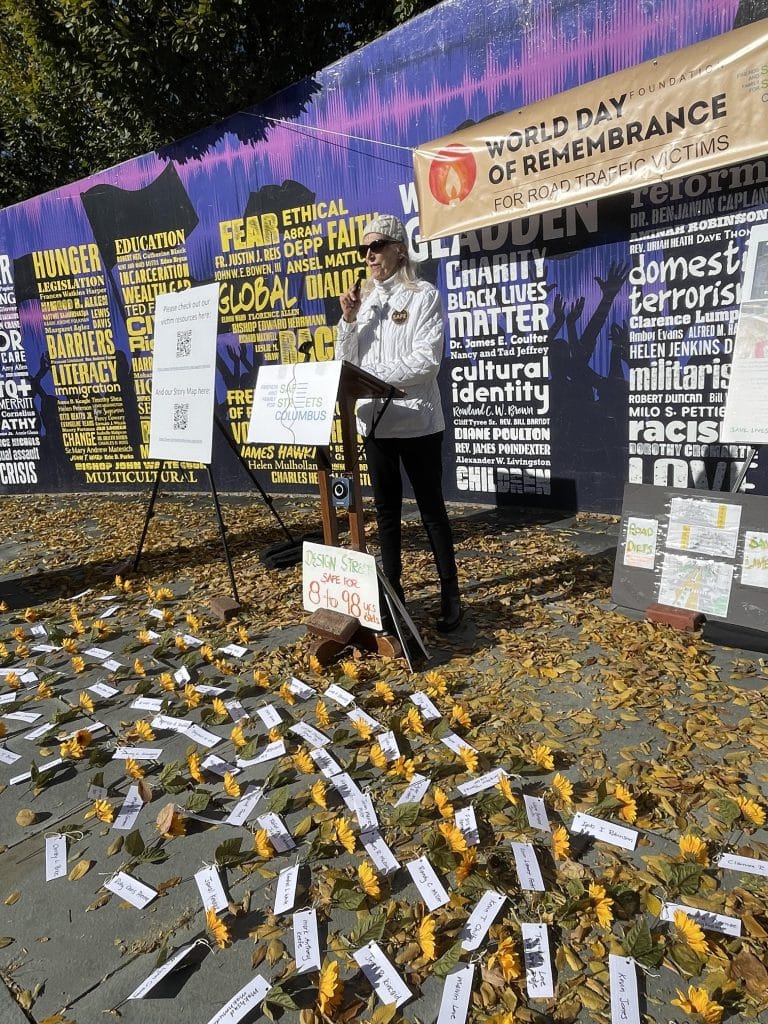
In Columbus, Ginger Tornes, who heads Friends and Families for Safe Streets Columbus, organized the local day of remembrance for road-traffic victims on Sunday, Nov. 16, at Washington Gladden Social Justice Park.
It was not huge – perhaps 40 people attended – but the array of speakers and other attendees covered the spectrum from victims, loved ones of victims, first responders, and emergency-room doctors to insurance-industry lobbyists and a former director of the Ohio Department of Transportation. And many of them stressed that language and terminology can be barriers to policies that would reduce what Tornes called “traffic violence.”
Traffic violence is not a term in common usage. But it’s a whole lot more accurate than “accidents” – a benign misnomer for the carnage that can take place on our streets and highways. Traffic engineers and transportation agencies have replaced “accidents” with “crashes” – a term that hints at the deadliness of traffic violence but avoids the question of causation or fault.
Valerie Glover does not mince words: “A vehicle is a weapon,” she said.
She is the mother of Brittany Glover, who was killed by a hit-and-run driver while crossing a street three years ago. Valerie Glover reminded those at the remembrance that the fleeing driver still has not been found.
Another topic at the event included laws and policy:
- Sharon Montgomery, who lost her husband in a crash a quarter century ago, has made traffic safety a quest in the years since then. One fact that frustrates her is that, according to the Ohio Revised Code, people who are killed or maimed by cars are not, by law, considered victims. Among the quirks in Marsy’s law – a 2017 amendment to the Ohio Constitution to provide more protection for crime victims – is that it “excludes most traffic violence casualties from the definition of ‘victim,’” Montgomery said.
- Dr. Mark DeBard, a longtime emergency room specialist at Ohio State East Hospital, has tales of traumatized first responders and ER staff trying to save “victims” and putting them back together – sometimes facing injured friends on the operating table. But most of his remarks focused on seat-belt and auto-insurance laws. He said enforcement of laws requiring drivers and car owners to have auto insurance and use seatbelts are lax. “If you go to a bar and want a drink, you can tell the bartender you’re 21,” he said. “But the bartender will ask for proof. … Trust, but verify.”
- Dean Fadel, president and CEO of the Ohio Insurance Institute, echoed DeBard’s comments. Fadel noted that, during the COVID shutdown in 2020, the number of U.S. car crashes increased by 5 percent – despite significant declines in traffic. The United States is the only industrialized country in the world to have an increase. Meanwhile, Germany’s crash rate declined almost to zero.
“Driving is a group activity,” Fadel said. “Driving inherently requires awareness of any other vehicles on the road.” But too many drivers are distracted. Research shows that people using cell phones have limited ranges of vision due to distraction.
“Looking and seeing are two different things,” Montgomery added, noting that what passes through our sight may not register with the brain if our minds are somewhere else.
In addition to speakers, the effort drew other supporters of the effort to stop traffic violence. Lauren Cardoni, Senior Transportation Planner at the engineering firm Burgess & Niple, brought 89 flowers, each tagged with the name of one of 89 people killed in Franklin County crashes during 2024. The flowers were spread in front of the lectern. First responders from Station 1/Station 9 of the Columbus Division of Fire, and Jack Marchbanks, former director of the Ohio Department of Transportation, lent moral support.
One theme not emphasized at the Day of Remembrance was road design. Multi-lane thoroughfares lined by shopping centers (such as Morse and Refugee roads) have few places for people to safely walk across the road. The high speeds and expanding size of vehicles make such areas even more deadly – especially for pedestrians. That is a topic for another column.
Brian Williams is a semi-retired newspaperman and planner.
Related Articles

Opinion: Get ICE out of the Franklin County Municipal Courthouse
Allowing federal agents to make arrests at the courthouse without judicial warrants or a court order is an affront to justice.
Local Politics: Show me the (weed) money
Under a new state law, Columbus will get payouts from a cannabis sales tax fund. We’ve been owed that money for two years.

There’s nothing passive about hope
They expect you to give up when they ‘flood the zone,’ marshalling chaos and outrage to divert your gaze. In the face of despair, we must continue to rise.