
Opinion column: A district in name only
The conversations taking place in the wake of Tiara Ross defeating Jesse Vogel for a seat on Columbus City Council suggest the city might finally be shaking off its history of complacency.
It’s refreshing to see even a little bit of public pushback over Tiara Ross’ Columbus City Council victory in the 7th District – despite being trounced in the district she ostensibly will represent.
Jesse Vogel won nearly two-thirds of votes within the district, to no avail. Since then, editorials and citizen commentaries have gotten people wondering whether arbitrarily drawn council districts bring new representation or old cliquishness.
It’s a sign that Columbus is growing out of its inferiority-complex heritage.
A donation powers the future of local, independent news in Columbus.
Support Matter News
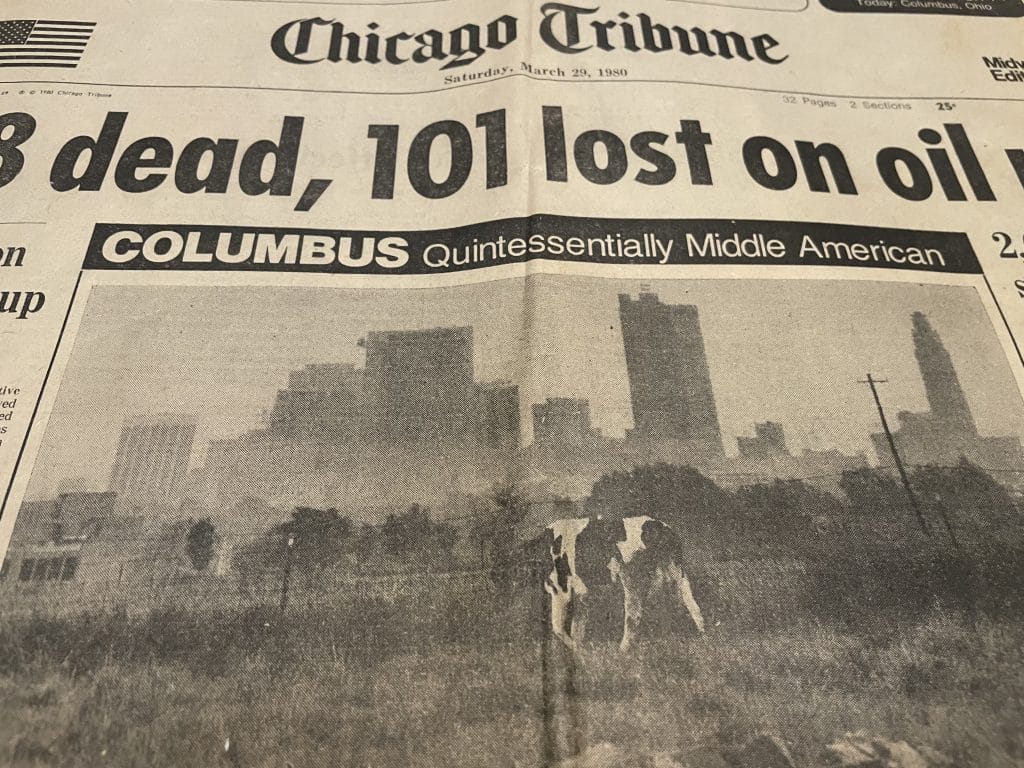
On March 29, 1980, the front page of the Chicago Tribune featured a photo of a Holstein cow grazing in a pasture north of Lane Avenue with the downtown Columbus skyline looming in the distance. Above the picture was a headline: “COLUMBUS: Quintessentially Middle American.”
As the sixth part in an 11-city analysis of “The American City: Challenge of the 1980s,” the Tribune article began with a quote from Mayor Tom Moody: “We tend to do everything in this city at about a B-grade level. But though we may not be first-class in anything, we’re not third class in anything either.”
The city’s motto might as well have been: “Good enough for us!”
The best thing about Columbus may be the fact that it’s an easy, comfortable place to live.
The greatest downside to Columbus is the tendency for this comfort to fade into complacency.
There’s that Grade B again. It’s not so bad; therefore, it’s good.
This malaise is abetted by local mainstream media, which traditionally has done little to explain the stakes of local elections. In the last couple of decades, city council elections have been little more than a couple of biographical paragraphs about each candidate, boosted by a couple of quotes about their love of the city and their support for growth.
Before I returned to Columbus as a reporter in 1995, I worked five years at a much smaller newspaper in Minnesota, where the Editorial Board identified key challenges facing the city and then grilled the candidates on those topics.
Local media should not necessarily determine what issues dominate the campaign agenda for Columbus mayoral and city council elections. But reporters should use the campaign as an opportunity to analyze recurring themes in news coverage – basically, to take an active role in identifying critical issues and ensuring that all candidates address those issues.
Reporters should ask candidates about things such as an evolving, expanding role of the Downtown Columbus Inc., and why so many tasks fall under the umbrella of a large, quasi-public entity about which voters have little say. They should ask why the city co-opts independent and citizen-operated entities (Capital Crossroads and Discovery District special improvement districts, and Friends of Tuttle Park, for instance) instead of embracing citizen groups and nonprofit organizations as assets that strengthen the community.
A goal of campaign coverage should be to engage voters, to encourage them to ask questions and seek answers. Post-election reporting should have the same goal. Here are a few obvious questions:
- What percentage of Columbus voters actually know which council district they’re in?
- How will council members be held accountable by their district if the vast majority of their votes come from outside their district?
- Why are council districts inconsistent with ward boundaries and natural community identity?
- How are Columbus residents better-served by the new districts and by the continued at-large elections?
Nine years ago, a citizen initiative sought to increase Columbus City Council to 13 members – 10 representing wards plus three at-large councilors. Many cities around Ohio have similar hybrid models, typically with four wards and three at-large seats. But in a low-turnout (9 percent of registered city voters) summer election, the 2016 proposal went down hard.
Still, elected Columbus leaders heard loud and clear in 2016 that there was dissatisfaction with their sweet gig of seven at-large council members. So, they went to work on changing things – but not too much. Yes: We would have districts – but not true district representation. And voters overwhelmingly went along with the charade in 2018.
Here’s hoping that complacency will lose in the next election.
Related Articles

Local Politics: Are we Charlie Kirk?
Here’s what Columbus educators have to say about the proposed Charlie Kirk American Heritage Act.
Opinion: Columbus City Schools and the looming iceberg
It’s time for the City Council and the mayor’s office to provide a long-term fix to the school system and take responsibility for CCS.

What two Canadians can teach us about the United States’ broken drug policy
What Jeremy Kalicum and Eris Nyx did was a legit shot across the bow and a reminder that there are ways to save lives other than arresting people or blowing up boats.