
The Worker’s View: Parable closure leaves employees reeling
Employees said the months leading up to the downtown coffee shop’s ‘temporary’ closure were marked by bounced and missed paychecks, sudden changes to the business, and increasingly poor communication.
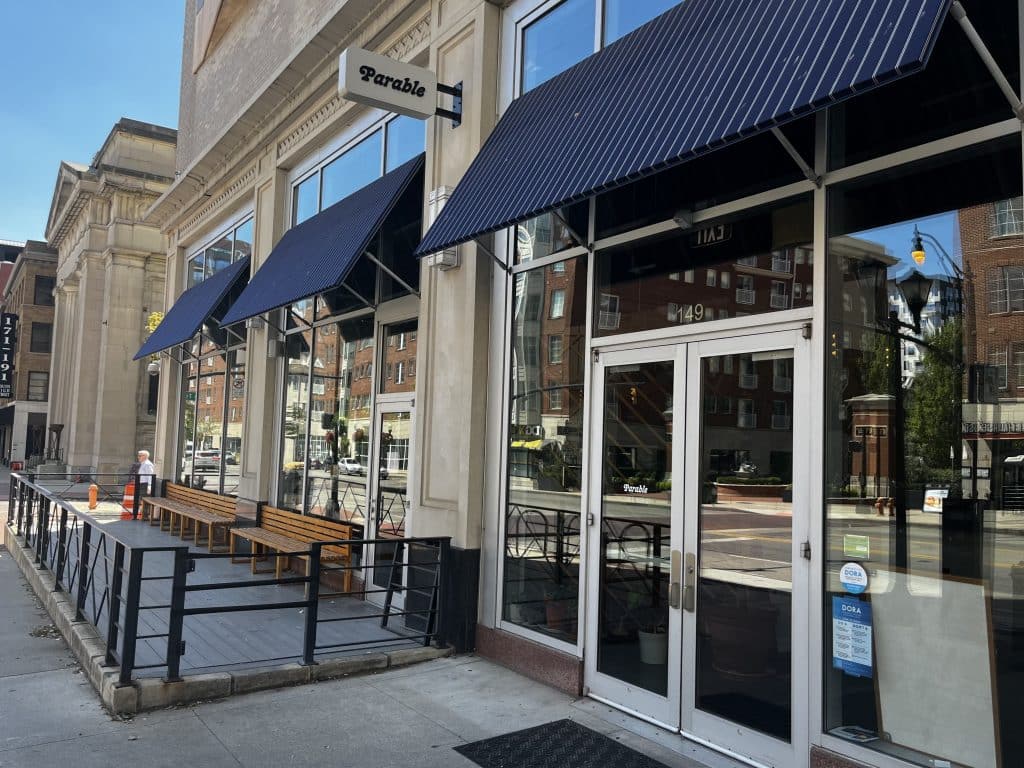
When the downtown community coffee shop Parable suddenly announced its closure last week, patrons may have been surprised. But employees said they have seen the writing on the wall for months.
Workers were clued in that something was amiss behind the scenes when late paychecks turned into bounced paychecks and then eventually missed paychecks. And then there was the mysterious “silent investor” working in the cafe’s backroom, the sudden shuttering of the shop’s pastry program, a broken window, and an ownership group dodging staff questions where there had previously been transparent communication.
There was a time, however, when Parable was doing revolutionary work in line with a pledge the business made on its website to “reimagine the service industry.” Employees were paid a living wage without relying on tips, ownership prioritized employee well-being and fostered a healthy company culture, and the store provided coffee and pastries to community members without the means to pay on a sliding scale. That’s the Parable that the community came to know and love. And the Parable that employees miss.
A donation powers the future of local, independent news in Columbus.
Support Matter News
Marco Colmenarez Aguilar, one of the first employees hired from outside of co-owners Benjamin Willis and Jeffrey Clark’s friend group four years ago, recalled the early days when Parable launched as a pop-up inside of Comune. “Back in the Comune days, it was scrappy,” Colmenarez Aguilar said. “It allowed us to provide a really high-quality cup of coffee with the kind of service that we wanted to see.”
When Comune asked for its space back because the restaurant was developing its own morning program, Parable moved into its current downtown location at 149 S. High St. (now temporarily closed as owners profess “to work through business operations”). Colmenarez Aguilar said the high downtown rent contributed to the shop’s financial woes.
Foxx Aardewulf was hired as a line cook in September 2024 and said they first experienced issues with their paycheck the following month. “There were a lot of bouncing paychecks. It happened too many times to count. I would ask for my pay. I’d say, ‘Hey, my paycheck bounced and I have a doctor’s appointment that I need to pay for. What do I do?’” Aardewulf said, adding that theirs was an “outlier experience.”
“I’d get a response pretty quickly and would get PayPalled. I don’t know if it’s the way that I was communicating with them because I was assertive and didn’t give them room to say no, but everybody else I talked to said they messaged and texted and hadn’t heard anything,” Aardewulf said.
Cyn Flores-Aguirre worked as a barista for a year and four months and said they experienced several bounced checks, which they said started once employees stopped being paid via direct deposit. “We started getting checks instead, and the days of when we were getting paid kept getting changed, and then the checks would bounce like four weeks after they were cashed,” they said. “So, I would wake up to a negative $500 [bank balance] after paying rent because the check bounced. Then it would still take them another week to reply and give me a new check or cash.”
Colmenarez Aguilar said that after the switch away from direct deposit, checks would originally be delivered to the shop on Thursdays. But as time went on, Thursdays would come and go, and the checks wouldn’t arrive. (Willis did not reply to an interview request from Matter News.)
“People are going to ask, ‘Where’s my money?’ As a [staff] lead, the only answer I had was to text [ownership] and just ask,” said Colmenarez Aguilar, who added that new employees and those without a personal relationship with management could be intimated by having to approach ownership to demand pay.
Colmenarez Aguilar and Aardewulf both said the payment issues affected every employee, to the best of their knowledge, including owners Willis and Clark, whose checks were also included in the delayed shipments.
Because Parable was a gratuity-free cafe for the majority of its operation, employees received all of their compensation from Parable paychecks. There was no tip jar to divvy up between paydays, which added to employees’ stress. In July, however, Parable abruptly shifted its payroll model, reducing prices and adding an automatic 20 percent gratuity to every check – a move that coincided with the spending bill passed by the Trump administration, which now allows workers to deduct up to $25,000 in tips from their federal taxes. (Columbus Underground reported that this pivot came with a catch: lower base wages for Parable workers.)
During this time, employees also noticed a man in a suit working in the backroom of the cafe.
“I think I was one of the first people to be introduced to Ron [Reynolds] as back of house,” Aardewulf said. “I wasn’t told his title. It was just like, ‘This is Ron. He’s going to be working in our backroom sometimes.’”
“From my understanding, he was the money guy and was just helping them with finances,” Flores-Aguirre said.
Though Reynolds maintained a presence at Parable for several months, employees weren’t told that he was a “silent investor” who had an ownership stake in the business until a month ago – around the last time workers received a paycheck.
Colmenarez Aguilar’s long history with Willis and Clark allowed him more leeway to ask direct questions of the owners, which is how he learned that Reynolds is a principal at the private equity firm Areté Capital Partners. “I was told that he was the business consultant and was helping them restrategize and reorganize money – things beyond my pay rate,” Colmenarez Aguilar said.
Workers said that it was around the time Reynolds arrived that the culture of transparent communication they had come to expect at Parable changed. “When we’d get information regarding late paychecks or no paychecks … the language that they’d give us was not an answer that sounded like [Willis and Clark]. It read different,” Colmenarez Aguilar said. “The initial reaction from staff was, ‘What the fuck is going on? This feels vague and dismissive of our questions.’”
Paychecks concerns had yet to be addressed when someone broke a window at Parable earlier this month. Workers said it appeared that a person used one of the cafe’s heavy patio chairs to smash the double-paned glass, and that estimated costs for the repair ranged from $6,000 to $16,000. A meeting for team leads was called to discuss the issues facing Parable. The leads logged on expecting to talk to Clark, but said Reynolds was running the meeting instead. (Reynolds did not immediately respond to a request for comment submitted via the Areté Capital Partners website.)
“No one had any idea that he was going to be on this meeting at all, and he’s talking to us about checking in and ‘You’re absolutely right, you should be mad. I’ll talk to Ben and Jeffrey.’ He’s being all buddy-buddy,” said Colmenarez Aguilar, adding that Reynolds shared on the call that he had invested “hundreds of thousands of dollars” into the shop. “So, I cut in and said, ‘This isn’t answering any of the questions that we have or anything that’s been on our minds. Where’s my money?’”
Another question that arose during the meeting regarded the best way to communicate the broken window to the community. “We wanted to write a Parable post because we need to just be vulnerable with our community. They’ve had our backs since the beginning of this place, and the community we’ve fostered loves us. Like, let’s be open and vulnerable with them and just say we’re struggling,” Aardewulf said. “And I believe [Reynold’s] response was ‘We don’t want to show weakness.’”
Professionals who inspected the window determined that it was structurally safe, workers said, and that operations could continue with the window boarded up and the affected area taped off. Yet, the employees said that around three hours after the meeting with Reynolds, Clark made a post to social media announcing the unilateral decision to close for evening service. Despite the meeting earlier in the day, employees learned of this decision from Instagram – an occurrence they said had become more common in the months leading up to the closure.
Those interviewed said one of the reasons the window repair expense was so detrimental to Parable is that, despite being renters of the space in the Lazarus Government Building, the landlord, Downtown Columbus, Inc. (formerly Columbus Downtown Development Corporation), wanted Parable to foot the bill. On top of the already high downtown rent, the expense was backbreaking, the workers said.
Since the closure, Parable workers have still not been paid their owed wages, so they started their own Instagram account, @parablegonedark, where they posted an official employee statement and a link to a GoFundMe. The only ownership response came from Willis, who reposted the employee statement to his personal Instagram stories with a note that he’s working to get them what they’re owed. Otherwise, staff said, it has been radio silence.
“We reached our goal of $14,000, which is to cover everybody’s housing, bills, and expenses for the next month, which was amazing,” Aardewulf said. “It’s still open for funding because we don’t know when and if we’re going to get the wages owed to us from Parable, and unemployment is not guaranteed. And on top of that, we’re having to look into whatever legal resources we might potentially need. Any further money is going to support us until we can all get our next jobs.”
The employee collective encourages those with leads or job openings to reach out via the Instagram account, and to stay tuned for updates on future actions and benefit events.
Related Articles
The Worker’s View: Dough Mama temporarily closes after half the staff quits
‘This was obviously a big wake-up call that something needed to change,’
The Crew comes up just short in electrifying U.S. Open Cup final
Columbus nearly delivered a highlight in what has been a challenging season, playing St. Louis City SC to a dead heat for 120 minutes on Wednesday before falling in penalty kicks.

‘Pitchfork Populism’ Over Data Centers Rattles Ohio’s U.S. Senate Race
The issue, which barely registered with candidates last year, looms large in a race that could determine control of Congress.