Behind the worker-led push to unionize the Columbus Metropolitan Library
Last week, CML United initiated the unionization process when it delivered signed union cards representing a supermajority of eligible library workers to Ohio’s State Employment Relations Board, taking the biggest step yet in a slow-building process that started more than 18 months ago.
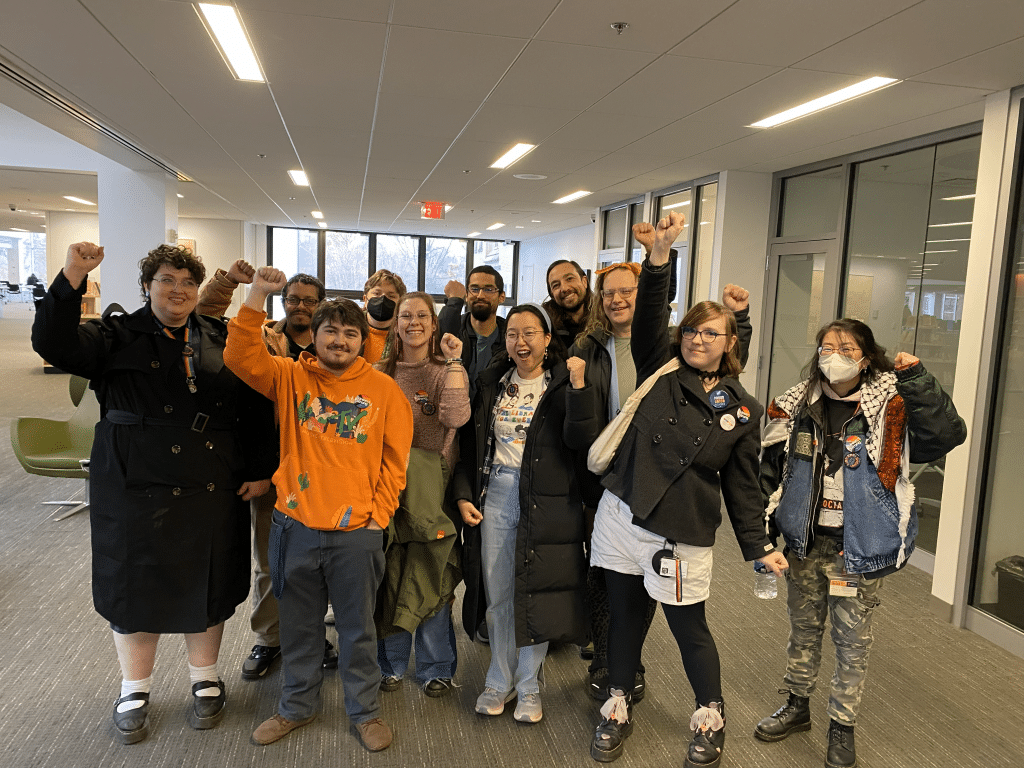
The pandemic served as one in a series of eye-opening moments that led Jude Virostko to join the CML United organizing committee, which last week initiated the union process when a supermajority of library workers submitted signed union cards to Ohio’s State Employment Relations Board (SERB). Members of the group also appeared in person on Friday to deliver a message to management at the Columbus Metropolitan Library, asking leadership to remain neutral during the union campaign.
When Covid hit, Virostko, then a part-time youth services specialist at Franklinton, said that CML management promised to preserve health care coverage for workers during staff furloughs, covering the full premium during those weeks employees were left off the schedule and did not receive pay. “And then when we came back [from furlough], CML took double the premium out of our checks to cover the amount they had paid,” said Virostko, now an adult services librarian at the South High Branch, who described the experience as “radicalizing.”
Another instance occurred in May 2024, when just weeks after joining the CML United organizing committee, doctors diagnosed Virostko with acute myeloid leukemia, the treatment of which required the librarian to take an extended absence under the Family and Medical Leave Act (FMLA). “And I don’t know if you’re aware, but leukemia is not really good at keeping a schedule, and I didn’t make the return date CML had assigned to me, and they tried to fire me for running out of leave,” Virostko said. “This is a disease where I’ve had holes drilled in my bones four times, and where I was isolated from my loved ones for months at a time, but the part that hurt the most was begging my job not to discard me. And I don’t want that to ever happen to anyone else. When you’re dealing with a critical illness or a loved one who needs medical care, you shouldn’t have to fight for your job in addition to all of the other things you’re fighting. … Every worker deserves safety and respect and dignity, and I think our union is the only way to make that a reality.”
A donation powers the future of local, independent news in Columbus.
Support Matter News
CML United organized with the Ohio Federation of Teachers, which also represents library systems in Worthington, Upper Arlington, Grandview Heights, Pickerington, and Delaware County. Taking note of this landscape, Virostko said the prospective union is “only able to do this because of the people who came before us.” “It’s because of Worthington, because of Grandview Heights, because of Upper Arlington,” Virostko continued. “They’ve been a tremendous help, and I think that makes us more powerful when we can all stand together.”
Working through the process, Mar Howell, a customer services specialist at the Southeast Branch, said that these local library unions frequently served as valuable sounding boards, offering both running encouragement and more practical, nuts and bolts movement-building advice. “They had these tips and tricks for [engaging coworkers], and a big one was to always have them give you their number, because if you give them your number they probably will not call you back” said Howell, who grew up with a deep affinity for the labor movement owing to their father being a member of the United Food & Commercial Workers International Union.
If approved by workers, CML United would represent more than 600 employees across all 23 CML public libraries and CML’s operation center in Gahanna, including librarians, customer service specialists, information service specialists, and more. As of last week, Rahaf Fares, a customer service specialist at the Martin Luther King Branch and a member of the CML United organizing committee, said the group had received signed union cards from more than 60 percent of these eligible workers, with the aim of holding an election early in 2026. Among workers who have so far declined to sign a union card, the most common reason given was a fear of retaliation from management, according to four people interviewed.
In response to the workers announcing their intent to initiate the unionization process, the Columbus Metropolitan Library issued a statement that read, in part, “Employees who are part of an organizing committee to unionize at the library notified us Friday morning of their intent to file a petition for election with the State Employment Relations Board. Columbus Metropolitan Library’s Board of Trustees will review the petition. We respect the rights of our employees who are for or against unionization and will comply with the law.”
Kimberly Lowe, a customer services specialist at the Southeast Branch and a library employee of more than 20 years, said the union campaign kicked off in earnest more than 18 months ago, developing slowly as the members of the organizing committee, which could fluctuate anywhere between a dozen and 30+ members, worked to engage all of the 630-odd union-eligible CML employees in one-on-one conversation.
“We wanted to talk to each person individually and discretely, which took a long time,” said Lowe, who last week joined other members of the CML United organizing committee in delivering the union announcement to CML leadership in person at the main branch downtown – a muted scene she described as being in line with the profession involved. “Because we’re all library workers, we were all pretty quiet, and we were respectful of the vibe we go for in the library.”
Virostko said the process of building toward unionization served as an extended listening tour, with members of the organizing committee meeting coworkers outside of the office to learn “what people are worried about, what keeps them up at night, and what they think would make the library a better place to work.”
In the course of these conversations, a number of recurring issues surfaced, with staffers repeatedly calling attention to staff safety, inequities existent in library PTO policies (Virostko said part-time workers accrue paid time off at a lower rate than full-time staffers), and the physical condition of some buildings in the library system. “We heard from staff who worked at their library without running water, staff who worked in a building that had a car crash into it and that still had a chunk missing,” Lowe said.
Fares said concerns were also raised system-wide in regard to the way CML leadership responded this year to threats of federal budget cuts, as well as Republican legislation aimed at stripping back DEI initiatives and potentially restricting the types of literature to which patrons can have access, including books dealing with sexual orientation and gender identity.
“And I think DEI, especially, is a core library value. Being open to all means being equitable, being inclusive, and being accepting of a diverse patron community,” Fares said. “And when the government, whether at the state or national level, tries to take that away, it threatens the very foundation on which libraries are built. … What does it say to our patrons if we’re telling them we can’t display a book that represents them? That goes completely against our values. It goes completely against the point of libraries.”
Across the board, the members of the CML United organizing committee interviewed said the establishment of a union would benefit staff members by granting them a seat at the table with leadership, allowing them to be better informed and to have a greater stake in the policies that have a direct impact on day-to-day working conditions across the system.
Lowe, for one, recalled a time a couple of years back when she served as a board member with the Association of Public Library Employees – “Not a union,” she stressed – a role in which she participated in committee meetings where worker-submitted concerns were raised with management but rarely meaningfully addressed.
“And being in those meetings, seeing how hard our committee members were advocating for us and how little traction they could make really cemented things for me, because they didn’t have any actual power to make changes,” Lowe said. “There are so many aspects of our work that our staff care about and want to improve, and we haven’t been able to without that collective voice. … We have to hold strong and remember this union is for us, and we are doing this to equalize the power.”
Author

Related Articles
How Wexner’s desire for a city center led to a more fragmented Columbus
As the central Ohio retail magnate faces a larger public reconciliation owing to his ties with disgraced financier Jeffrey Epstein, a look back at how the Wexner name became so synonymous with the city.
‘They took away our voices’: Administrators quash planned Plain City student walkout
In a statement sent late last week to district families, the Jonathan Alder Board of Education wrote that while it recognizes and respects the constitutional right of students to express their views, ‘those rights must be exercised in a manner that does not disrupt the operation of the schools.’
Local Politics: The fallout of serving ICE(d) coffee
A local coffee chain has been under fire for saying it would not refuse to serve ICE agents. But the people who work there say that’s not the full story.