Columbus artist Colleen Scott learns how to love herself again
‘Redirected Pathways,’ which kicks off with an opening reception at the Franklin County Coroner’s Office on Thursday, April 2, centers on work created both pre- and post-sobriety, capturing a personal evolution that speaks to a range of universal concepts.
Set 10 feet apart within “Redirected Pathways,” the new solo exhibition from Columbus artist Colleen Scott, are two sculptural pieces that share a number of qualities. Both are constructed around objects Scott has owned for years – one built from a childhood globe and the other from the bust of a mannequin – and both incorporate jewelry.
And yet, the two works stand in almost direct opposition, the globe wrapped in ropes and heavier metallic chains and meant to signify the addictions that for decades prevented the artist from gaining access to everything the world had to offer. The bust, in contrast, emerged in the years after Scott embraced sobriety and projects delicacy and softness, wrapped in satin-like material and draped in strands of translucent faux-pearls.
“And this one is really representing the protection I have received from the other women in my family, and specifically my grandma and my mom,” the artist said in late March at the Franklin County Coroner’s Office, where “Redirected Pathways” will kick off with an opening reception from 6-8 p.m. on Thursday, April 2. “But it’s also having that protection that’s not just armor. And the fabric is breathable, because it’s about learning to let people in.”
A donation powers the future of local, independent news in Columbus.
Support Matter News
These types of transformations are present throughout the diverse exhibition, which incorporates sculptural pieces, paintings, and mixed-media collages created both before and in the years since Scott kicked her addictions in January 2024 with the help of a 12-step program. “I had my last drunk on January 14, 2024, and I just knew I only had two options,” she said. “I had the suicide note … or I had to pick up the 500-pound phone with people willing to help me. And thank goodness I chose the latter.”
In that initial phone call with the woman who would become Scott’s sponsor, the artist said the words that really stuck with her were you never have to feel this way again – a reality that had appeared impossibly distant from the time she started drinking alcohol around age 11. In one drawing done in crayon and titled “I Was Just a Child,” the artist wrangled with the early life circumstances that eventually led her to seek escape in the bottle, describing how as a kid it felt as though she didn’t have a voice. “‘Because I said so’ was the big thing in my house,” she said. “But that was also the generation back then.”
From an early age, Scott turned to art as a means to express the bottled up feelings that could threaten to overwhelm, describing the practice as something she has always leaned into as a way to make sense of her inner and outer worlds, and which she abandoned for a time when her addictions enforced their tightest grip, “because nothing then gave me joy,” she said.
Owing in part to this, the works created prior to Scott’s sobriety have a darker, comparatively desperate feel, exploring concepts of ego, isolation, and the artist’s desire to hide aspects of herself from the world at large. As one example, Scott directed my attention toward a piece she created by ripping and pasting down paperwork from her DUI charge and then obscuring the pages with collaged chips of dried paint. “I was hiding who I was inside, because I was ashamed,” she said.
Another painting includes a beer bottle with “I thought you loved me” inscribed on the label, reflective of the attachment the artist said she once felt to these substances. “That’s what I thought true love was. It was like, oh, I can get messed up and the alcohol and the drugs love me,” she said. “When in reality, they didn’t. And I didn’t love myself either. And I think that’s really big for me, and that’s what this show is about: It’s the self-love I found.”
The evolution is reflected in a triptych Scott began toward the end of her active addiction and completed in sobriety, with the earliest of the three paintings incorporating more tightly structured shapes that can be interpreted as barriers and the most recent building around amorphous, fluid forms that echo the inner workings of a lava lamp. Collectively, the trio encompasses ideas that include finding and enforcing boundaries but also learning how to go with the flow and to accept life on its own terms.
Other paintings are more explicit in their aims, including one titled “Spiritual Awakening,” which Scott created to capture the sense of letting go that she described as intrinsic to sober living. “It’s truly about releasing all of the things that held me back into the universe – the resentments, the self-hate, the [memories of] things I had done to people,” said Scott, who has come to view her new exhibition as a collective act of rediscovery. “I’m almost 42 years old, and to just now realize I’m allowed to be me, it’s a blessing.”
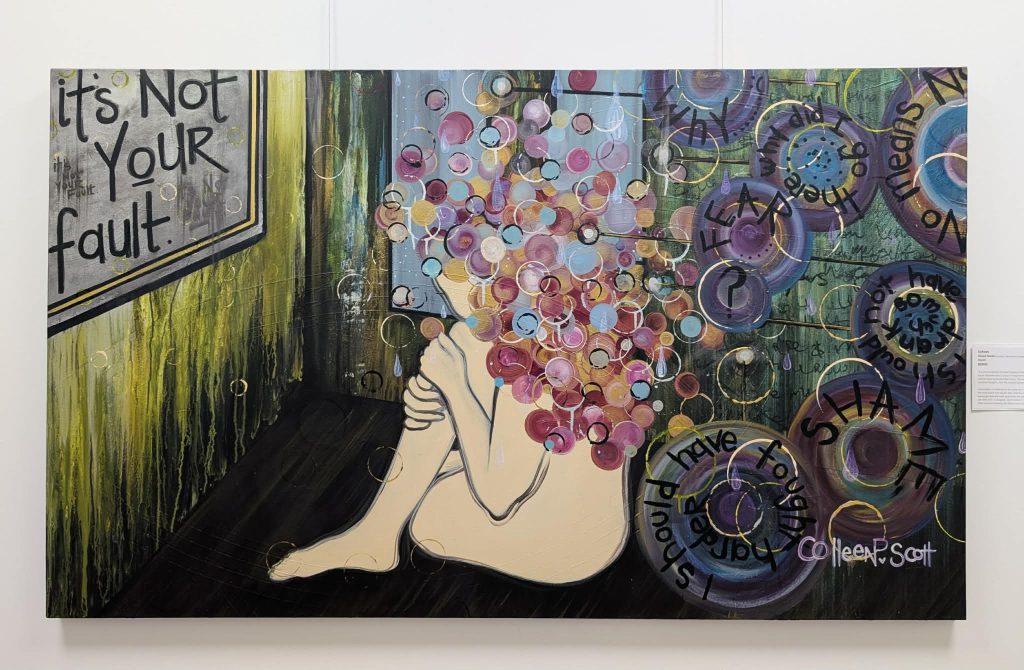
While all of the work on display comes from an intensely personal place, Scott acknowledged that with the benefit of distance there are aspects to the show that have become more universal – an idea the artist first began to confront when she presented a handful of her paintings during a talk for others in her 12-step program. “And I took this one, and everyone said they saw themselves in it, even though it’s me, and I’m sitting there with my elbows on my knees, with my hands on my head, like, ‘Oh, God. Why did I do this?’” Scott said. “But I hung out with some friends one night a couple weeks ago, and someone mentioned something, and then they said, ‘Does anyone else think this way?’ And that was big, because we had all had those thoughts. Even those weird, sometimes messed up thoughts, I guarantee someone else has had them. … And that’s something I’ve felt whenever someone comes up to me and says, ‘I see myself in all of these pieces.’”
Author
Related Articles
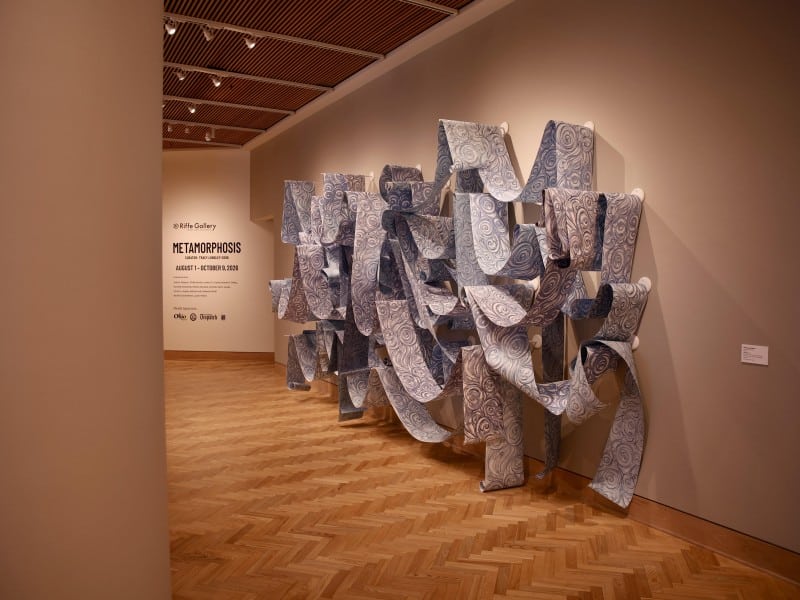
Change takes many forms within ‘Metamorphosis’
The new group exhibition at the Riffe Gallery kicks off with an opening reception from 2-4 p.m. on Saturday, Aug. 1.
Straight Through provides space for healing, connection
Dr. Adrienne Kennedy created Straight Through, the next installment of which takes place at Urban Arts Space on Thursday, July 30, as means to embrace the act of listening to music as a cultural practice and to foster community.
Katherine Fahey finds the magic in handmade crankies
The Baltimore artist and shadow puppeteer will present her hand-turned, panoramic scrolls in a performance at Secret Studio on Tuesday, July 21, joined by Dan Van Allen and the Columbus poet Maggie Smith.