
Lawsuit, ballot initiatives seek to make Columbus City Council more accountable to residents
A lawsuit looking to restrict council from closed-door sessions is making its way through the courts at the same time that organizers with Our City, Our Say are beginning to collect signatures for a ballot initiative designed to recast how council members are elected.
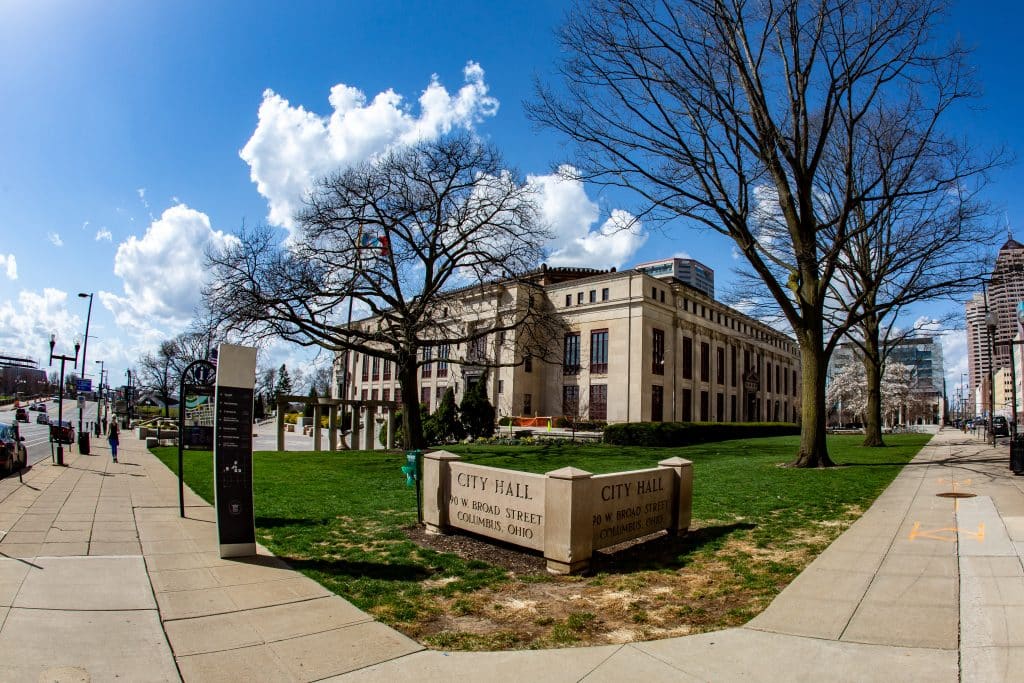
In late March, Hilltop resident Rachel Wenning filed a lawsuit with the Ohio Supreme Court asking the court to make Columbus City Council hold all of its meetings in public.
Wenning’s filing was prompted by what she viewed as an increase in City Council’s reliance on executive sessions over the last year, with her lawsuit making reference to eight times the council members met behind closed doors, including a January 2025 session held to discuss the potential appointment to fill the seat being vacated by departing member Shayla Favor.
“And that doesn’t seem like a conversation that needs to happen in private,” said Wenning, a former Local Politics columnist for Matter News. “That’s a person who is going to be representing us on council, and we should be privy to that person’s upsides and downsides. And that was the first time I was like, ‘What is up with these sessions? Why are they holding these in private? And what does the law actually say about them?’”
A donation powers the future of local, independent news in Columbus.
Support Matter News
According to Wenning, there are provisions within the Ohio Code that allow for executive sessions in cases such as negotiating collective bargaining agreements, terminating an employee, or conferencing with the City Attorney’s Office in relation to a lawsuit. Columbus, however, is governed by a City Charter, which Wenning said includes language related to executive sessions that is invalidated by the requirement that all City Council meetings be public. “They need to actually put in the charter that they can have private meetings, and they have never done that,” she said.
In response to a request for comment, the Columbus City Attorney’s Office provided Matter News with a statement that reads, “The City appreciates the need for openness and transparency as it’s foundational to good government. We’re currently reviewing this matter before the Court and have no further comment at this time.”
Wenning’s lawsuit is making its way through the courts at the same time that organizers with Our City, Our Say are beginning to collect signatures for a ballot initiative designed to recast how members of City Council are elected in Columbus, both efforts professing to make the council more transparent and more accountable to the city’s residents.
Both can also trace their roots back to the jockeying over the District 7 seat vacated by Favor, with Wenning’s lawsuit taking shape after she learned of the executive session held to discuss Favor’s temporary seat-filler, and the Our City, Our Say campaign extending from the electoral showdown between Jesse Vogel and Tiara Ross to see who would represent District 7 voters on council longer-term.
Under Columbus’ current hybrid district system, instituted in 2023, City Council members must live in the districts they serve, but the entire city votes in all nine district council races. In the case of last year’s District 7 election, this created a situation in which Vogel won 63 percent of the vote within the district the two were campaigning to serve while losing the city-wide count to Ross by just 1,585 votes.
“And I think having a candidate win the majority of votes in his district, both in the primary and the election, and still lose, that really made it clear … for a lot of Columbus residents the issues that exist with the system that City Council put into place,” said Sharon Kim, a lead organizer with Asian American Midwest Progressives (AAMP) – one in a handful of organizations that have coalesced behind Our City, Our Say, which in early April started its push to collect the 13,000 signatures required to get a charter amendment on the November ballot. If successful, the amendment would establish a system in which the representative for each district is elected solely by the voters residing in that district.
“Ultimately, I think what each member of our coalition has come to, regardless of how they’ve gotten involved, is that the current system of running for and winning a council seat is virtually impossible for people who don’t have corporate sponsorship or the backing of the Franklin County Democratic Party to be able to fund and support a city-wide campaign,” Kim continued. “And the idea that you have to raise hundreds of thousands of dollars to even be a viable candidate is something most working- and middle-class people can’t do. This could level that playing field.”
Proponents of the initiative also argue that the proposed amendment could help to make council members more accountable to the voters in their districts, with Kim pointing to the inequities that exist under the current system, which benefits some neighborhoods more than others. “If we’re talking about resources and the argument is, ‘Oh, the at-large system makes it more equitable for people across the city,’ then I would say, take a look at Clintonville, and then take a look at the Far East Side. Would you say these resources are being used or are accessible to residents equally?” Kim said. “Under this system, people are not feeling like council members are accessible or responsive to their needs.”
In response, Columbus City Council President Shannon Hardin released a statement to Matter News in which he said he always viewed the the at-large district model approved by voters in 2018 as “a first step toward reform, not the final destination,” while also calling attention to potential issues he said he viewed with a pivot toward a strict district representative system.
“Every model comes with different incentives. For me, the questions are: would the new structure allow Council to build the housing our City needs, knowing that ward models amplify voices that tend to oppose affordable housing? Will it enable representation that looks like the City as a whole, knowing what a racially and economically segregated city we are geographically? And will it allow the City to make investments where they’re most needed, not pitting neighborhoods against each other?” wrote Hardin, who described himself as “intrigued” with the potential of a hybrid model that would combine at-large and district-based seats.
Columbus City Council President Pro Tempore Rob Dorans expressed his distaste for the current hybrid system in a statement, writing that he voted against it at the ballot box in part because he didn’t believe it adequately addressed concerns regarding neighborhood representation. “I personally believe council should be open to considering making changes,” he wrote.
While Kim said the Our City, Our Say campaign has been met with enthusiasm from Columbus voters, the proposal has received pushback from a group of Black activists and community leaders, who in late March submitted what they termed “an urgent request for council action,” penning a letter to Hardin later distributed to the media.
“We are concerned that another citizen initiative petition (Our City, Our Say) may violate the Voting Rights Act of 1965 by retaining the current residential districts and turning them into electoral districts. While this looked like a simple fix to them, we note that although our city is economically and racially segregated, none of those residential districts have a majority-Black electorate,” wrote the group, whose membership includes the likes of pastor Kujenga Ashe, social worker Tom Dillard, and Jonathan Beard, who was involved with the 2015 push to get a citizen-initiated charter amendment on the ballot to address how council members are elected, which was rejected a year later by voters.
In place of adopting the city’s current residential districts as electoral districts, Beard and others have proposed drawing a new district map that would create multiple majority-minority districts. “We ask that you fix the current broken council election system by rapidly advancing to the ballot a district-based electoral method along with an electoral map that finally (after 60 years) seeks to secure those hard-won federal rights for Black voters in Columbus,” the group wrote in its letter to Hardin.
Kim of AAMP conceded that issues exist with the city’s districts as currently constructed – “Who was responsible for drawing up those districts? It wasn’t the public,” she said – while going on to describe the ballot initiative being proposed by Our City, Our Say as a needed “first step.”
“I know Jonathan [Beard] is talking about the districts, which were part of his original proposal back in 2016, and that’s something we also agree with,” she said. “But the first thing that needs to happen is we have to change how we elect our city council members.”
Author

Related Articles

Ripped to Shreds is ready to hit the runway
The new resale shop, created in partnership between artist and musician Courtney L. Hall and Used Kids owner Greg Hall (no relation), will celebrate its grand opening on Sunday, Oct. 11.
Community Pride returns with a new urgency
Now in its ninth year, the volunteer-run festival takes place at Mayme Moore Park on Saturday, Oct. 10.
Two Dollar Radio HQ reopens with an expanded ownership group and a similarly expanded vision for the future
‘I think a big part from opening was to give authorship of the space to people with good ideas, to open the doors to people to try different things.’