
A different justice: The HALT Fentanyl Act traffics in fear, not fact
‘We know that prohibition itself is what’s causing the [overdose] crisis.’
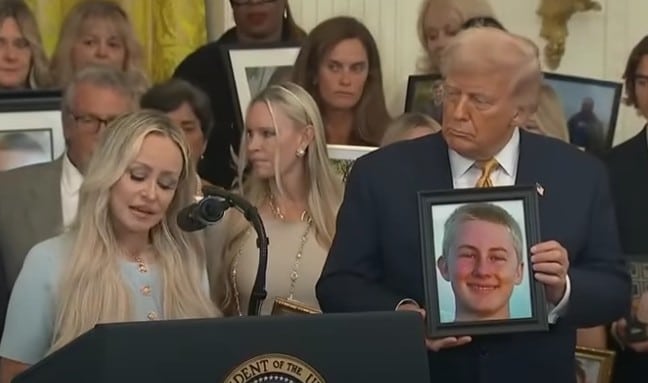
Surrounded by families who have lost loved ones to an overdose involving fentanyl, President Donald Trump signed the HALT Fentanyl Act into law last week, saying as he did so that the law would put more people behind bars.
The new law puts fentanyl analogues into Schedule 1 of the Controlled Substances Act, and as Filter Magazine noted, because the pool of eligible substances is larger, so is the pool of those likely to be arrested.
These are political choices. These are the actions of people who traffic in fear and retribution rather than facts.
A donation powers the future of local, independent news in Columbus.
Support Matter News
When I spoke with her last week, Susan Ousterman used the word “performative” when describing the new law. Ousterman is the executive director of the Vilomah Memorial Foundation, an advocate for harm reduction, and a supporter of parents who have lost their children to overdose. The law criminalizes more people and spreads stigma and fear of people who use drugs, Ousterman said. “We know that prohibition itself is what’s causing the crisis,” she added pointedly.
Two weeks ago, 27 people overdosed in Baltimore’s Penn North neighborhood. Eyewitnesses said that multiple people were overdosing at the same time. Outreach workers searched the community for people who may have been overlooked. According to NPR, five people are in critical condition.
We’ve been here before.
In late April 2024, a surge in Austin led to 50 overdoses in 24 hours. In 2016 in Ohio, the emergence of the potent synthetic opioid carfentinil in the supply led to a surge in overdoses and deaths. If we go further back to July 1926 during alcohol prohibition, a bad batch of alcohol from Buffalo, New York, killed 37 people, including a Cleveland man who collapsed in front of a movie theater.
Scientists with the National Institute of Standards and Technology said that samples of what led to the mass overdose in Baltimore contained N-Methylclonazepam, a benzodiazepine derivative. This could explain why even people who had been administered naloxone remained sedated.
This should underscore how dangerous HALT could be. People who use drugs are forced to gamble. Meanwhile, policies – from the latest prohibitions to Federal cuts to healthcare, harm reduction, and research – have created the circumstances for the dice to be rolled.
“They just want to be able to lock people up so they can get re-elected,” Ousterman said. “I don’t think this has anything to do with stopping fentanyl.”
Ousterman speaks from a place of deep knowledge – she lost her son, Tyler, to an overdose in 2020. Watching her talk about him in a series of videos for Drug Policy Alliance, that loss still feels close to the surface. What has always impressed me about Ousterman is the clarity of her vision and work in spite of that loss. There’s a conviction rooted in love that’s almost palpable.
So, the presence of families at the HALT signing bothered Ousterman, as do bills that are named after people who have died. “It’s pure manipulation,” she said. “A short-term feeling of relief.”
Later, she said, there’s going to be regret for the families involved.
“They don’t have a full understanding of drug policy, and they’re seeking probably closure and justice,” she said. “But child loss is a primal injustice. We’re never going to have closure. There’s never going to be anything that feels like justice for losing a child.”
Ousterman has something to teach us about the paradox of grief and forgiveness. She has become close with someone her son had been with when he purchased drugs on the day he died. The relationship, she said, has given her access to a different kind of justice.
“I think that’s more justice than anything when you can continue to give the love that you can’t give to your child to someone else who may need it,” she said.
“That must be hard,” I said.
She shook her head. “No. He’s a good kid. He’s no different…” she said, and trailed off.
Ousterman said she was prompted to reach out to her son’s friend when she received her son’s autopsy report. It listed a drug she had never heard of called Xylazine. She wanted to find out if her son and anyone he may have been in contact with knew it was there, or if it was an adulterant. She combed through her son’s messages to see who he was with that day. She reached out to him and asked if he knew he had taken Xylazine.
It took him 10 months to reply – he later shared with her that he was scared to – but he told her that neither of them had heard of Xylazine at the time.
Ousterman got to know him, learned his story. He’d lost parents when he was young. He had a lot of trauma to work through.
“People use drugs for a reason, to cope with stress or mental health or chronic pain,” she said. “So [with these laws], we’re punishing people for trying to relieve a problem.”
It’s easier to access drugs than mental health care, she said.
And for most of us, it’s easier to access vengeance than forgiveness.
Author

Related Articles

‘I am not going to stand before God and say, well, I chickened out’: Reflections on building caring coalitions
More than three years after the City of Columbus bulldozed Camp Shameless, one of the founders of the encampment offers their perspective on the housing crisis and the people working at the grassroots to give aid to those routinely left behind.
New affordable housing investments may leave Columbus’ most vulnerable properties, and tenants, behind
Even as new bonds approved by voters hope to transform housing development for years to come, a desperate shortage of affordable units continues to push low-income renters into the lowest-quality homes.
Columbus City Council meeting debates the local impact of data centers
‘This is the beginning of a conversation,’ councilmember Christopher Wyche said of the four-hour meeting, during which reps from the data center industry, labor unions, and environmental groups joined residents to debate everything from data center water usage to the number of jobs these massive facilities actually create.