
Bhutanese Nepali refugee faces deportation following April detention by ICE
Mohan Karki is currently in a Michigan jail under the threat of deportation. His wife, Tika Basnet, continues to push for his freedom while raising the Columbus couple’s newborn daughter on her own.
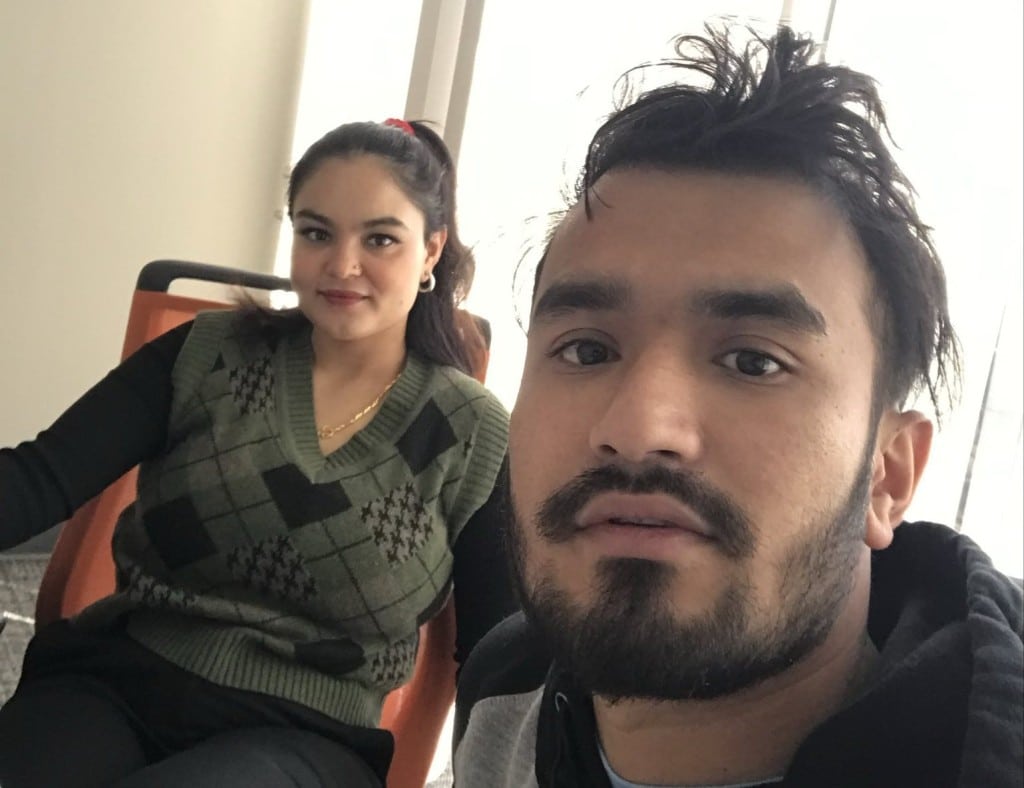
On June 9, the day after doctors originally planned to induce labor in Tika Basnet, she instead found herself navigating fraught new developments in the detention of her Bhutanese-Nepali husband, Mohan Karki, whom authorities shuffled from Butler County Jail outside of Cincinnati to Michigan’s St. Clair County Jail with plans for immediate deportation to Bhutan – a tiny Himalayan country in which he’d never lived.
“My husband called me at 11 a.m. and said, ‘I’m in Michigan. They’re taking me.’ I said goodbye for the last time. I just sat there crying, exhausted, thinking, ‘There’s nothing I can do here,’” said Basnet, a U.S. citizen who had pushed back her planned childbirth two weeks to better harness her strength in the fight against Karki’s looming deportation.
Basnet’s spirits momentarily lifted when she received word on June 10 that a judge had granted a stay against Karki’s removal in the wake of his detention by officials with U.S. Immigration and Customs Enforcement (ICE). Less than two weeks later, she gave birth to the Blacklick couple’s first child, a daughter, who was just 15 days old on the early July afternoon we spoke, and who has yet to be held by her father, who remains locked up in Michigan awaiting potential deportation to Bhutan, yet another country that doesn’t recognize him as a citizen. (Karki was born in a refugee camp in Nepal, which Basnet said denied granting him legal status and rendered him essentially stateless.)
A donation powers the future of local, independent news in Columbus.
Support Matter News
“I don’t know which pain hurts more. Is it the fear that my husband could be deported to a country where he might be tortured, imprisoned, persecuted, or even killed?” Basnet said. “Or is it the pain I carried during my pregnancy, when I went through every moment alone? … I gave birth in a hospital bed without his hand in mine. I went home with a newborn and a heart full of sorrow. I faced postpartum depression, emotional trauma, and sleepless nights – all while pretending to be strong.”
Basnet’s fight began on April 8, when she accompanied her husband to what the two expected would be his routine yearly ICE check-in. Instead, Karki, 30, was detained by the officers, jailed, and marked for deportation, his order of removal based on a teenage burglary charge to which he pleaded guilty shortly after he arrived legally in the U.S. – a point in time when he didn’t yet understand the rules and culture in the country to which he had recently immigrated, Basnet said.
Karki is one of more than 100,000 Bhutanese Nepalis whose families fled ethnic cleansing in Bhutan, the majority of whom settled legally in the United States, and more specifically in Pennsylvania and Ohio, each of which boasts a Bhutanese Nepali community numbering more than 40,000 people. Since arriving in the U.S., these refugee communities have led relatively stable existences, said Sudarshan Pyakurel of the Bhutanese Community of Central Ohio – a calm community members hoped might prevail even as the Trump administration began to ramp up its attacks against immigrants earlier this year.
“We anticipated there would be some deportations coming our way … but at the time, the Trump administration was saying only people who came to the United States illegally would be deported,” Pyakurel continued. “And we as a community thought we came here by legal means, and we were resettled refugees. … And then even when ICE began to detain people, we still thought, ‘Oh, there is no way they will be deported.’”
Pyakurel attributed this early confidence in large part to the legal limbo in which the members of this particular community continue to exist, having previously been made stateless by the Bhutanese government, which began to strip them of their citizenship rights in the 1980s. The Guardian reported in May on two dozen Bhutanese Nepali refugees who had been deported a month earlier by ICE to Bhutan, at least four of whom were rejected by Bhutanese authorities and expelled to India, where several are now believed to be missing. Aisa Villarosa of the Asian Law Caucus said the group recently learned about the experiences of one deportee who, following their expulsion from Bhutan, was forced to wander by foot from the Bhutan/India border to Nepal, a treacherous journey of more than 120 miles that took roughly a month to complete.
“My husband is scared, and he doesn’t know what will happen to him,” said Basnet, who first met Karki at the gym in July 2021 and began dating him a month later. “Every single day, rules is changing. Every single day, laws is changing. I don’t know where my husband will end up. And he’s scared he will end up in Bhutan, where he’ll end up dying, where he’ll end up getting killed. … We were never born in Bhutan. We don’t know the language of Bhutan. … This is our home.”
Karki’s attorney, Brian Hoffman, said the case for staying his deportation hinges on proving to the Board of Immigration Appeals that Karki would face at least a 51 percent likelihood of being tortured were he deported to Bhutan, which would then qualify him for a deferral of removal under the Convention Against Torture. Of course, the up-in-the-air status of some of those already deported to Bhutan has introduced little in the way of clarity. “If you get deported to another country and disappear into the Himalayas, where maybe you’re dead, how do you prove that you’ve been tortured?” said Hoffman, who also serves as executive director of the Ohio Center for Strategic Immigration Litigation & Outreach. “It’s the quintessential catch-22. How do you meet that burden of proof if you’re just vanished into the snow?”
Recent actions taken by the Trump administration have had a palpable impact on the Bhutanese Nepali community within Ohio, said Pyakurel, who described the current state of affairs within this traditionally tight-knit group as “a nightmare scenario.” “There’s a great deal of anxiety and fear,” said Pyakurel, who added that recent deportations have triggered deeply held traumas within some Bhutanese Nepalis, many of whom still carry the painful memories of the targeting and persecution they experienced amid the ethnic cleansing carried out by the government of Bhutan. “People don’t know what to do, and so the only thing most of the people are doing is staying silent.”
Basnet, in contrast, has adopted a more outspoken approach, opening up about her struggles in the months since ICE agents ripped Karki from her and the couple’s then-unborn daughter – “What will I tell [our daughter] when she’s old enough to ask, ‘Where is my daddy?’ How do I explain that he didn’t leave her, that he was forced away?” she said – and sharing details about the kind of man Karki has grown into as a husband and partner. Both in our interview and in a detailed follow-up email, Basnet described Karki as a kind and humble provider who managed to balance his family, his faith community, and his work as a truck driver.
“One mistake doesn’t define my husband, who has worked hard to stay out of trouble and build a life grounded in love, service and responsibility,” she said. “He is not just my partner – he is my support system, my strength, and the person I built my future with. We came here with dreams, and together we started building a life full of hope. But now, everything feels shattered. … Every day, I carry this weight. Every day, I pray that [our daughter] won’t have to grow up with a hole in her heart where her father should have been.”
Correction: An earlier version of this piece stated that “a judge had granted a stay against Karki’s removal, which also applied to two other Ohio residents from the Bhutanese Nepali community who were similarly detained by officials with U.S. Immigration and Customs Enforcement (ICE).” While the three are part of a separate habeas petition in federal court, the emergency stay applies only to Karki. Matter News regrets the error.
Author

Related Articles
New affordable housing investments may leave Columbus’ most vulnerable properties, and tenants, behind
Even as new bonds approved by voters hope to transform housing development for years to come, a desperate shortage of affordable units continues to push low-income renters into the lowest-quality homes.
Columbus City Council meeting debates the local impact of data centers
‘This is the beginning of a conversation,’ councilmember Christopher Wyche said of the four-hour meeting, during which reps from the data center industry, labor unions, and environmental groups joined residents to debate everything from data center water usage to the number of jobs these massive facilities actually create.
The problem with the CDC prohibiting ‘never use alone’
Officials from the Centers for Disease Control and Prevention reportedly told recipients of overdose prevention funding that they may no longer be allowed to promote the message that has become one of the pillars of harm reduction.