
Columbus refugee detained by ICE in April faces imminent deportation
Days before Mohan Karki was set to appear in federal court, his attorneys learned that U.S. authorities plan to deport the Ohio resident to Bhutan on Tuesday, Dec. 2. Emergency appeals have since been filed, while attorneys and advocates work to see if Karki will be able to meet with his wife and his 5-month-old daughter, whom he has yet to hold.
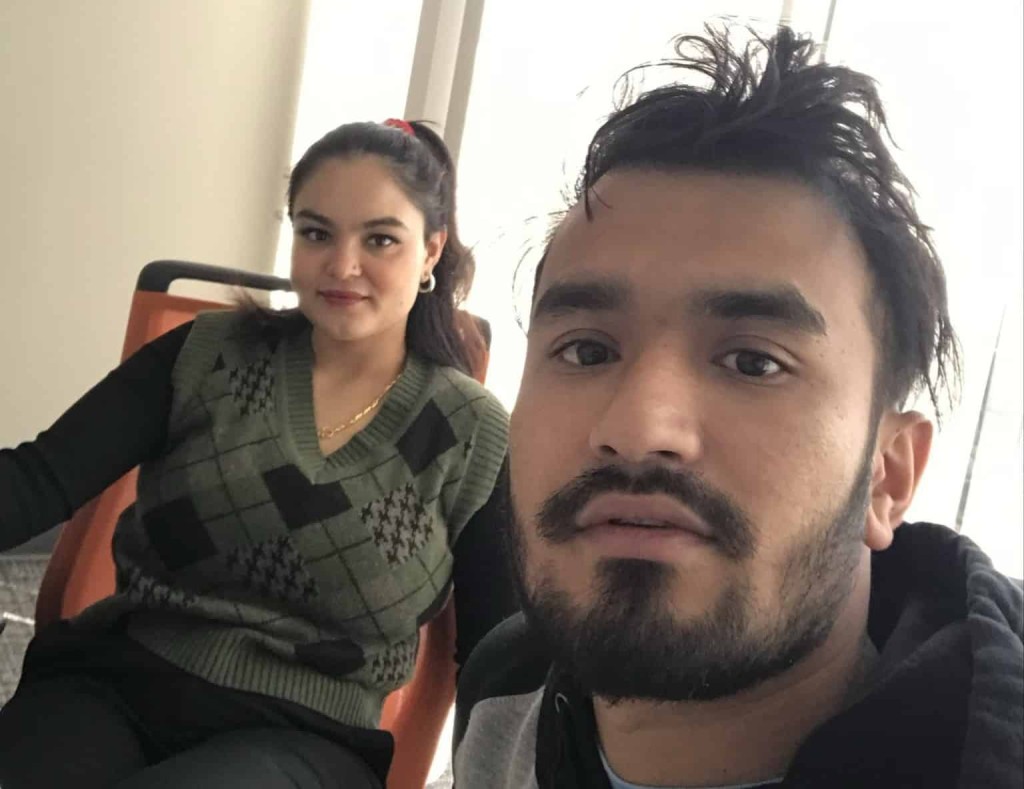
UPDATE: On Monday, a federal judge in Michigan denied ICE’s motion to vacate the order requiring Karki to attend his hearing in federal court, and Karki is now scheduled to present his habeas case in person tomorrow (Wednesday, Dec. 3). Karki’s wife and baby plan to be present in Michigan for the hearing, which will focus on his due process claims and the emergency TRO filed by his attorneys on Sunday.
Since April 8, Mohan Karki, a Bhutanese Nepali refugee and resident of Blacklick, Ohio, has been detained by U.S. Immigration and Customs Enforcement (ICE), the bulk of his time spent in a Michigan jail under threat of deportation.
These months have been particularly tumultuous for Karki’s wife, Tika Basnet, who in June delayed giving birth to the couple’s daughter by two weeks in order to contend with developments in Karki’s case that then included his being shuffled from Butler County Jail outside of Cincinnati to Michigan’s St. Clair County Jail with plans for immediate deportation to Bhutan – a tiny Himalayan country in which he has never set foot. (Karki, who has not yet met or held his now 5-month-old daughter, was born in a refugee camp in Nepal.)
A donation powers the future of local, independent news in Columbus.
Support Matter News
On June 10, a judge granted a stay against Karki’s removal, and in the months since multiple attorneys have waged a supportive battle on multiple legal fronts. Attorney Brian Hoffman has led the work to stay Karki’s deportation – a case that Hoffman said currently rests with the Eleventh Circuit Court of Appeals – and attorney Diana Marin has focused her efforts on the habeas corpus case challenging Karki’s extended detention by the government, for which Karki was set to appear in federal court on Wednesday, Dec. 3. (Marin said the habeas case is based on the manner in which ICE revoked Karki’s order of supervision, as well the length of time he has been detained, both of which she described as violations of due process.)
“Then on Wednesday [Nov. 26], I received a message and I spoke to the attorney for the government in the habeas case, who said, ‘I want to file a motion to vacate the judge’s order for Mohan to appear in person [on Dec. 3] because his deportation is imminent,’” said Marin, who joined Hoffman, Aisa Villarosa of the Asian Law Caucus, and Robin Gurung, co-executive director of Asian Refugees United, for a late November interview. “And when I called him to ask what this was about, he said, ‘There’s a final order of removal in place, they have a travel document for Mohan, and they have scheduled a commercial flight for him to leave the country on December 2. And that’s how we learned of [the deportation], which obviously set other things in motion.”
With time limited by the pending Thanksgiving holiday, Hoffman filed an immediate emergency motion for a stay with the Eleventh Circuit Court of Appeals, while Villarosa and Gurung communicated these developments to Basnet, who was in the midst of preparations to host the couple’s extended families for the holiday ahead of a planned trip to Michigan to be in court with Karki for his early December habeas hearing.
“It’s just so fatiguing [for Basnet], and it’s been marathon after marathon,” Villarosa said. “Even something so basic as, ‘Can my husband hold his baby?’ becomes a battle.”
Hoffman said the legal team only learned about the order of removal because the habeas case was in motion, describing instances with other refugee clients in which he received an email from the jail an hour or less ahead of a planned virtual visit informing him that the person he was scheduled to speak with was no longer being held at the facility. “And that’s how we learn that person has been removed,” he said. “And it’s chilling.”
With the information surrounding these new developments in hand, the team supporting Karki and Basnet began to engage on multiple fronts, with Hoffman filing for an emergency stay and Gurung martialing community members to begin contacting the ICE Field Office and politicians who might advocate on the family’s behalf. Others also petitioned ICE to follow its posted directives pertaining to parental rights, trying to ensure that if the worst-case scenario comes to pass and Karki is deported to Bhutan, that he’ll first be able to meet and hold his infant daughter – something he has been unable to do while held within St. Clair County Jail, which Villarosa said doesn’t allow in-person visitation, even for parents.
“In some ways, the immigrant community has even fewer rights than a criminal defendant who is incarcerated, even though they’re supposed to have more, because it’s a civil matter and not a criminal offense,” said Marin, who noted there might be a point at which Karki’s team is forced to shift from fighting his removal to helping the family prepare as best it can for his deportation. “I don’t know at what point the team will decide we need to pivot, but that would mean helping Mohan and his wife and family prepare for the inevitable. And most people don’t even get that opportunity. And they aren’t able to plan. … and get even the most basic things in order, like, do I have a cell phone that’s going to work in this new country? Do I have access to my bank accounts? Do I have access to my family, my relatives, my children?”
Karki’s case is further complicated by his standing as a stateless person, having been born 30 years ago in a refugee camp in Nepal, which denied him legal status. (Karki is one of more than 100,000 Bhutanese Nepalis whose families fled ethnic cleansing in Bhutan, the majority of whom eventually settled legally in the United States.)
“And immigration courts are not really set up to deal with the issue of statelessness,” Hoffman said. “The very first sentence denying our motion and dismissing our appeal said, ‘The respondent, a citizen and native of Nepal,’ which is not true. And over and over again that has been an issue in the litigation.”
The detainment and potential deportation of Karki have served as both a galvanizing point and cause for alarm within the U.S. Bhutanese Nepali community, said Gurung, who shared a video by the Asian Refugees United storytelling group in which artist Nawal Rai tells of how Karki was detained by ICE after appearing for a routine check-in. “The community is in a state of shock and fear and confusion,” he said. “We came to this country through the formal refugee resettlement program, and there was a perception that they were not going to come after us. So, when our community members all of a sudden started to disappear, we were not prepared. And now our work has had to shift toward virtual and in-person rights training, so people are aware of how to respond and how to protect their family members.”
Members of the Bhutanese Nepali community have long existed in legal limbo, having previously been made stateless by the Bhutanese government, which began to strip them of their citizenship rights in the 1980s. In May, the Guardian reported on two dozen Bhutanese Nepali refugees who had been deported to Bhutan a month prior by ICE, at least four of whom were rejected by Bhutanese authorities and expelled to India, where several are now believed to be missing. In July, Basnet expressed the fears she felt in knowing her husband could similarly be deported to a country “where he might be tortured, imprisoned, persecuted, or even killed.”
“And those conditions have not changed,” said Villarosa, who noted that upon landing in Bhutan, Karki would be immediately expelled from the country, with Nepal existing as one potential destination. “At this point, Nepal has said, ‘You can stay here, kind of. We’ll not recognize you as citizens. We’ll charge you for each day you stay in Nepal. And ultimately, we want you to leave.’”
Even if Karki were to make it safely to Nepal, Marin said that his lack of legal documentation (as a stateless individual, Karki doesn’t have a passport or a birth certificate) would severely restrict his ability to work or travel. “So, everything that has been documented about what happens to Bhutanese Nepali refugees when they are deported,” the attorney said, “that’s exactly what awaits him.”
The unknowable situation attorneys and advocates anticipate for Karki upon his arrival in Bhutan continues to drive their work, which is partially rooted in an understanding that if the young father is forced to board a commercial flight for a country that will immediately expel him, the prospects of him ever reuniting with his wife and infant daughter dim significantly.
“Anecdotally, I can say that the situation is not good for any [deported Bhutanese Nepali refugee] that we know,” said Villarosa, who pointed to data on expelled refugees being collected by the Deportation Data Project. “There are folks who are in hiding, and who are in fear for their lives, essentially moving from shelter to shelter across Nepal and India. … But many are simply missing.”
Author

Related Articles
‘If the adults don’t, kids will’: Columbus students continue to protest ICE
‘I definitely think this is only the beginning, and it’s going to grow bigger and more powerful as more people speak up.’
Ohio’s Recovery: The past, present, and future of the overdose crisis
Fewer people are dying from overdose, but the policies and the social determinants of health did not vanish.

Longtime OSU Wexner Medical Center doctor received payments from Epstein
Dr. Mark Landon, the chair of the Department of Obstetrics and Gynecology at the Ohio State University College of Medicine and a faculty member at Ohio State University Wexner Medical Center since 1987, said in a statement that he did not provide clinical care for Jeffrey Epstein or any of his victims.