
The Worker’s View: Nurses at Ohio State Wexner Medical Center rally public support
The Ohio State University Nurses’ Organization marched in front of the hospital last week in hopes that administrators would take member concerns more seriously as the nurses negotiated their union contract.
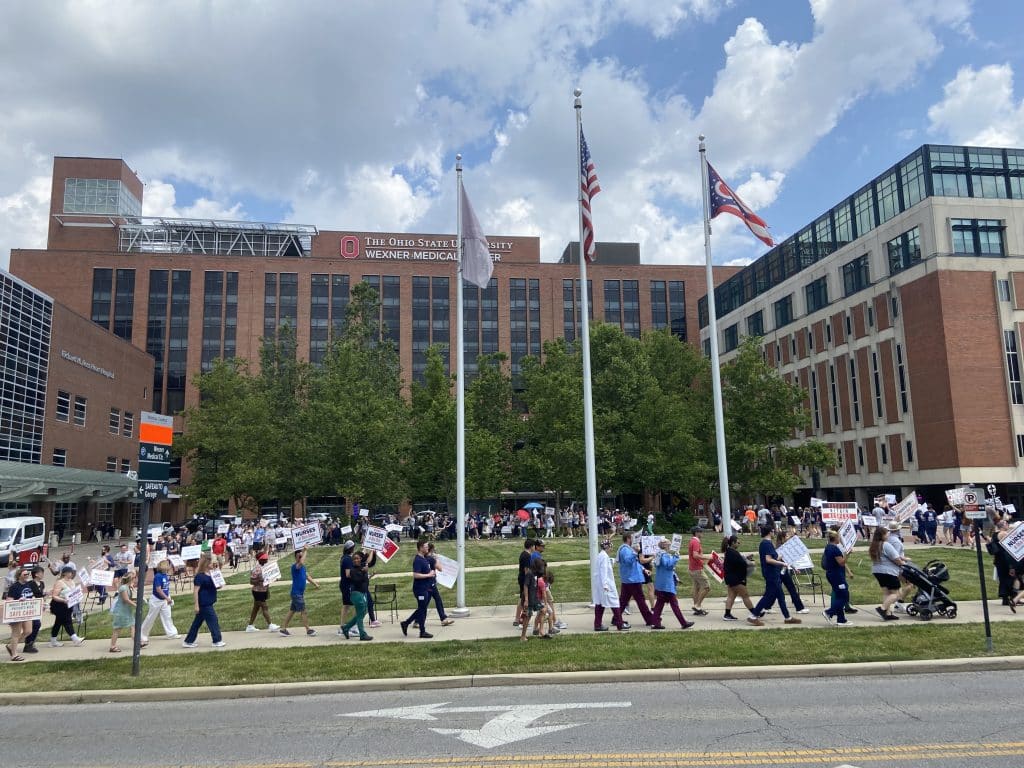
Nurses at Ohio State University Wexner Medical Center continue to feel the impact of what they described as hospital leadership’s decision to short-staff the facility during the pandemic – a practice they said has carried forward, leading to an increase in workplace violence and a decline in patient care.
While the Ohio State University Nurses’ Organization (OSUNO) has been vocal in its demands for safe staff-to-patient ratios, metal detectors at all hospital entrances, and improved support resources for nurses who have experienced workplace violence, union members said hospital administrators have not fully addressed these issues.
“This is not a problem that just happened overnight. It’s a chronic problem that we’re trying to address through negotiations with the hospital,” said staff nurse Catharyne Henderson. “Being short-staffed means people are waiting longer for care, whether it’s medications or to go to the bathroom, and people are getting fed up and taking it out on us.”
A donation powers the future of local, independent news in Columbus.
Support Matter News
“If the food trays don’t get delivered, who goes and gets the food? The nurse does. If the PCA (patient care assistant) has too many patients and can’t take the patient to the bathroom, then who does it? The nurse. If there’s not a PCA to give the patient a bath, then who does it? The nurse does,” said Drew Forehand, who has worked as a nurse at the Wexner Medical Center for nine years and was prompted to become involved in the union in 2020 by what he described as the administration’s concerning attitudes toward patient care early in the pandemic. “I can’t tell you how many times I’ve emptied the trash, changed the linens, and cleaned up my patients’ rooms. Or how many times I’ve cleaned the floors because there’s not enough custodial staff.”
OSUNO marched in front of the hospital on a Wednesday in late June, chanting, “Nurses on the outside, problems on the inside!” and “What do we want? Safe staffing! When do we want it? Now!” in hopes that hospital leadership would take member concerns more seriously as the nurses negotiated their union contract.
Asked via email about the issues raised by the nurses, Marti Leitch, the hospital’s director of media relations, replied to Matter News with a statement. “We believe we’re making meaningful progress at the bargaining table, having reached tentative agreements on a number of topics such as staffing and workplace safety,” Leitch wrote. “We are incredibly proud of our Buckeye nurses, like our University Hospital, Ross Heart Hospital, Brain and Spine Hospital and Dodd Rehabilitation Hospital nurses who have just earned a 5th Magnet designation. It is the highest national honor for nursing excellence, and only about 100 hospitals nationwide have earned Magnet five times. It is a testament to our excellent nursing care for every patient, every time. We truly appreciate the passion and engagement our nurses bring every day, and we look forward to reaching a fair contract that achieves our shared goals.”
Asked to elaborate on the details of these tentative agreements, Leitch declined. But the visual of more than 100 nurses marching outside of the hospital in the final hours of union contract negotiations suggested there is more work to be done in order for a deal to be reached.
Nationwide, nurses are leaving the profession in droves, with the American Nurses Association (ANA) citing burnout, high patient-to-nurse ratios, bullying, incivility, workplace violence, non-competitive pay, and feeling undervalued as the primary forces driving nurses from the field. And OSUNO members voiced all of these issues as concerns during the late June march.
Discussing issues with security, Forehand cited the gun discovered on a patient during a CT scan at Ohio State East Hospital – one of two instances in which patients carrying firearms went undetected at Wexner Medical Center and Ohio State East, prompting calls for improved security from nurses. (10TV reported that 10,000 weapons were confiscated through metal detectors at Wexner Medical Center in 2024.)
Workplace violence is also commonplace in nursing, with studies conducted by the American Nurses Association finding that one in four nurses have been assaulted and that 13 percent of missed shifts are the result of workplace violence. The actual percentage could be higher, though, since the study also found that only 20 to 60 percent of incidents are reported.
OSUNO President-elect Tony Myers, a veteran nurse of 27 years, attended the rally with his weiner dog, Oscar Myers, where he shared his own experience with workplace violence from just a few months ago. “I heard nurses calling in distress, and I was in the charge office probably 20 feet away, so I responded,” said Myers, who upon reaching the room discovered two nurses trapped by a patient who had just woken from anesthesia. “He’d broken his restraints, and he was swinging at them, with cords and IV pumps.”
Myers said he was able to distract the patient long enough for the two nurses to exit – no thanks to the lone on-site corrections officer, whom Myers described as ill-equipped to handle the scene.
While it may be difficult, if not impossible, to prevent violence entirely, the nurses interviewed said that addressing staffing concerns is a vital step in making the hospital safer for everyone who enters its doors.
Safe staffing is all the more vital at a hospital such as OSU Wexner Medical Center, which has high-needs patients, including those recovering from organ transplants, traumatic brain injuries, and spinal injuries, among other serious health issues.
“All the studies show that when you work outside of what the established safe patient ratios are – for example, one nurse to four patients on a medical surgical unit, one nurse to three patients on a progressive care unit, or one to two on ICU – morbidity and mortality rise,” Myers said. “There are more delays in care, so infection rates go up.”
The hospital’s PCAs and PCTs won their union in January 2025 and conducted a similar informational picket outside of the hospital two months later in March. Like the nurses, they too demanded safe staffing, but Forehand said administrators have also ignored these pleas. “In my area they’ve actually decided that one less PCA is what is needed,” said Forehand, adding that it has become routine to send workers home early or cancel shifts altogether. “So, the PCAs were able to win their union, then the administration’s decision was to actually reduce staffing.”
In a video update posted to the OSUNO Facebook page over the weekend, the union members said the strong showing of public solidarity kept administrators at the bargaining table beyond the initial late June deadline, with work continuing toward a deal. You can support OSUNO and many more hospital workers by signing the union’s petition here.
Related Articles

Local Politics: The fallout of serving ICE(d) coffee
A local coffee chain has been under fire for saying it would not refuse to serve ICE agents. But the people who work there say that’s not the full story.

‘If the adults don’t, kids will’: Columbus students continue to protest ICE
‘I definitely think this is only the beginning, and it’s going to grow bigger and more powerful as more people speak up.’
Ohio’s Recovery: The past, present, and future of the overdose crisis
Fewer people are dying from overdose, but the policies and the social determinants of health did not vanish.