
Aaron Troyer brings a colorful cast of characters to life in ‘False Meridian’
The artist’s new duo exhibition with Jolene Powell kicks off with an opening reception at Brandt Gallery tonight (Friday, Feb. 6).
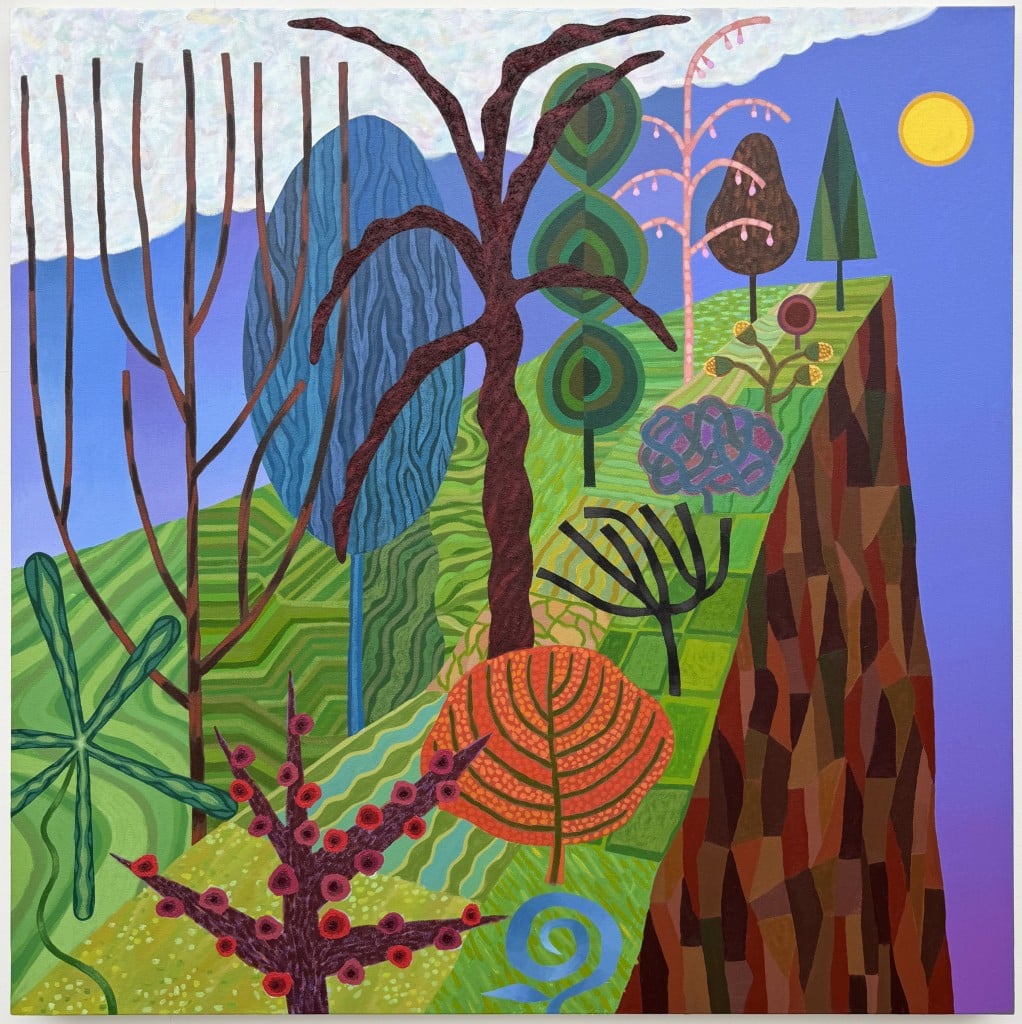
Roughly five years ago, Aaron Troyer pivoted from painting more abstracted works to deconstructed, patterned landscapes filled with more easily recognizable forms: flattened trees, potted flowers, moon-filled skies, and open windows overlooking expansive vistas.
“I’d done that collage-y, abstracted stuff for a long time. And at one point it felt experimental, and it was exciting for me. And then after doing it for 10-plus years, like anything else, it becomes formulaic,” Troyer said in early February from Brandt Gallery, where his work will feature in “False Meridian,” a new duo exhibition with Jolene Powell that kicks off with an opening reception from 5-7:30 p.m. today (Friday, Feb. 6). “And then it became like, the craziest thing I could do right now is paint a flower, because that’s such a cliche, overdone thing. … So, it was kind of a challenge to myself: Let’s do things that are more traditional but try to imbue them with the same kind of experimental, abstract approach I’d been taking for so long.”
The pivot to plant life arrived nearly in tandem with the pandemic – a stretch of time in which, for many people, nature remained a rare place of respite – a connection Troyer viewed as more circumstantial. “Psychologically, the pandemic fucked us all up,” he said. “But one thing it did give me was a lot more time [to paint].”
A donation powers the future of local, independent news in Columbus.
Support Matter News
In the years since, the works have gone through a series of evolutions, with Troyer incorporating more textures, at times even mixing sand and fine granite with the paints. His compositions have also become increasingly busy and ornate – not trending toward realism, but a more intricate surrealism in which the once-flattened trees and flowers have started to take on greater detail, such as the suggestion of leaves.
The way Troyer views the work has also begun to shift, with the artist coming to see the assorted trees, flowers, and potted plants as characters in a film, some of whom are meant for starring roles and others supporting players best suited to the background. “I think of this one as an extra in the cast,” he said, directing my attention toward a tree visible through a window in the background of one painting. “They’re not a focal point of the composition but they’re necessary to tie everything together. … Some of these more simplified [paintings], they’re cool, but they’re more focused on formalist aspects: tone, perspective, weight – that kind of thing. And I wanted to focus more on plants as characters, thinking about them as going through the same strife and struggles that we do.”
As a result, there are myriad psychological dynamics in play throughout the exhibition. Witness a couple of smaller paintings of individual flowers that are both accompanied by spiraling shapes – a reflection of the artist’s tendency to allow his thoughts to circle the drain when left too long to his own devices.
More recent paintings, in turn, feature a swelling roster of Troyer’s plant characters, which the artist attributed to some combination of his love for maximalism and a growing pull toward community.
“Minimalism is not my thing, and I feel the need to kind of cram as many colors and patterns and textures as I can into a canvas. I admire people who can keep things simple, but I cannot,” said Troyer, who also sees in the work a need for connection, pointing to one piece titled “Lovers and Dust” that features two orchid-like flowers locked in romantic embrace. “It can be this kind of disparate cast of characters, but they all rely on each other. A lot of them, they’re interacting with each other, overlapping, holding onto each other.”
Of course, even these more communal scenes can sit on the precipice of disaster, with one painting, “Between the Teller and the Told,” depicting a colorful collective existent at the edge of a cliff.
“So, there’s some uncertainty, some unknown that comes up in a lot of these,” Troyer said, directing my attention to a flower in an adjacent painting that appeared to be waving to passersby from a small island set in a stream. “It’s a happy flower, but it’s also marooned and isolated, so maybe things aren’t going too great.”
Author

Related Articles
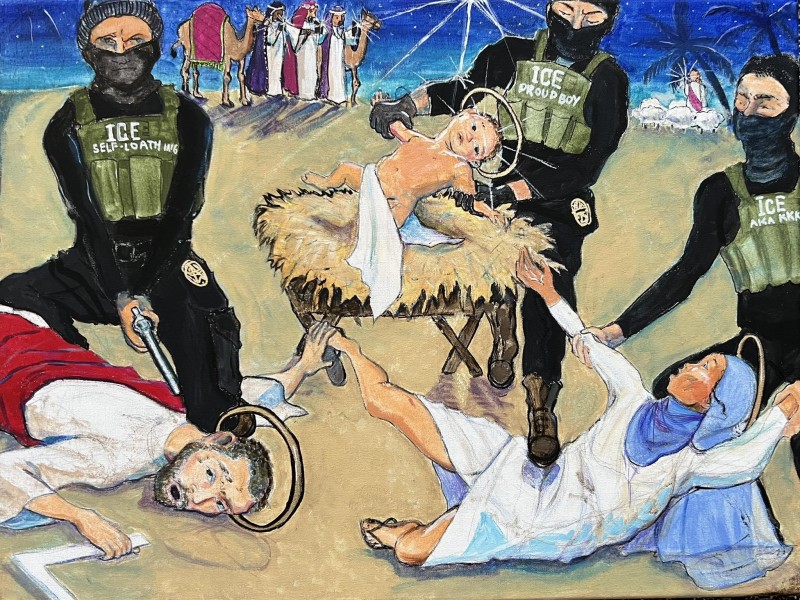
Gaye Reissland leaves no doubt about the circumstances shaping her work
The Columbus artist, who will take part in Aminah Day at the King Arts Complex this weekend, has taken to writing on the back of each canvas, explaining in detail the circumstances that gave rise to her paintings.
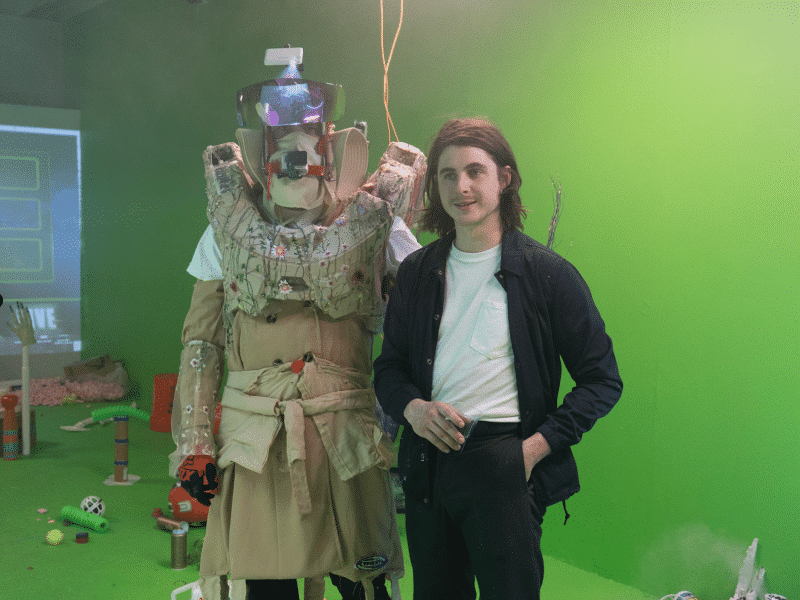
No Place Gallery turns 10
‘Between Fields and What Isn’t: A Decade Inside No Place’ will take over a pair of galleries beginning on Thursday, Feb. 12, with an opening reception running from 4-7 p.m. at Beeler Gallery and then continuing at No Place from 7-9 p.m.
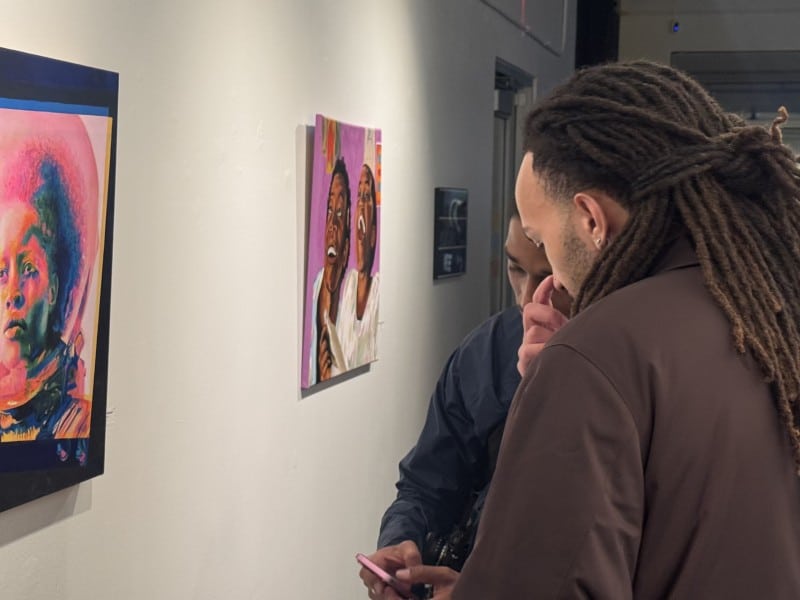
David Butler finds big screen escape in ‘F’Reel’
The Columbus artist curated the new group exhibition, on display at All People Arts through April, in part to create a place of joy and healing coming out of an emotionally heavy time.